
Boosting Ontology Matching: Why Ensembles Outperform Individual Experts
Improving Ontology Matching Using Meta-level Learning
The paper proposes a meta-level learning approach to improve ontology matching by treating existing matching systems as an ensemble. Using machine learning classifiers (Decision Trees and Naive Bayes) on a rich set of lexical, structural, and matcher-specific features, the method achieves significant performance gains, notably outperforming the best individual matchers in the OAEI conference track.
TL;DR
Ontology matching—the process of finding equivalent concepts between different data schemas—has long been the "Achilles' heel" of the Semantic Web. This paper presents a meta-level learning framework that doesn't just pick the best matcher, but learns how to combine them. By analyzing lexical and structural features alongside matcher outputs, the authors achieved a massive 24% F-measure improvement over median baselines.
The Problem: The Confidence Crisis
Most ontology matching systems output a set of correspondences with a "confidence value" (between 0 and 1). However, these values are notoriously unreliable. A 0.7 confidence from Matcher A might mean something entirely different than a 0.7 from Matcher B.
Existing solutions typically:
- Pick the "Best" Matcher: Requires prior knowledge of the task.
- Manual Weighting: Requires tedious human tuning.
- Ad-hoc Heuristics: Often fail to generalize across different domains.
Methodology: Beyond the Black Box
The authors propose a Meta-level Learning approach. Instead of trusting a single algorithm, they run a suite of matchers (like Aroma, ASMOV, Lily) and treat their outputs as features for a higher-level classifier.
The Feature Secret Sauce
The breakthrough wasn't just using machine learning, but the features fed into it. They categorized features into four groups:
- Matcher Features: Did Matcher X find it? How many matchers agreed (The "Matcher Vote")?
- Ontology Ratios: How similar are the sizes and shapes of the two ontologies?
- Lexical Features: Using TF/IDF and WordNet to see if the labels and comments contain significant, overlapping information.
- Structural Features: Are the concepts root nodes or leaf nodes?
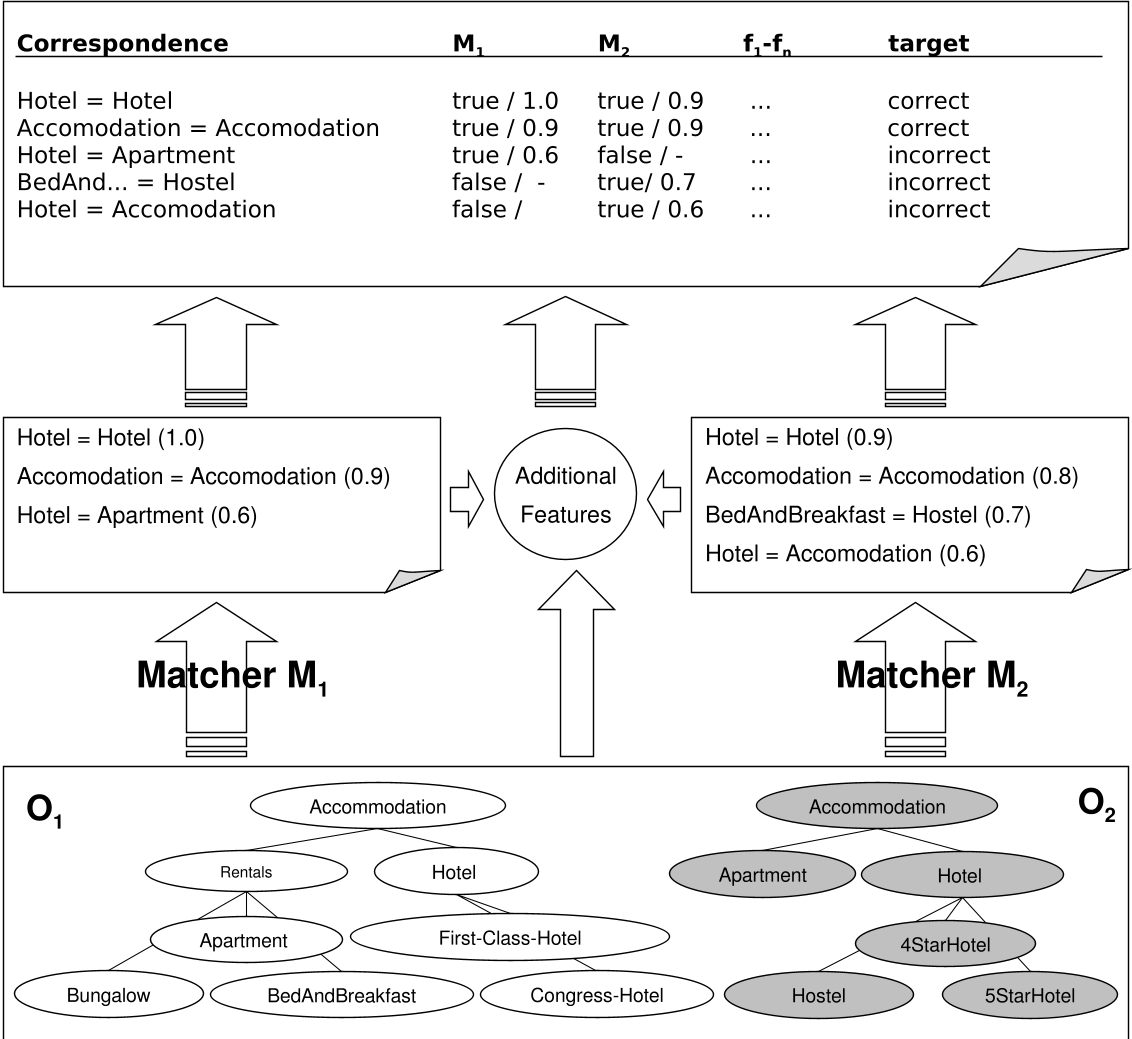 The workflow: Matcher results and ontology features are combined into a training set where a classifier learns to distinguish correct mappings.
Experiments and Shifting Paradigms
The authors tested their method on OAEI (Ontology Alignment Evaluation Initiative) tracks.
Key Finding 1: Confidence is Overrated
One of the most provocative results was that matcher-provided confidence values actually decreased performance when other features were available. When the classifier knew "how many" matchers agreed and "where" the nodes were located, the numerical confidence (0.6, 0.8, etc.) became noise.
Key Finding 2: The Power of the Majority
The authors discovered that a simple Majority Vote (selecting correspondences found by >50% of matchers) performed incredibly well, often rivaling complex machine learning models and crushing single "expert" matchers.
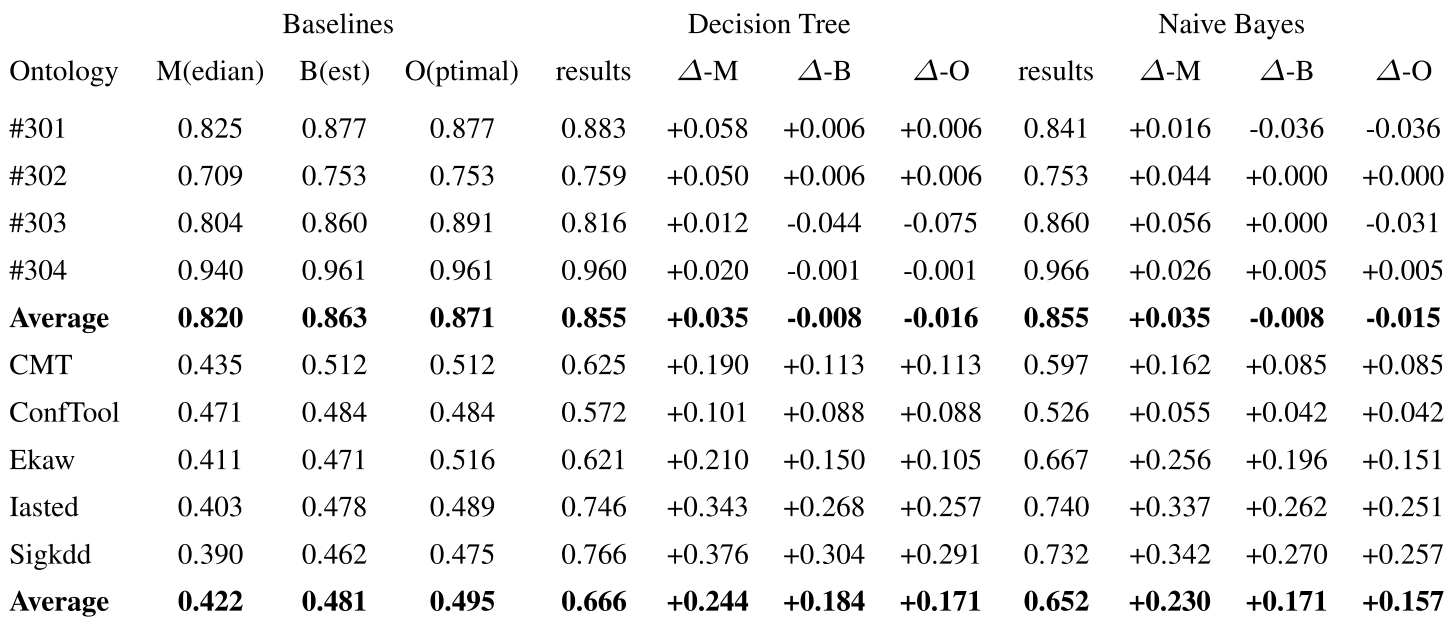 As seen in the table, the Meta-Level Learning (Decision Tree) consistently outperforms the "Optimal" baseline, which represents the theoretical best a single matcher could do with a perfect threshold.
Critical Analysis & Conclusion
Takeaway
If you are building an integration pipeline, don't hunt for the "perfect" matcher. Instead, deploy an ensemble of 3-5 diverse matchers and use a meta-classifier (or even a simple majority vote) to filter the results.
Limitations
- Dependency on Training Data: The meta-learner requires reference mappings to train. While the authors suggest using existing gold standards (like Medicine or Bibliography), domain transferability remains a question.
- Computational Cost: Running an ensemble of matchers is inherently more expensive than running one.
Future Outlook
This work lays the groundwork for "Self-tuning" matching systems. In an era where LLMs are becoming the default for text processing, applying this meta-learning logic—treating LLM outputs as ensemble members alongside traditional structural matchers—could be the next frontier in data integration.