
Precise Pathways: Refined Process Mining in Healthcare via Interval-Based Selection
Improving Pattern Detection in Healthcare Process Mining Using an Interval-Based Event Selection Method
The paper introduces an Interval-Based Event Selection Method for healthcare process mining, specifically targeting the high variability and noise in clinical pathways. Tested on the MIMIC-III dataset, the method filters outlier events based on temporal patterns to improve model representational quality.
TL;DR
Discovering structured clinical pathways from Electronic Health Records (EHR) is notoriously difficult due to "noise" from repeated measurements. This paper introduces a novel preprocessing method that uses activity-specific temporal intervals to filter outlier events. By applying this to the MIMIC-III dataset, the researchers doubled model precision without losing process accuracy (fitness), effectively turning "spaghetti" data into actionable process models.
The "Spaghetti" Problem in Clinical Data
In a typical ICU setting, data isn't just a sequence of discrete steps; it's a flood of "charting" events. Heart rates are recorded every few minutes, medications are adjusted, and labs are batched.
When standard process mining algorithms (like the Inductive Miner) try to process this "raw" log, they produce Spaghetti Models—complex, unreadable webs where every activity seems connected to every other activity. Traditional fixes involve:
- Merging subsequent events: Simple, but ignores the time-gap logic.
- Refining labels: Accurate, but leads to "label explosion" where the number of unique activities becomes unmanageable.
The authors' insight: Clinical events have a "rhythm." If a measurement happens significantly faster than its usual frequency for the same item, it’s likely an outlier or a redundant adjustment rather than a new process step.
Methodology: The Rationale of "Rhythm"
The core of the methodology is a 5-step pipeline that transitions from raw SQL extraction to a cleaned event log.
1. Data Modeling with MIMIC-III
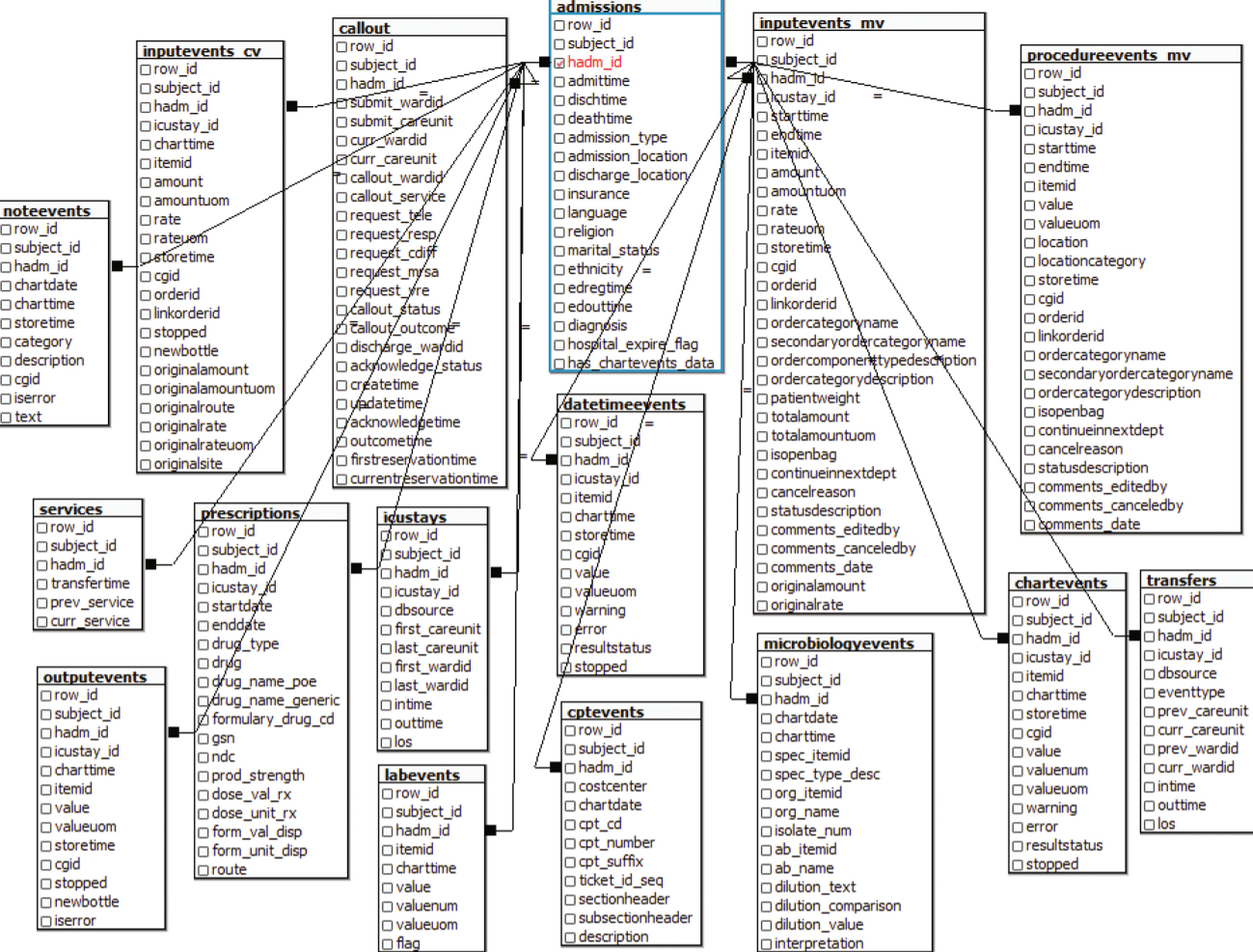
The authors are among the first to bring the MIMIC-III (Medical Information Mart for Intensive Care) database into the process mining fold. They constructed a healthcare data model categorized into six event groups: Administrative, Charted, Test, Medication, Billing, and Report.
2. Interval-Based Filtering
The "magic" happens in the selection logic. For every activity (e.g., "Lab Event"), the system calculates a Threshold Interval based on historical patterns (histograms).
- The Logic: If Event follows Event for the same Item ID (e.g., Blood Pressure) within a timeframe shorter than the threshold, Event is flagged as an outlier and removed.
- Why it works: It respects the clinical intent. A second blood pressure reading 5 minutes after the first usually indicates a re-check or an error correction, not a fundamentally new step in the patient's journey.
Experimental Results: Precision without Compromise
The researchers tested the method on a cohort of diabetes patients with congestive heart failure.
Quantifiable Gains
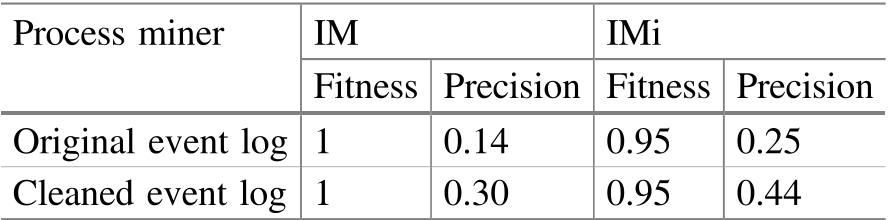
The most impressive result was the impact on Precision. In process mining, precision measures how much "extra" (unobserved) behavior a model allows. A low precision model is too vague.
| Process Miner | Original Precision | Cleaned Precision | Improvement |
|---|---|---|---|
| Inductive Miner (IM) | 0.14 | 0.30 | +114% |
| IM - Infrequent | 0.25 | 0.44 | +76% |
Crucially, Fitness remained at 1.0 (or 0.95), meaning the cleaned log still perfectly represented the actual patient traces.
Visual Impact
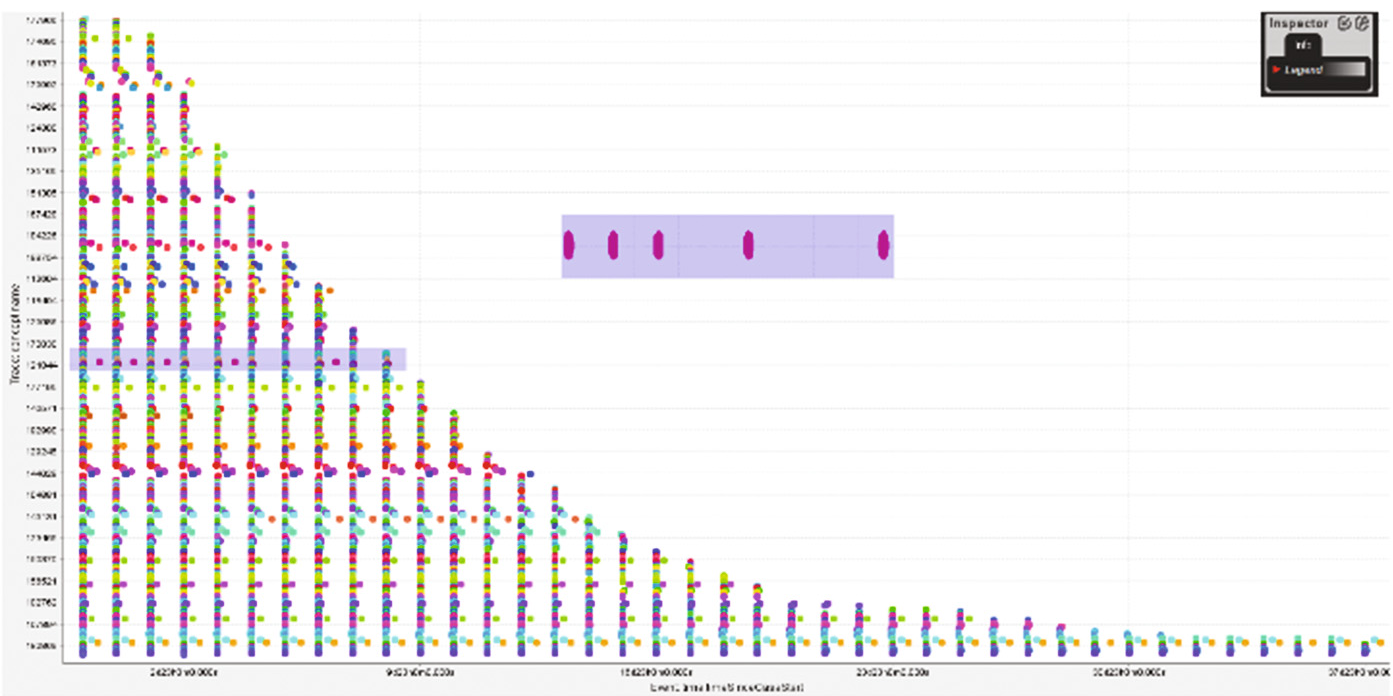
The removal of "noise" is best seen in the dotted chart visualizations. The "Cleaned Event" chart shows clear, horizontal patterns of activity that were previously obscured by a dense fog of overlapping points.
Critical Insight & Future Outlook
This work highlights that data quality in healthcare is not just about missing values; it's about temporal granularity. By treating time as a filter rather than just a metadata field, we can extract the "mainstream" patient pathway.
Limitations: The choice of "mean" as a threshold is sensitive to skewed distributions. Future iterations might benefit from more robust statistics (like MAD - Median Absolute Deviation) or N-gram pattern recognition to ensure that unusual—but critical—clinical escalations aren't accidentally filtered out.
Conclusion
The Interval-Based Event Selection method provides a scalable, repeatable way to clean medical event logs. As healthcare systems move toward "Data-Driven Clinical Pathways," techniques like this will be essential to ensure that the models we build are both accurate and human-readable.