
Kpark: Improving Mobile Crowdsourcing via Trust-Based Fusion and Algorithm Portfolios
Improving the Performance of Mobile Phone Crowdsourcing Applications
This paper introduces Kpark, a mobile crowdsourcing application designed for real-time parking availability monitoring. It features an ensemble-based data fusion framework that utilizes AdaBoost and a novel real-time decay mechanism to aggregate sparse and potentially erroneous user-submitted data into a reliable campus-wide occupancy map.
TL;DR
Finding a parking spot on a busy campus is often less about "having a permit" and more about having a "hunting license." Kpark turns this problem on its head by transforming students into a participatory sensing network. By using complex trust-based models and an AdaBoost ensemble, the system filters out erroneous reports and accounts for "stale" data, providing a real-time occupancy map that outperforms simple majority voting.
The Challenge: Privacy vs. Accuracy
Most urban sensing apps face a catch-22: tracking users via GPS provides high accuracy but destroys spatial privacy. Kpark opts for active reporting, where users manually tag occupancy. However, this introduces two major hurdles:
- Heterogeneous Reliability: Some users are honest; others are sloppy or intentionally deceptive.
- Temporal Sparsity: A report from three hours ago is nearly useless in a high-turnover parking garage.
Methodology: The Core Engine
The authors didn't just pick one algorithm; they built a Portfolio of Trust Models.
1. Trust Prediction Models
Kpark evaluates users during a "calibration period" by comparing their reports against historical aggregate data. The system utilizes:
- Beta Reputation: Treats reporting as a binary process of "agreement" or "disagreement" with the consensus.
- Gompertz Function: Gains trust slowly but loses it rapidly—mimicking human psychological trust.
- Robust Averaging: An iterative approach to filter out outliers in sensor measurements.
2. The Portfolio Approach (AdaBoost)
The "Secret Sauce" of Kpark is its two architectural configurations for selecting the best prediction:
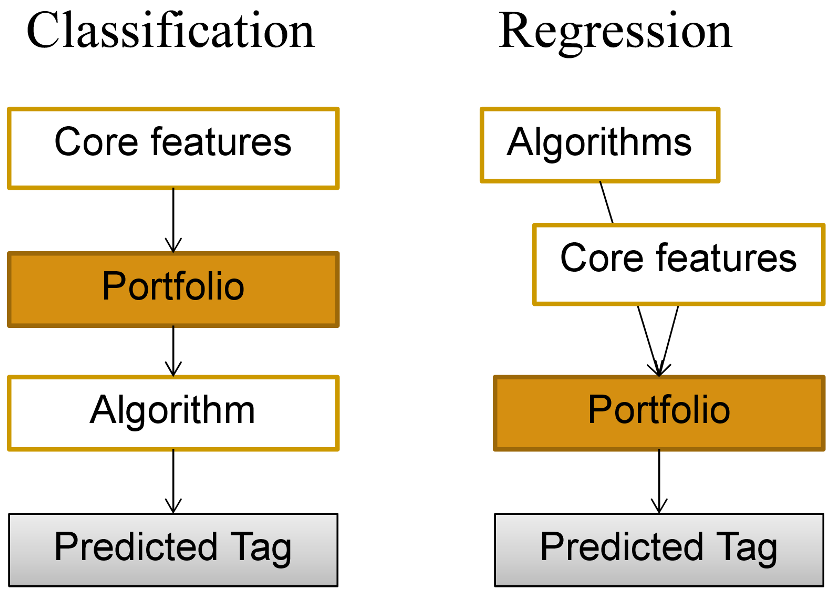
- Classification Variant: The system uses features like Hour of Day and Weekday to choose the single best algorithm for that specific context.
- Regression Variant: It concatenates the outputs of ALL trust models and feeds them into an AdaBoost regressor to predict the final occupancy (1-3 scale).
3. Real-Time Data Decay
To handle the "freshness" problem, the authors introduced a decay constant (). Recent reports from highly trusted users can "override" older tags. The model essentially asks: "How much do I trust this 20-minute-old report given that the garage has a high turnover rate?"
Experimental Results & SOTA Comparison
The system was validated against actual university parking counts. The results were clear: Majority voting is not enough.
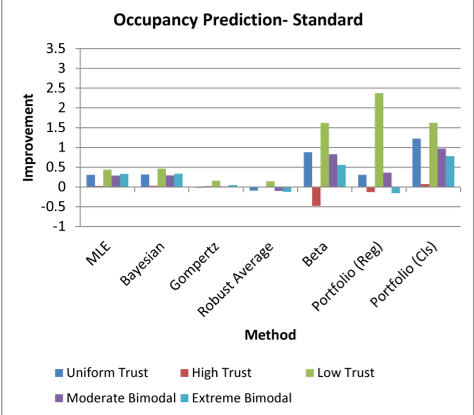
- Performance Boost: The AdaBoost Regression model consistently showed the highest improvement over the baseline.
- User Trust Correlation: The Spearman rank correlation between predicted and actual trust reached 0.54, proving that the system can successfully "rank" the reliability of its contributors over time.
Critical Insights & Takeaways
- Asymmetric Trust: One of the most effective strategies was implementing a "penalty factor" where users lost trust faster than they gained it. This is a vital inductive bias for crowdsourcing.
- Ensemble Power: No single algorithm won in every scenario (Low Adoption vs. Low Tagging Rate). The Portfolio approach provided the necessary robustness to handle these edge cases.
- Limitations: The system still relies on a critical mass of users. With only an 8% active user ratio, the authors note that further incentives (like a "car finder" feature) are needed to maintain data density.
Conclusion
Kpark demonstrates that sophisticated multi-agent system (MAS) techniques—like trust modeling and algorithm portfolios—can turn "noisy" human input into high-quality environmental data. It serves as a blueprint for future participatory sensing apps where privacy and data quality must coexist.