
EVSR: Beyond Positive Correlation—Boosting Recommendations with Negative Similarity and Social Graphs
Improving Ranking-based Recommendation by Social Information and Negative Similarity
The paper introduces EVSR, an enhanced ranking-based recommendation system that improves upon the VSRank algorithm by leveraging negative user similarities and social network data. It aims to optimize the top-N item ranking directly rather than predicting specific rating scores, achieving state-of-the-art performance on the Epinions dataset.
TL;DR
While most recommender systems focus on finding "users like you," this paper argues that users unlike you are equally informative. The authors propose EVSR, an evolution of the VSRank algorithm. By capturing the value of negative similarities (opposite interests) and using social network data to smooth out ranking uncertainties, EVSR achieves a significant performance leap, outperforming traditional Collaborative Filtering by over 12% in ranking accuracy (NDCG@1).
The "Blind Spot" in Modern Ranking
The shift from rating-based (predicting a score of 1-5) to ranking-based (deciding if Item A is better than Item B) has revolutionized recommendation quality. However, state-of-the-art algorithms like VSRank have a significant flaw: they ignore negative correlations.
If User A consistently hates what User B loves, User B is a powerful predictor for User A—just in reverse. VSRank discards these negative neighbors. Furthermore, when neighbors haven't rated specific pairs of items, the system reaches a "zero preference" deadlock, leading to random, low-quality rankings.
Methodology: The Core Innovations
1. Harnessing Negative Similarity
In traditional Vector Space Models, users with a similarity of -1 are pushed to the bottom of the list. EVSR introduces a Relative Preference Measure that uses the absolute value of similarity (). This allows the system to identify "strongly opposite" neighbors and flip their preferences to help predict the target user's interests.
2. Social Preference Smoothing
To solve the "zero relative preference" problem, the authors integrate social network information. If the collaborative neighbors provide no clear signal on whether Item is better than Item , the system pivots to the user's social circle.
 The smoothing formula balances collaborative filtering data and social trust data using a parameter .
Experimental Results: Proving the Intuition
The researchers utilized the Epinions dataset, which is unique for containing both item ratings and explicit social trust connections.
SOTA Comparison
As shown in the table below, the inclusion of negative similarity (SVSR) already beats the baseline. When combined with social smoothing (EVSR), the performance gap widens.

Table 1: Comparison of NDCG scores. EVSR consistently outperforms both CF and the original VSRank.
The Impact of Social Data
The study found that the best results occurred when collaborative similarity and social information were balanced.
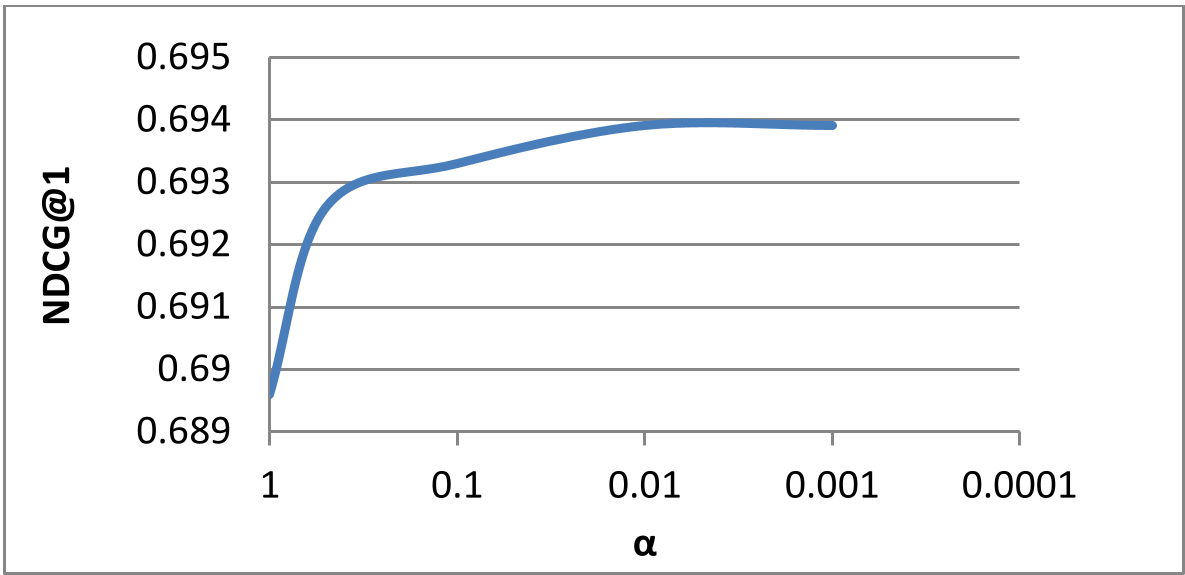 Fig 1: Sensitivity analysis of the social factor . The curve demonstrates that even a small injection of social data significantly stabilizes the ranking quality.
Critical Insight & Conclusion
The genius of EVSR lies in its recognition of Inductive Bias—the assumption that social friends and "consistent enemies" both provide high-signal data for ranking.
Takeaways:
- Negative correlations matter: High negative similarity is not "no information"; it describes a predictable inverse relationship.
- Social smoothing: Social graphs are excellent "tie-breakers" for the sparsity issues inherent in collaborative filtering.
While the greedy aggregation method remains a bottleneck for absolute global optimization, EVSR provides a robust framework for improving user experience in real-world, sparse data environments.