
Socially-Aware Matrix Factorization: Leveraging Friendships to Solve Data Sparsity
Improving recommendation quality by merging collaborative filtering and social relationships
The paper introduces a novel Matrix Factorization (MF) approach for Collaborative Filtering that merges traditional user-item ratings with social friendship data. By adding a social regularization term to the objective function, the method maps socially connected users to proximal vectors in the latent space, achieving state-of-the-art accuracy on real-world social network datasets.
TL;DR
This paper presents a social-enhanced Collaborative Filtering (CF) system that integrates friendship data into Matrix Factorization (MF). By enforcing that friends stay "close" in the latent feature space, the model overcomes the classic data sparsity problem, leading to more accurate movie recommendations compared to standard NMF techniques.
The Sparsity Wall: Why Ratings Aren't Enough
Collaborating Filtering relies on the overlap of user interests. However, in real-world scenarios, the user-item matrix is incredibly sparse; two users might share identical tastes in adventure movies but have never watched the same specific titles. In such cases, traditional CF fails to recognize their similarity.
The authors' core insight is grounded in social psychology: we often trust the advice of friends more than strangers. Therefore, social relationships provide a "hidden signal" of similarity that exists even when rating data is missing.
Methodology: Bridging the Social and the Latent
The paper proposes a Social Rating Network (SRN). The mathematical heart of the work is an extension of the standard Matrix Factorization objective function.
1. The Standard Model
Standard MF decomposes the rating matrix into User matrix and Item matrix . The goal is to minimize the difference between the actual rating and the dot product of .
2. The Social Extension
The authors introduce a new Social Penalty Term. If user and are friends, the optimization seeks to minimize the distance between their latent vectors .
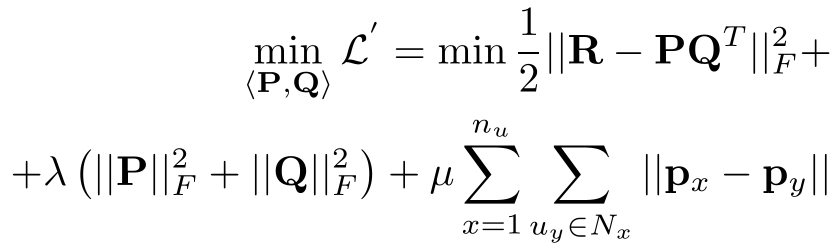
This ensures that the "genre preferences" of friends influence each other during the learning process. If my friend likes Action movies, the model pulls my latent vector closer to the Action dimension, even if I haven't rated an Action movie yet.
Experimental Validation
The authors tested their approach on Cofe, a social network populated by university students.
Impact of Latent Dimensions (k)
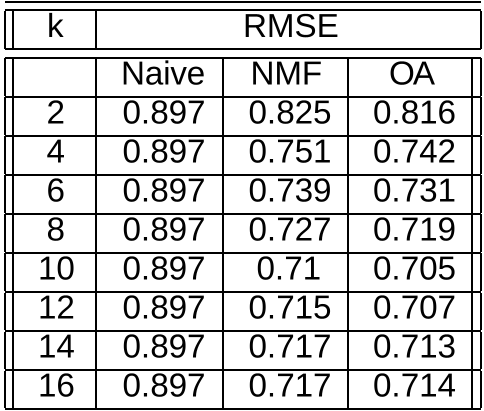
The study found that the number of latent factors significantly impacts performance. At , the model peaks, effectively capturing the complexity of movie genres without overcomplicating the memory requirements.
The Balance of Social Influence ()
A critical hyperparameter is , which controls the weight of social information.
- If is too low (), the model ignores friends and performs like standard NMF.
- If is too high (), social ties overwhelm individual tastes.
- The "sweet spot" at demonstrates that a blend of individual behavior and social influence yields the highest accuracy.
Critical Insights & Future Directions
The strength of this work lies in its simplicity and interpretability. By framing social influence as a distance penalty in the latent space, the authors provide a geometrically intuitive way to handle sparse data.
Limitations:
- The dataset size (37 users) is quite small by modern standards, which may limit the generalizability to platforms with millions of users.
- The model treats all "friendships" as equally influential, whereas in reality, some friends are more influential than others.
Future Outlook: The next logical step is moving toward Trusted Social Networks, where the model accounts for both "friends" (positive influence) and "foes" (negative influence). Furthermore, scaling this via distributed systems like Hadoop would be essential for production environments.
Conclusion
By merging the "math" of Matrix Factorization with the "sociology" of human relationships, this paper provides a robust blueprint for the next generation of Recommender Systems—ones that understand not just what we buy, but who we are.