
VMRec: Elevating Social Recommendation via Multi-Graph Synergy and Viewpoint Mechanisms
Improving Social Recommendations with Item Relationships
The paper introduces VMRec, a novel Graph Neural Network (GNN) framework for social recommendation that integrates multi-graph data (user-item, user-user, and item-item). By leveraging a "viewpoint mechanism" based on review text, it achieves state-of-the-art results, including a 10% improvement in Hit Rate (HR) over strong baselines like DiffNet.
TL;DR
Social recommendation systems often miss a piece of the puzzle: Item-Item relationships. While standard models look at who your friends are and what you've bought, VMRec introduces a triple-graph approach (User-Item, User-User, and Item-Item) combined with a "Viewpoint Mechanism" that uses review text to weight graph connections. The result is a more nuanced representation of user preferences that outperforms existing SOTA models like DiffNet by up to 10% in Hit Rate.
Problem & Motivation: Beyond the Social Circle
Most social recommender systems operate on two pillars: the user-item interaction matrix and the social graph. The assumption is simple: "You like what your friends like."
However, the authors identify two major gaps:
- Independent Items: Items are often treated as isolated entities. In reality, items are connected because they are co-purchased or because they are favored by similar social clusters.
- Uniform Influence: Existing GNNs often treat all social ties or item interactions with equal weight, whereas in reality, some friends are more influential, and some reviews are more relevant.
Theoretical grounding in Social Correlation Theory suggests that while social neighbors influence preferences, the inherent properties and relationships of items (complementarity/substitutability) are equally vital for overcoming the "sparse data" problem.
Methodology: The Triple-Graph Architecture
VMRec (Viewpoint Multi-graph Recommendation) processes three distinct graphs simultaneously to learn latent factors.
1. The Multi-Graph Framework
Instead of a simple bipartite graph, VMRec defines:
- User-User Graph (): Captures social influence.
- User-Item Graph (): Captures historical interactions.
- Item-Item Graph (): Captures relationships between products based on co-occurrence and social similarity.
2. The Viewpoint Mechanism
This is the "secret sauce." Rather than relying solely on "free embeddings" (ID-based vectors), the model uses Review Information.
- Reviews are processed via Word2Vec.
- A Viewpoint Weight () is calculated using an exponential similarity function:
- This weight acts as an "Attention" mechanism, ensuring that the GNN aggregates features more heavily from neighbors that share similar semantic "viewpoints" in their reviews.
 Figure 1: Conceptual overview of social recommendation integration.
Experiments & Results
The model was tested on the Yelp and Flickr datasets against heavyweights like PinSage and DiffNet.
Key Findings:
- SOTA Performance: VMRec consistently led in both HR@N and NDCG@N. On Yelp, it achieved an HR@10 of 0.3630, significantly higher than DiffNet (0.3477).
- Ablation Insight: The "Viewpoint Mechanism" proved critical. A version of the model using standard GCN aggregation (without review-based weights) performed significantly worse, confirming that what users say is just as important as who they know.
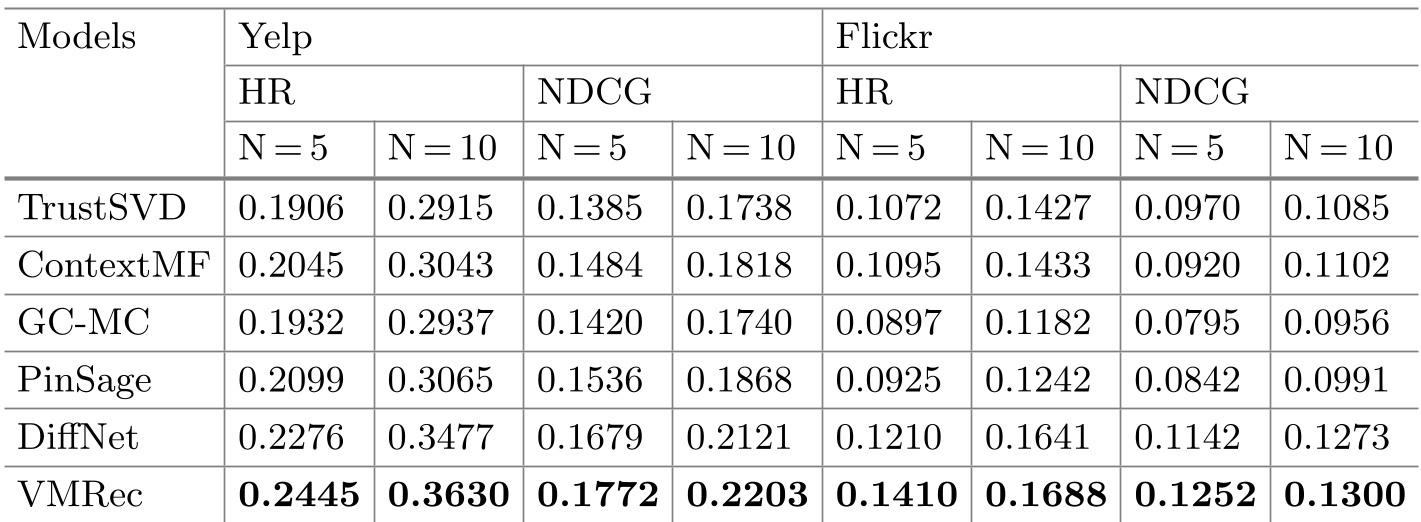 Table 1: Performance comparison across Yelp and Flickr datasets.
Critical Insight & Conclusion
Why it works
VMRec succeeds because it addresses the heterogeneity of influence. In a social network, "noise" is rampant—not every friend shares your taste in every category. By using natural language reviews to gate the information flow between nodes, VMRec effectively filters out the noise and focuses on high-signal relationships.
Limitations & Future Work
While powerful, the model relies on the availability of review text, which might not exist in all platforms (e.g., simple "like" apps). Future extensions could explore using Zero-shot LLM embeddings to replace Word2Vec for even deeper semantic understanding, or applying this multi-graph logic to Temporal data to see how item relationships evolve over time.
Final Takeaway: To build a better recommender, don't just look at the people; look at the items and the actual words exchanged between them.