
Beyond Shared Preferences: Grounding Recommender Systems in Behavioral Theory
Improving Social Recommender Systems
This paper proposes a multidimensional social recommendation framework that integrates homophily, tie strength, trust, and reputation to enhance recommendation accuracy. By moving beyond traditional Collaborative Filtering (CF) which relies solely on shared preferences, the authors establish a theoretically grounded approach to source qualification and item prediction.
TL;DR
Since the mid-1990s, Collaborative Filtering (CF) has been the gold standard for online recommendations. However, most systems only care about what you bought, not who you are connected to. This paper argues that by incorporating behavioral constructs—Homophily, Tie Strength, Trust, and Reputation—we can build systems that not only predict more accurately but also solve the notorious "cold-start" problem.
The Motivation: Why Math Needs Sociology
The industry-standard CF approach assumes that similarity in past consumption is the only determinant of a good recommendation. But as anyone who has ever asked a friend for a movie tip knows, we weigh advice based on our relationship with the person.
The authors identify a critical gap: existing systems are often "ad hoc." They might use trust (like Epinions) or shared preferences (like Amazon), but they rarely integrate a comprehensive suite of social indicators grounded in behavioral sciences.
Our Proposed Framework
The core contribution of this work is a conceptual model that transforms social signals into a quantitative Source Qualification score ().
1. The Four Pillars of Advice-Taking
- Homophily: Similarity in knowledge and preferences (The traditional CF "shared tastes").
- Tie Strength: The intensity of a relationship, measured by interaction frequency and closeness.
- Trust: Both cognitive and affective dimensions of reliability between users.
- Social Capital: A source's global reputation or structural position in a network.
2. Architecture and Algorithm
The system works in two stages:
- Source Qualification: Aggregating the four pillars using weighted averages.
- Prediction: Using these qualifications to weight the ratings of top sources.
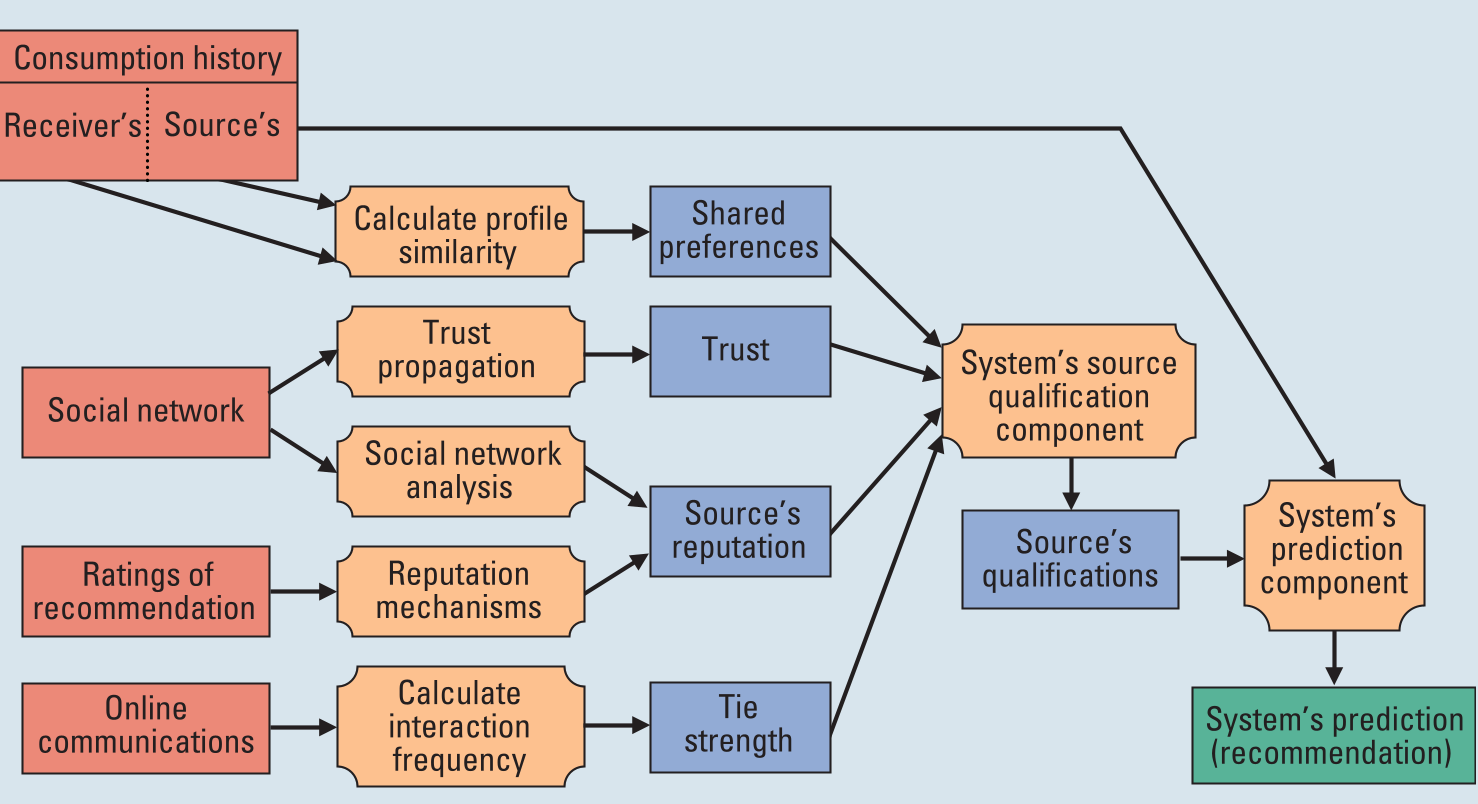
The mathematical implementation relies on a weighted sum for qualification and a modified mean-centered prediction formula:
Tackling the Cold-Start Problem
One of the most profound insights of this paper is that social ties can serve as a proxy for preference similarity. In a "cold-start" scenario where a new user has no ratings, the system can look at their social network (Trust and Tie Strength) to find qualified sources, ensuring the recommendation engine doesn't go "numb" just because data is scarce.
The Cost of Intelligence: Effort and Privacy
The authors provide a nuanced analysis of the trade-offs involved in implementing these social indicators.
| Evidence | User Effort | Privacy Concerns |
|---|---|---|
| Shared Preferences | Low/Medium | Low |
| Communication Frequency | Low (Auto) | Medium |
| Social Network (Direct) | High | Medium |
| Reputation System | Medium | Low |
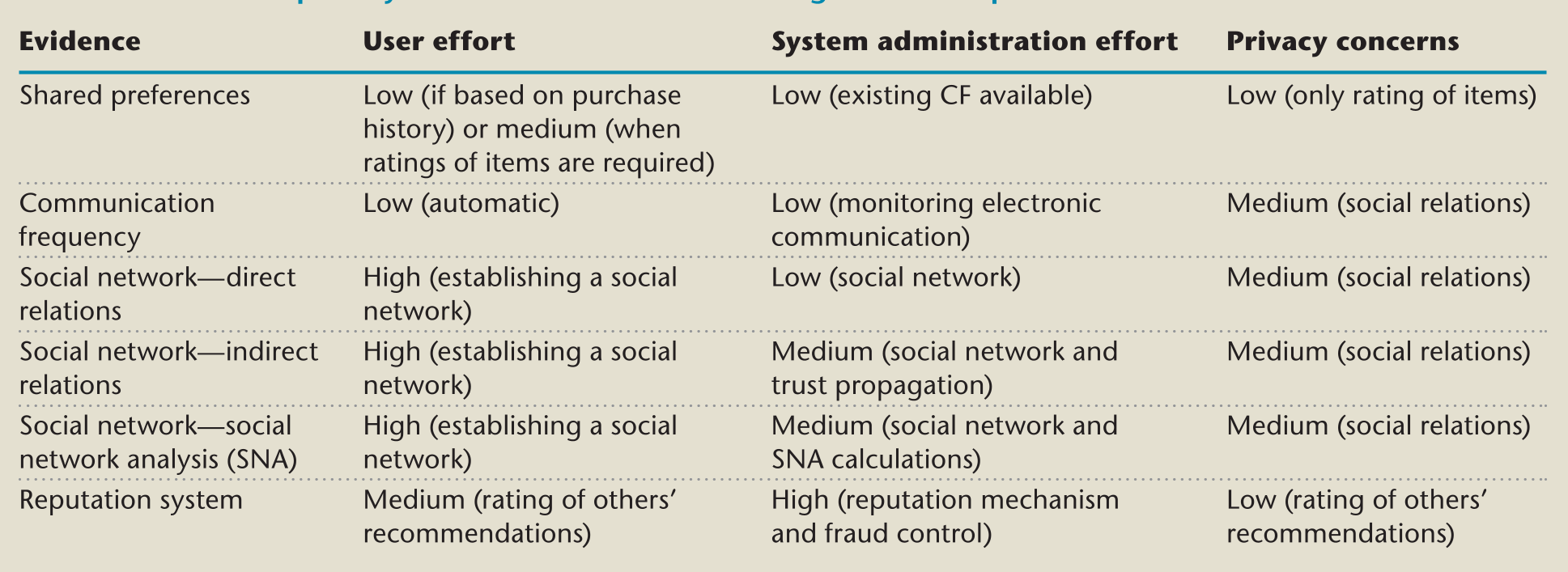
While tracking communication frequency (Tie Strength) requires zero user effort, it raises significant privacy alarms. Conversely, building an explicit social network is privacy-permissive but requires high user cognitive load (effort).
Critical Analysis & Conclusion
The real value of this work lies in its structural approach to human behavior. It moves the conversation from pure "algorithmic optimization" to "human-centric modeling."
Takeaways:
- Context Matters: The weights () for homophily or trust should change depending on whether the system is recommending a professional research paper or a Saturday night comedy.
- Social Proxies: Social relationship data is the ultimate cure for the cold-start problem in early-stage platform deployment.
- Future Outlook: Modern Enterprise 2.0 and social media platforms have made the harvesting of these signals much easier than when CF was first conceived, making this framework more relevant today than ever.
In summary, this paper provides the blueprint for "Trust-Aware" recommenders that mirror the way we seek advice in the real world.