
EDA-Calibration: Bridging the Individual Gap in Emotion Recognition
Improving Subject-independent Human Emotion Recognition Using Electrodermal Activity Sensors for Active and Assisted Living
This paper introduces a dynamic calibration module for subject-independent human emotion recognition using only Electrodermal Activity (EDA) sensors. By finding the most similar subject in the training data and shifting feature vectors accordingly, the system achieves significant performance improvements across the MAHNOB dataset.
TL;DR
Recognizing human emotions through wearable sensors often fails when the model encounters a new person (subject-independence). This paper tackles this by introducing a Dynamic Calibration Module that uses Collaborative Filtering logic to shift a new user's signal features toward the most "similar" person in the training database. Using only Electrodermal Activity (EDA) sensors, the method boosts sensitivity by up to 26%.
Context & Motivation
In the world of Active and Assisted Living (AAL), monitoring the emotional well-being of the elderly or disabled is crucial. However, we face a "Universal Gap": your "stressed" skin conductance signal looks very different from mine.
Most current solutions try to solve this by:
- Sensor Overload: Piling on EEG, heart rate, and cameras (highly intrusive).
- Subject-Dependent Models: Training a specific model for every user (not scalable).
The authors argue that EDA (Electrodermal Activity) is the "sweet spot"—it's non-intrusive (wearable via smartwatches) but carries deep information about the autonomic nervous system. Their goal? Make EDA-based recognition work for anyone without extensive personalized training.
Methodology: The Dynamic Calibration Logic
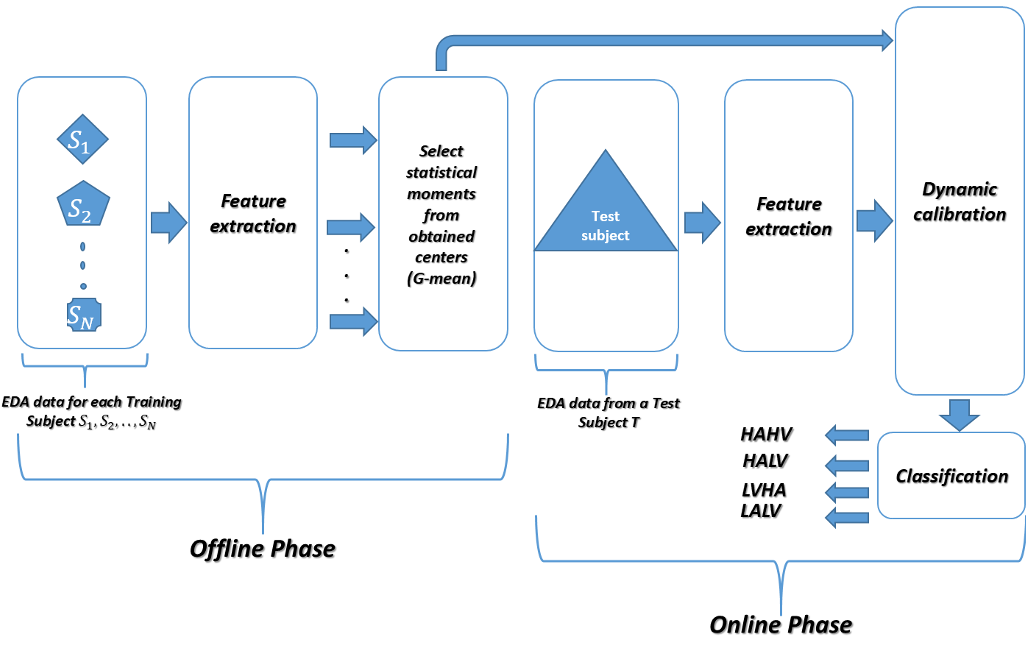
The core innovation is a two-phase system that treats emotion recognition like a recommendation engine.
1. Offline Phase (The Reference Map)
The system doesn't just look at raw data. It uses the G-means algorithm to cluster training data. Unlike standard K-means, G-means automatically determines the "K" (number of clusters) by checking for Gaussian distributions. These clusters act as "anchor points" representing how different training subjects express emotions.
2. Online Phase (The Dynamic Shift)
When a new subject starts using the device:
- Feature Extraction: 12 statistical features are pulled from the EDA signal (SCL and SCR components).
- Correlation: The system calculates the Pearson’s correlation coefficient between the new user's features and the stored centroids.
- Feature Shifting: It identifies the "most similar" training subject and performs a mathematical translation (shifting) of the new user's feature vector toward that subject’s space.
Experiments & Results
The team tested their approach on the MAHNOB dataset, a gold standard in affective computing. They mapped the 1-9 scale of Valence and Arousal into a 4-class quadrant (e.g., High Valence/High Arousal = Excited).
Performance Gains
Using a K-Nearest Neighbor (KNN) classifier to highlight the impact of the feature rearrangement, the results were striking:
- Sensitivity: Improved from an average of ~0.50 to ~0.68 (a peak gain of 26%).
- Specificity: Consistent gains across all subjects, ensuring the model doesn't just guess randomly.
| Metric | Before Calibration | After Calibration | Max Improvement |
|---|---|---|---|
| Sensitivity | 0.41 - 0.59 | 0.64 - 0.72 | +26% |
| Specificity | 0.62 - 0.70 | 0.73 - 0.77 | +11% |
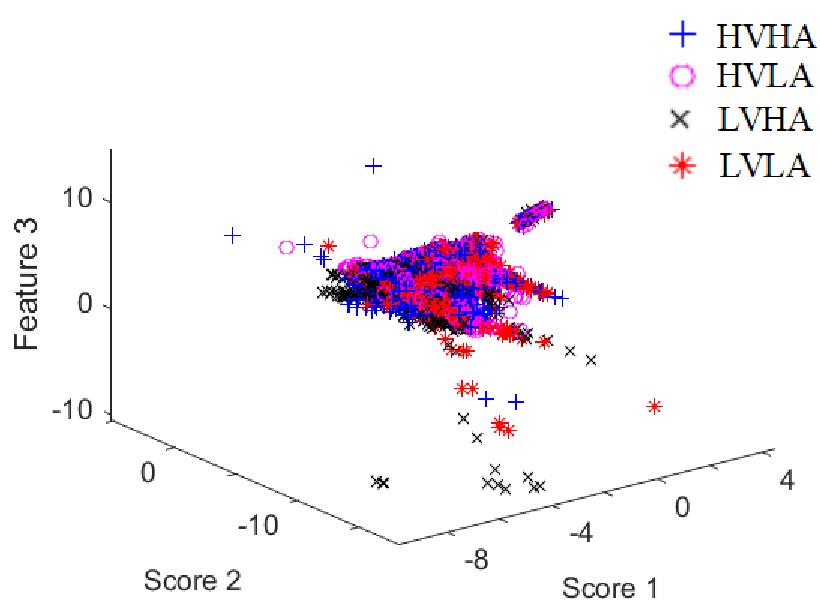 The Fisher Score plots above illustrate how overlapping and complex the raw emotion classes are, justifying the need for the calibration shift.
Critical Insight: Why This Works
The "magic" here isn't a more complex neural network—it's data alignment. By acknowledging that physiological signals are relative rather than absolute, the authors shifted the problem from Classification to Registration. They proved that subject-independent barriers are largely a matter of "offset" in the feature space.
Summary & Future Outlook
This paper provides a robust blueprint for real-world AAL applications. While multi-modal fusion (combining EDA with EEG) will always be more accurate in lab settings, this EDA-only approach is much more likely to be adopted by actual users.
Future Directions:
- Expanding the dataset to include more diverse age groups (specifically Alzheimer's patients).
- Testing the robustness of the "shift" when users move between different physical environments.
Takeaway: In biometric AI, sometimes a simple "calibration" of features is more powerful than the deepest neural network.