
Beyond Autoregressors: Fusing Transactional Intelligence into Agricultural Forecasting
Improving time series forecasting using information fusion in local agricultural markets
The paper proposes a novel Information Fusion and Data Mining methodology to enhance agricultural time-series forecasting in Ecuador's local markets (CIALCO). By integrating Association Rules (Apriori algorithm) into multivariate non-linear regression models like MLP and SMOreg, the authors achieve superior prediction accuracy for consumption trends.
TL;DR
Predicting what people will buy in local agricultural markets is notoriously difficult due to "noisy" data and seasonal shifts. This paper introduces an Information Fusion methodology that uses Association Rule Mining (discovering that customers who buy onions almost always buy tomatoes) to create "overlay" variables. These variables are fed into non-linear models like Neural Networks (MLP) and Support Vector Regression (SMOreg), resulting in a massive reduction in forecasting error (up to 60% MAE improvement).
The Core Problem: The Isolation of Time-Series
Most forecasting models treat a product's history as an island. They look at yesterday's tomato sales to predict tomorrow's. However, in the Alternative Marketing Circuits (CIALCO) of the Ecuadorian Andes, consumption is interconnected. Linear models like ARIMA or simple Linear Regression lack the "Inductive Bias" to understand that the demand for "Kidney Tomatoes" is intrinsically linked to the sales of "White Onions" or "Carrots." Without this context, models suffer from high variance and poor generalization when moving from training to real-world test data.
Methodology: The Fusion of Association and Time
The authors suggest that the secret to better accuracy isn't just a "deeper" model, but better "informed" data.
Phase 1: Mining the "Hidden Logic"
Using the Apriori algorithm, the researchers analyzed over 17,000 transactions. They looked for rules where the Confidence was > 0.8. For example:
{White Onion} => {Kidney Tomato}(Confidence: 0.87, Lift: 1.1)
This effectively identifies Kidney Tomato as a "consequent" product whose demand is signaled by several other "antecedent" vegetables.
Phase 2: The Multivariate Overlay
Instead of a univariate model: They built an Overlay Model:
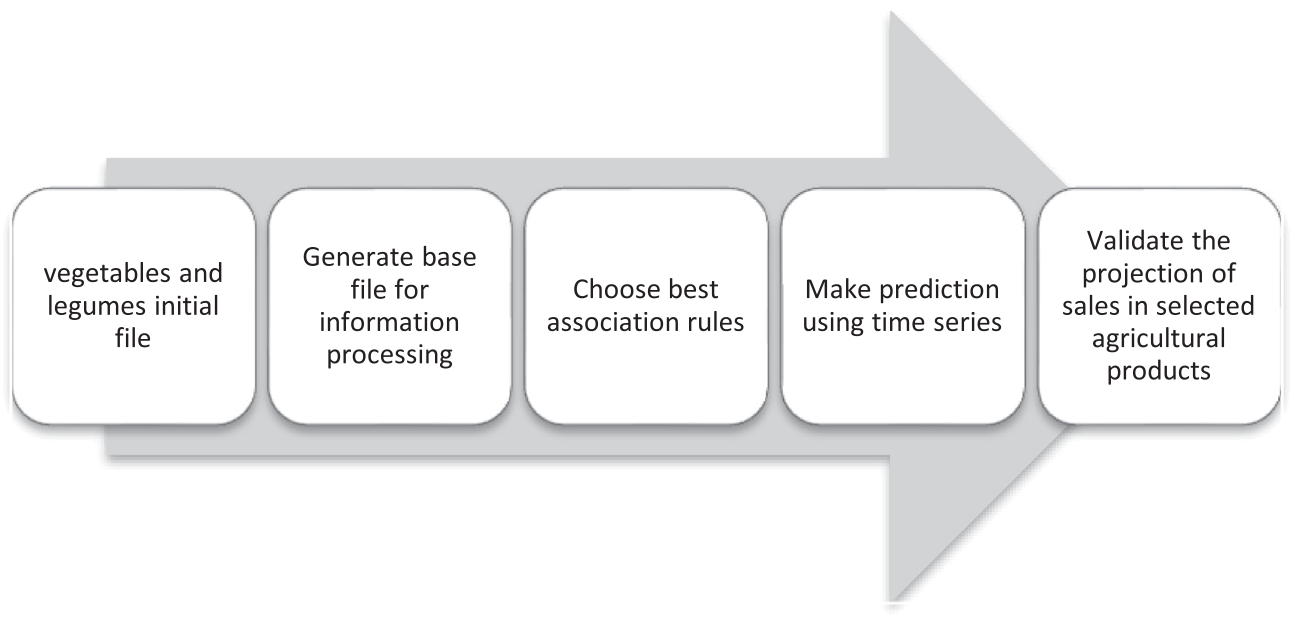 Figure 1: The four-step process: Preparation, Association, Prediction, and Evaluation.
Experimental Results: The Power of Context
The study compared six algorithms: Linear Regression, M5P Trees, SMOreg, MLP, Gaussian Processes, and Holt-Winters.
Key Insights:
- Non-Linearity Wins: Methods like SMOreg and MLP showed the most significant gains when "overlay" variables were added.
- The Overfit Barrier: Univariate models often look perfect during training but fail on test data. Adding associated products acted as a regularizer, providing a more stable ground for prediction.
- Accuracy Gains: For the "Tomato" test series, the MAE (Mean Absolute Error) for SMOreg dropped from 85.92 to 32.51 once associated products were included.
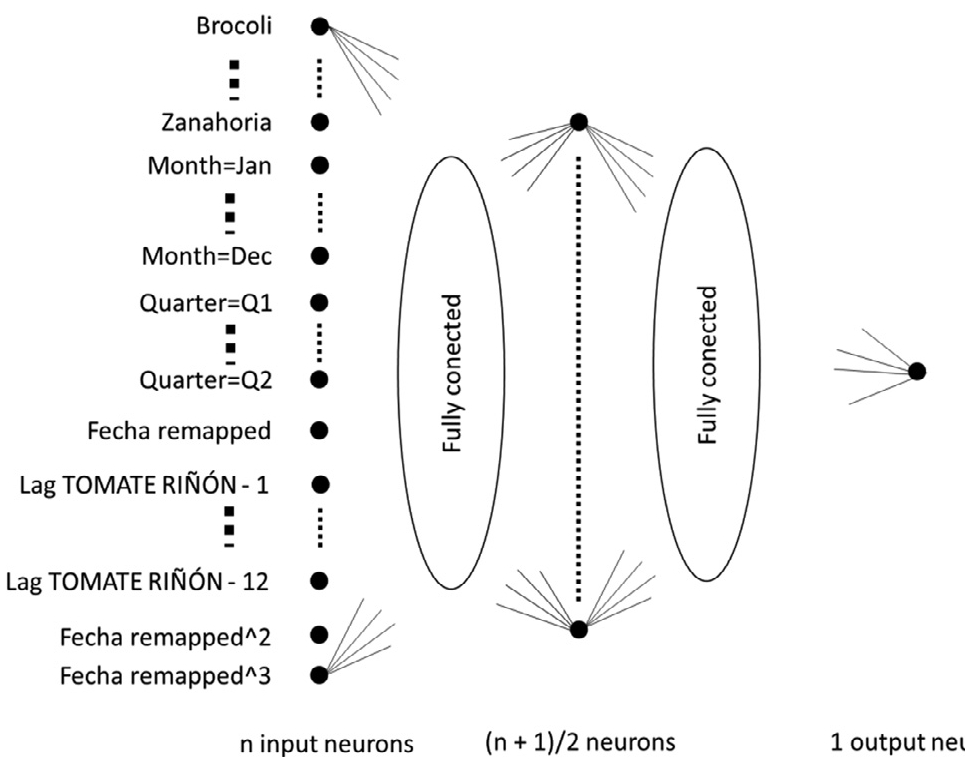 Figure 2: The Neural Network architecture for tomato forecasting, including time-lagged inputs and overlay variables.
Deep Dive: Hidden Layers and Saturation
The authors also conducted an Ablation Study on the depth of the MLP. They found a "sweet spot" at 3 to 4 hidden layers. Beyond this, adding more complexity (a 5th layer) led to saturation, where the model stopped improving or started slightly overfitting the training data without benefiting the test set.
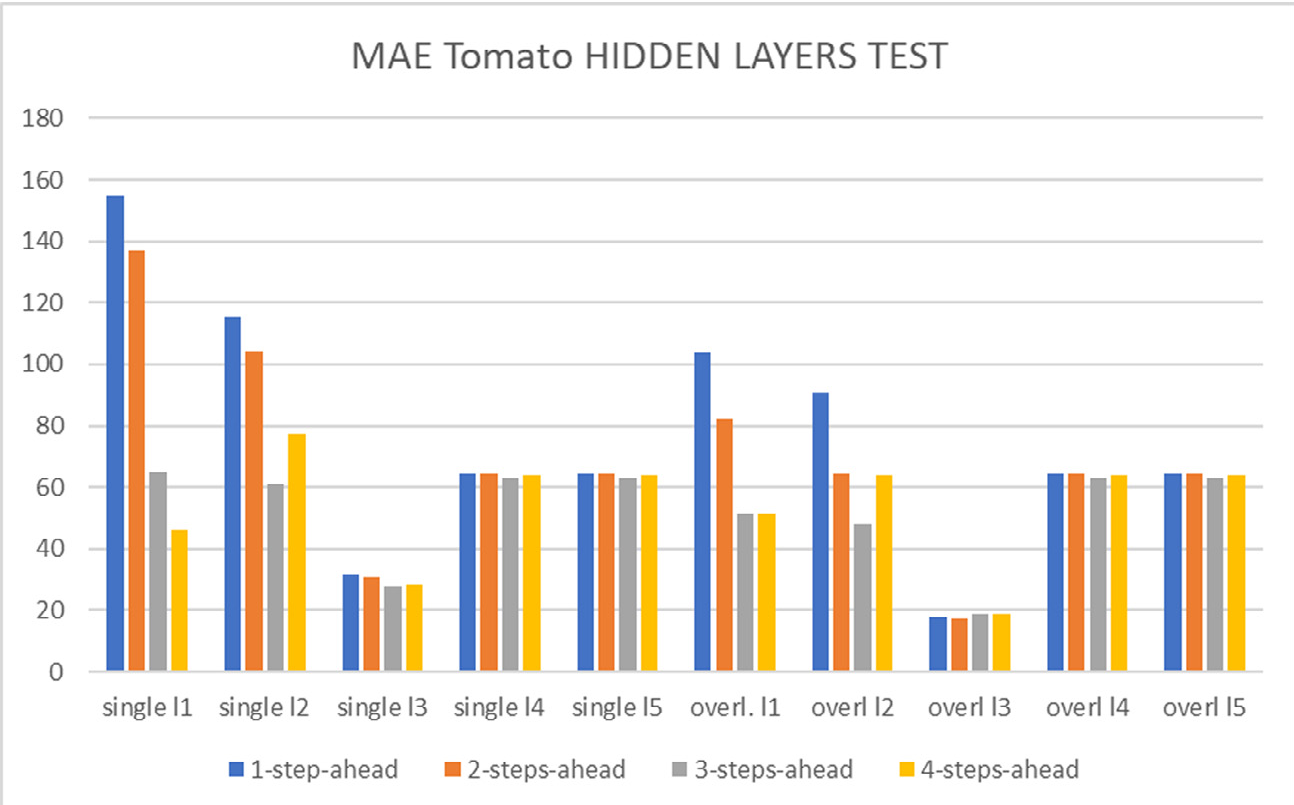 Figure 3: Impact of hidden layers on test accuracy—notice the sharp drop in error as layers are optimized.
Critical Insight & Future Outlook
The brilliance of this paper lies in its Information Fusion philosophy. It proves that domain-specific knowledge (market associations) is just as important as algorithmic complexity.
Limitations: The study relies on 2014 data, which may not account for modern shifts in consumer behavior or extreme climate events. Future Work: The next logical step is to evolve these "rules" into Spatiotemporal Associations, mapping not just what is bought together, but where and how those relationships move across different regional markets in real-time.
For small farmers in the Andes, this isn't just math—it's a tool for economic survival, ensuring they grow exactly what the market is ready to consume.