
Beyond Pixels: Why Emotion is the Missing Link in Visual Saliency
15647_Improving Visual Saliency Computing With Emotion Intensity.
This paper introduces a novel approach to visual saliency computing by incorporating emotional factors—general emotional content, facial expression intensity, and emotional object locations—into traditional bottom-up saliency models. By leveraging Multiple Instance Learning (MIL) and Rank SVM, the method significantly enhances gaze density estimation, achieving a SOTA improvement of approximately 0.1 in AUC across multiple baseline architectures.
TL;DR
While most AI models look for "bright colors" or "high contrast" to predict where you look, this paper argues that your feelings are the real drivers of your gaze. By quantifying emotion intensity—through facial expressions, scary objects, and general atmosphere—the authors boosted the accuracy of traditional saliency models by as much as 14.6% in AUC.
The "Snake in the Grass" Insight
Why do we spot a spider in a garden faster than a flower? Evolutionary psychology tells us that "fear drives attention." Traditional saliency models (bottom-up) focus on stimulus-driven factors like a red dot on a green background. However, they lack the top-down cognitive "software" that tells the human brain: "That snake is more important than that blurry mountain."
The authors identify a critical gap: existing methods ignore the Affective Gap. Even if an emotional region doesn't have high contrast, it will dominate human gaze density.
Methodology: Quantifying the Unquantifiable
The core challenge is turning "emotion" into a mathematical intensity map. The authors breakdown emotion into three distinct pipelines:
1. General Emotional Content (The MIL Approach)
Since images are often labeled "happy" globally but only contain happy regions locally, the authors use Multiple Instance Learning (MIL). They treat the image as a "bag" of patches. If the bag is "Sad," at least one patch must be sad. This allows the model to learn localized emotional triggers without pixel-perfect labels.
2. Facial Expression Intensity (Rank SVM)
Not all faces are equal. An intensely screaming face attracts more eye fixations than a neutral one. Using Rank SVM, the system doesn't just "detect" a face; it ranks its emotional potency, allowing the saliency map to weigh intense expressions more heavily.
3. Emotional Object Detection
Certain objects are "attention magnets." The paper uses an Object Bank to specifically look for snakes, worms, and injuries—stimuli known to trigger immediate "fear" responses and focal attention.
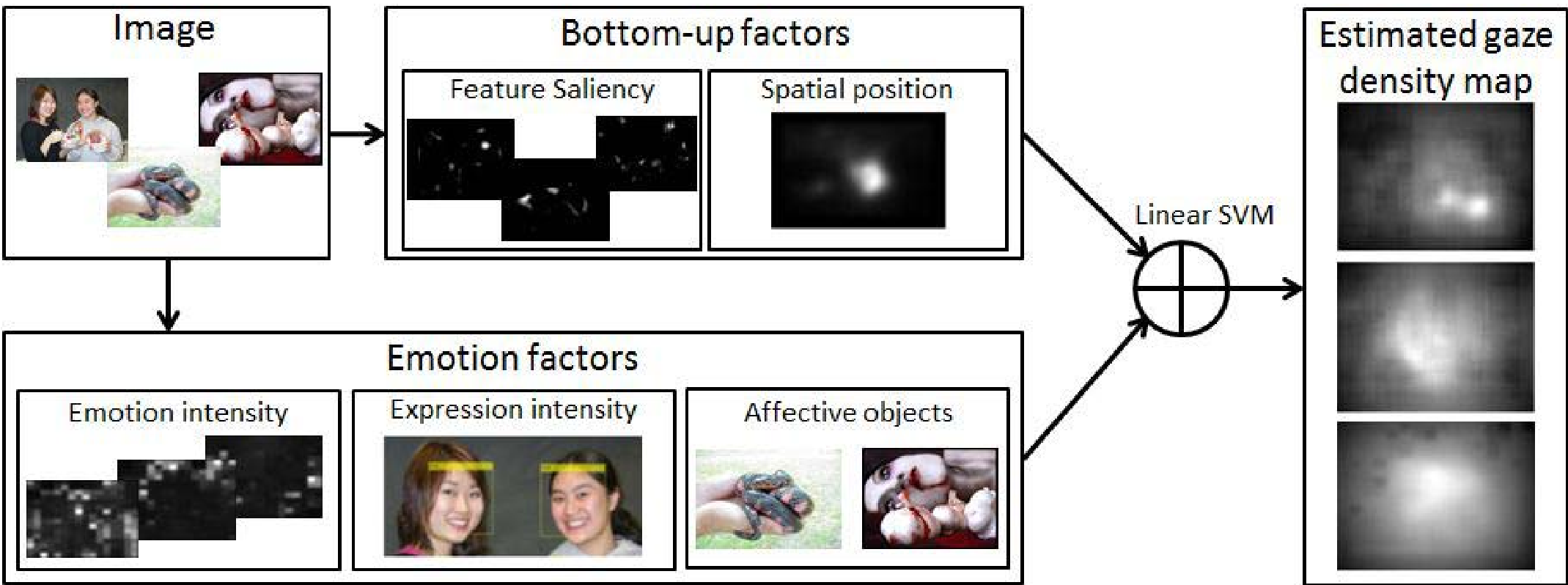 Fig 2: The pipeline showing how emotion factors (MIL, Rank SVM, OB) are fused with traditional saliency via Linear SVM.
Experiments & Results: Emotion Wins
The study utilized the NUSEF eye gaze dataset, which is rich in emotional imagery. The results were clear:
- Baseline Boost: Adding emotion factors to the classic Itti model improved the AUC from 0.56 to 0.70.
- Emotion vs. Center Prior: Traditionally, researchers thought the "center bias" (looking at the middle of a photo) was the strongest factor. This paper proves that emotion intensity outperforms center prior in predicting gaze.
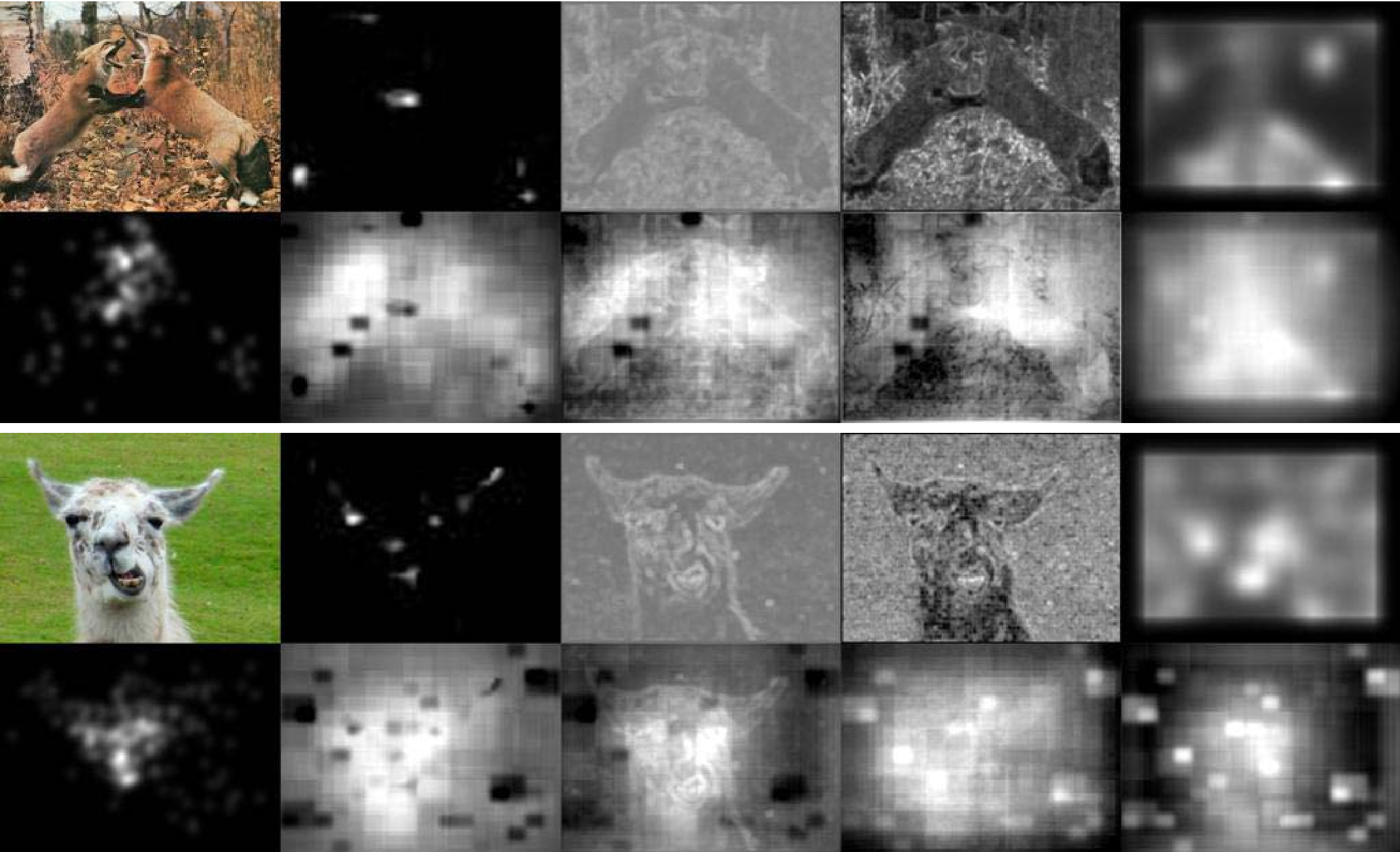 Fig 10: Visual comparison. Notice how the "Our results" (bottom row) more closely match the human gaze density (first column) by highlighting emotional subjects that baselines ignored.
Critical Analysis & Conclusion
Takeaway
Visual saliency is not just a geometry problem; it’s a psychological one. This paper successfully bridges the gap between computer vision and affective neuroscience.
Limitations
- Computational Complexity: Running three separate emotion detection pipelines (MIL, Rank SVM, OB) before calculating saliency is computationally expensive compared to simple gradient-based methods.
- Object Scope: The "Emotional Object" bank was limited to fear-based stimuli (snakes/injuries). A truly universal model would need a much larger bank of culturally and biologically relevant objects.
Future Outlook
As we move toward more human-centric AI, incorporating "Affective Priors" into Large Vision Models (LVMs) will be essential for creating interfaces and content that feel naturally engaging to the human eye.