
Beyond the Web Form: Boosting Crowd Worker Engagement Through Conversational Agents
Improving Worker Engagement Through Conversational Microtask Crowdsourcing
This paper presents a study on using text-based conversational interfaces to replace traditional Web-based UIs in microtask crowdsourcing. By implementing agents with varying conversational styles (High-Involvement vs. High-Considerateness), the authors aimed to improve worker engagement across tasks like image classification and sentiment analysis on Amazon Mechanical Turk.
TL;DR
Crowdsourcing tasks (HITs) are notoriously monotonous, leading to worker burnout and high abandonment rates. This research demonstrates that replacing standard web forms with Conversational Interfaces can significantly increase worker retention (from 28% up to 75%) without degrading quality or increasing stress. The key takeaway: a "High-Involvement" conversational style is the most effective at keeping workers active.
The "Boredom Crisis" in Digital Labor
Microtasking marketplaces like Amazon Mechanical Turk (AMT) act as the engine for modern AI, providing the labeled data required for training. However, the work is often repetitive. Prior research suggests that this monotony leads to "sloppy work." While we know chatbots can do the job, the fundamental question was: Can a chatbot make the work actually feel better?
Methodology: Designing the Digital Coworker
The authors didn't just build a simple chat interface; they applied sociolinguistic theories to design specific "personas" for the agents. They focused on two main styles:
- High-Involvement: Fast-paced, uses simple syntax, direct, and enthusiastic (e.g., "Hey! Good job! I know you want to continue, right?").
- High-Considerateness: Slower, polite, uses complex syntax and hesitations (e.g., "Well... no worries, you can stop if you don't want to continue.").
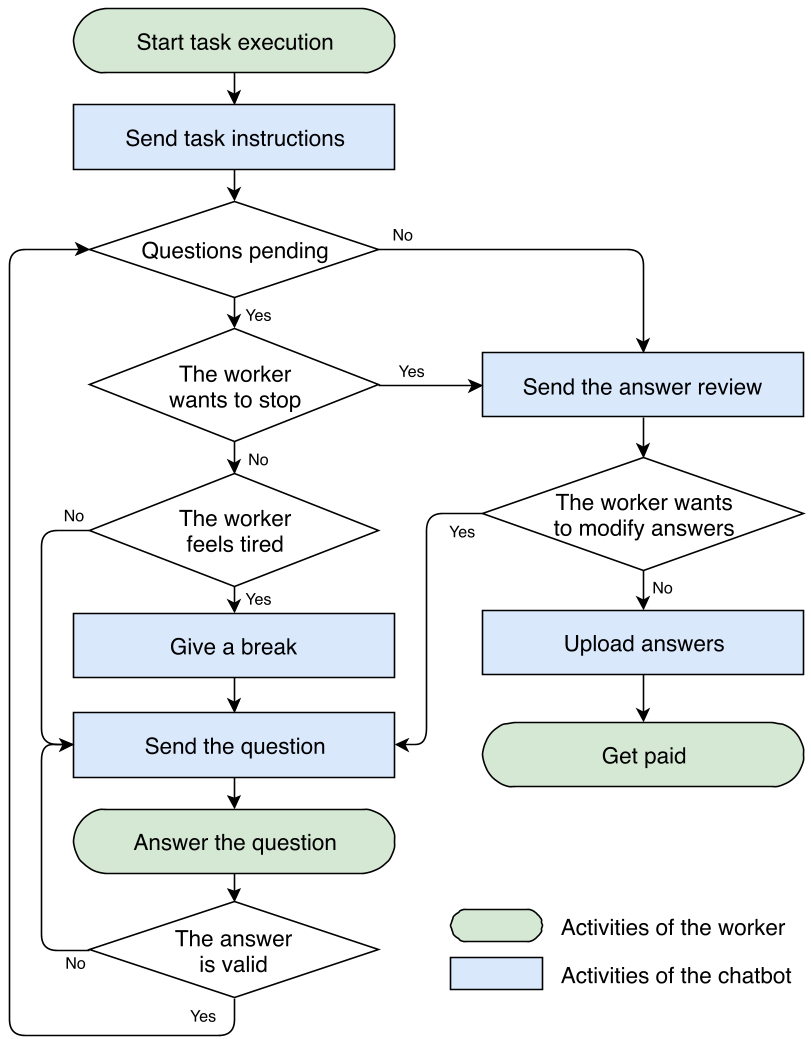 Figure 1: The workflow of conversational microtasking, from initialization to reviewing and submitting answers.
Style Alignment
One of the most innovative parts of the study was Style Alignment (Con+A). The agent would present dual options during the introduction to "gauge" the worker's own style and then switch its persona to match the worker, testing the hypothesis that we prefer interacting with individuals who speak like us.
Key Findings: Retention is the Winner
The study evaluated four task types: Information Finding, Sentiment Analysis, CAPTCHA Recognition, and Image Classification.
- Retention Explosion: In multiple-choice tasks (Image Classification), workers using the conversational interface answered significantly more optional questions than those using the Web UI.
- Engagement Scores: While self-reported User Engagement Scale (UES) scores were similar, the behavioral data showed that workers were much less likely to quit early when chatting with an agent.
- Style Matters: The "High-Involvement" style was a universal winner for retention. Even in complex tasks, the energetic, direct nature of the Involvement style kept workers from dropping off.
 Figure 2: Violin plot showing the dramatic difference in optional tasks completed between the Web UI and Conversational styles (Con+I, Con+C, Con+A).
Critical Analysis & Conclusion
This work challenges the status quo of "form-filling" for data annotation. By humanizing the interaction, requesters can build more sustainable workflows.
Limitations: The study capped optional tasks at 45. In many conversational conditions, workers hit this ceiling, suggesting the retention gap might be even larger if the task pool were infinite. Furthermore, while simple tasks saw huge gains, the benefit for highly complex "text-heavy" tasks was slightly more muted, likely due to the cognitive overhead of switching between reading long texts and interacting with a chat bubble.
The Takeaway for Requesters: If you have a large batch of image tagging or sentiment tasks, skip the web form. Build a "High-Involvement" chatbot to guide your workers—it’s essentially a "nudge" that pays for itself in throughput and data consistency.