
ITERGM: Mastering the Ghost in the Social Machine
Imputation of missing links and attributes in longitudinal social surveys
This paper introduces ITERGM (Iterative Temporal Exponential Random Graph Model), a unified framework for the simultaneous imputation of missing links and node attributes in longitudinal social surveys. By framing imputation as an Expectation-Maximization (EM) process over a decoupled ERGM architecture, it achieves superior accuracy in reconstructing temporal graph dynamics.
TL;DR
Social scientists often face a nightmare: a longitudinal survey where 40% of the participants simply stop answering. A team of researchers has developed ITERGM, a sophisticated iterative algorithm that uses the "physics" of social interaction—reciprocity, transitivity, and homophily—to mathematically "hallucinate" missing friendships and personal attributes with unprecedented accuracy.
Background: The Price of Silence
In social network analysis, missing data isn't just a nuisance; it's a structural catastrophic failure. Unlike standard tabular data, where a missing value is just one lost data point, a missing person in a social network erases an unknown number of connections (links). Traditionally, we either ignored these gaps or used simplistic averages. However, social networks are governed by deep-seated rules: if I am friends with your friends, we will likely become friends (Transitivity). If you are like me, we are more likely to talk (Homophily). The ITERGM paper argues that we can only fill in the gaps by respecting these "social laws" over time.
Methodology: The EM-MCMC Hybrid
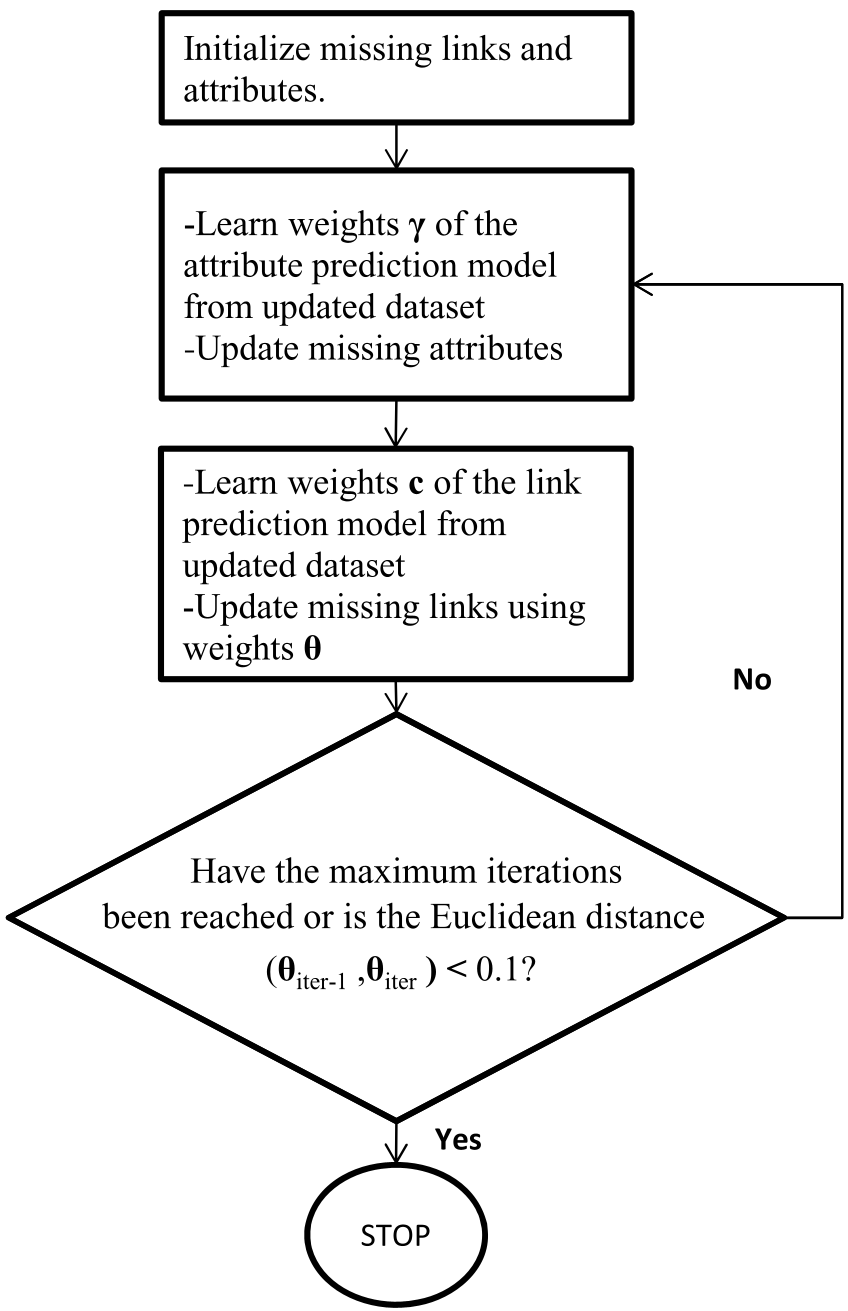
The core innovation of this work is the ITERGM (Iterative Temporal Exponential Random Graph Model). Instead of a one-pass imputation, it treats the problem as an optimization loop.
1. The Decoupled Architecture
The model splits the world into two parts:
- Link Prediction Model: Uses previous network states and current attributes to predict the probability of a tie.
- Attribute Prediction Model: Uses previous attributes and the current network structure to predict features (like a student's alcohol consumption or delinquency score).
2. The Iterative Loop (EM Algorithm)
The process follows a "chicken-and-egg" logic. It initializes missing values using baseline methods and then enters a loop:
- Step A (Train): Learn the "social rules" (weights) from the current version of the data.
- Step B (Sample): Use Markov Chain Monte Carlo (MCMC) to "draw" thousands of possible versions of the missing links and attributes based on those rules.
- Step C (Update): Update the dataset with the average (most likely) version of those samples.
Experimental Proof: Resurrecting the "Teenagers" Dataset
The authors tested ITERGM against standard benchmarks using both synthetic data and famous real-world datasets:
- Delinquency: 26 students over 4 time steps.
- Teenagers: 50 girls over 3 years.
Performance vs. Baselines
Whether the data was "Missing at Random" (MAR) or "Missing Not at Random" (MNAR—e.g., drinkers are less likely to respond), ITERGM consistently outperformed traditional methods like DynaMMo (multivariate Gaussian processes) and CRDPG (Latent Space models).
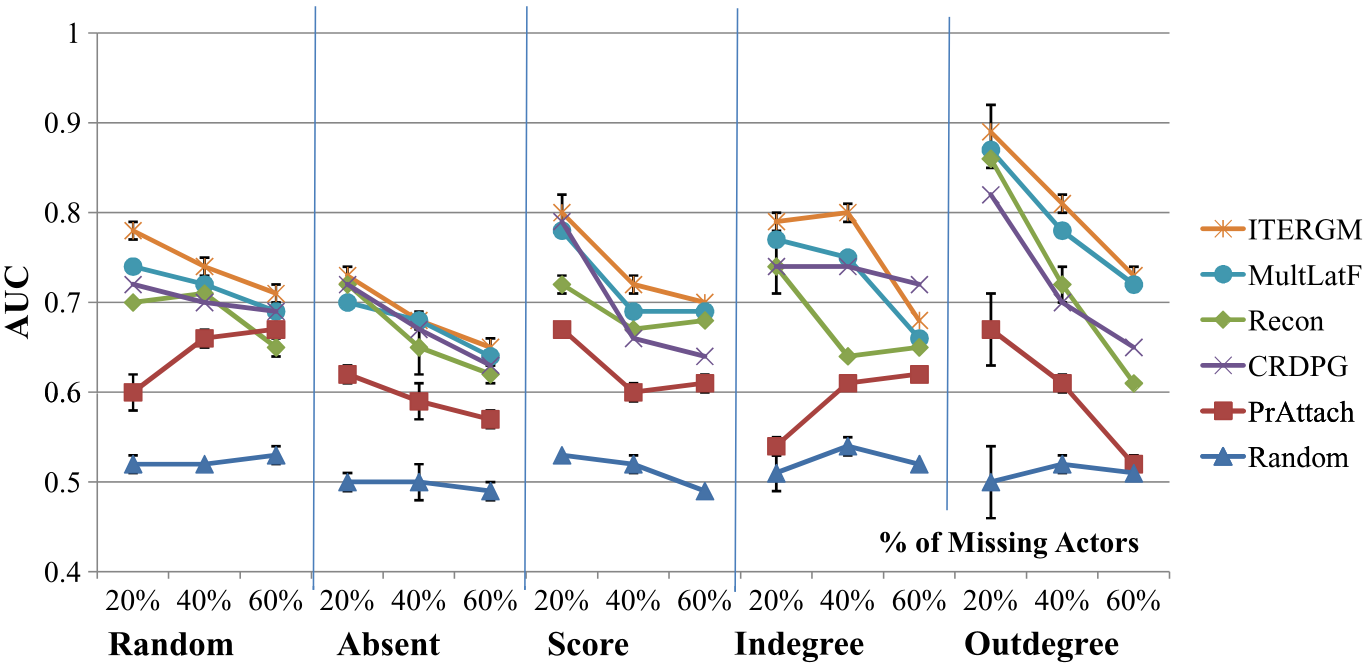
As shown in the charts above, the Area Under Curve (AUC) for ITERGM remains significantly higher than its peers, especially as the "missingness" percentage increases from 20% to 60%.
Deep Insight: Why It Works
The beauty of ITERGM lies in its transitivity and reciprocity statistics. By looking at the "Score Matrix" (the sum of 1,000 sampled sociomatrices), the model can find the "best cut"—the optimal threshold that maximizes the probability of the network's structure. It doesn't just guess a link; it validates that the link makes sense within the global topology of the community.
Scalability & Limitations
One potential hurdle is the computational cost. The algorithm shows quadratic complexity O(k²) relative to the number of actors because it has to evaluate every possible pair of relationships. While efficient for school-sized classes (dozens to hundreds of nodes), applying this directly to a million-node Facebook subgraph would require community detection to break the graph into manageable "pods" for parallel processing.
Conclusion: A New Standard for Social Surveys
The ITERGM approach proves that the "ghosts" in our social data—the non-respondents—leave behind a "gravitational pull" in the data of their peers. By modeling the co-evolution of behavior and friendship, we can accurately reconstruct the missing pieces of the social puzzle. This is a vital tool for any sociologist or data scientist working with longitudinal panel data.