
[CVPR 2026] SKILL0: Internalizing Agentic Skills for Zero-Shot Autonomous Intelligence
Skill0 : In-Context Agentic Reinforcement Learning for Skill Internalization
SKILL0 is an in-context reinforcement learning (ICRL) framework designed to internalize agentic skills directly into LLM parameters. It transitions agents from relying on inference-time skill retrieval to fully autonomous zero-shot behavior, achieving SOTA performance on ALFWorld (+9.7%) and Search-QA (+6.6%) while maintaining ultra-low token overhead.
TL;DR
SKILL0 shifts the LLM agent paradigm from "Skills at Inference" to "Skills at Training, Zero at Inference." By using a dynamic curriculum within an In-Context Reinforcement Learning (ICRL) framework, it teaches models to internalize procedural knowledge (skills). The result? An agent that performs like a retrieval-augmented model but runs with the speed and efficiency of a zero-shot model, requiring fewer than 0.5k tokens per step.
Problem & Motivation: The "Context Dependency" Trap
Current AI agents are often "lazy learners." We provide them with "Skill Banks" and use RAG to pump relevant instructions into their context windows. While effective, this approach has three fatal flaws:
- Noise Sensitivity: Poor retrieval introduces irrelevant guidance that "hallucinates" the agent off-track.
- Token Bloat: Injecting markdown skills into every turn of a multi-turn conversation quickly hits context limits and increases latency/cost.
- No True Learning: The model isn't getting smarter; it's just a better instruction follower. If you take the prompt away, the agent collapses.
The authors of SKILL0 ask: Can we use these skills as training wheels? Let the model read the skills while learning, then slowly take them away until the knowledge is baked into the model's weights.
Methodology: The Core Mechanism of SKILL0
SKILL0 achieves this through a sophisticated interplay between Reinforcement Learning and an adaptive curriculum.
1. In-Context Reinforcement Learning (ICRL)
Instead of standard SFT, the model undergoes RL (using a GRPO-style objective). During the early phases of training, the model has access to a hierarchical SkillBank. These skills are rendered—alongside interaction history—into a compact visual context to save tokens during training rollouts.
2. Helpfulness-Driven Dynamic Curriculum
This is the "secret sauce." The framework doesn't just drop skills randomly. It follows a three-step process:
- Filter: Evaluate the "Helpfulness Metric" () by comparing performance with and without a specific skill file.
- Rank: Sort skills by how much they actually improve the current policy's success rate.
- Select: Retain only the most helpful skills within a linearly decaying Skill Budget ().
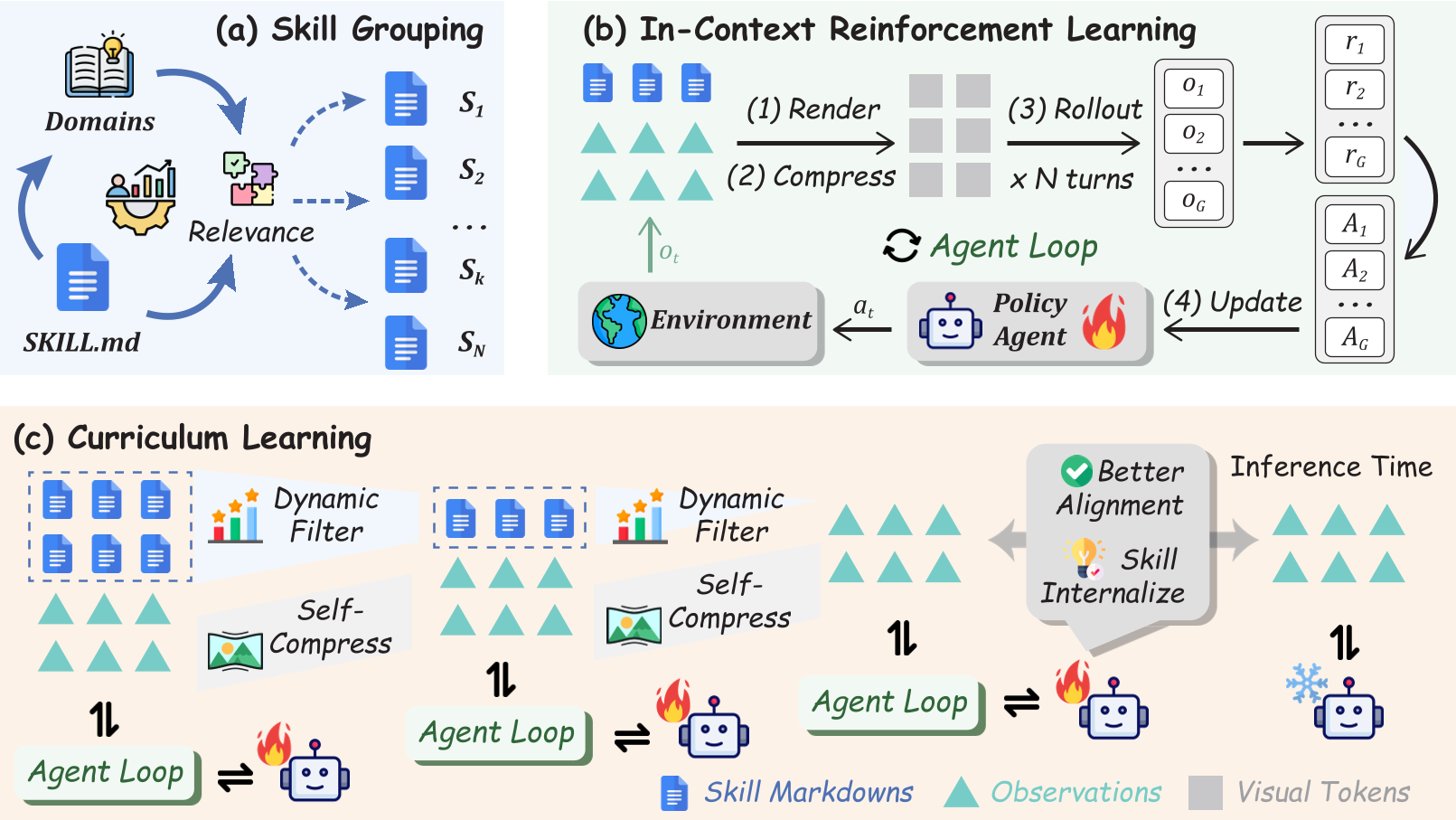 Figure 1: The SKILL0 workflow: From relevance-driven grouping to dynamic budget annealing.
Experiments: Superior Performance with Minimal Context
The model was tested on ALFWorld (embodied tasks) and Search-QA (complex information retrieval).
SOTA Results
SKILL0 doesn't just beat zero-shot models; it beats models that have access to the skills at inference time. On ALFWorld, SKILL0 (3B) hit an 87.9% success rate, outperforming the previous RL champion, AgentOCR, by nearly 10%.
The Token Efficiency Miracle
Because the model has internalized the skills, it doesn't need to "read" them anymore.
- SkillRL (Baseline): ~2.2k tokens/step
- SKILL0 (Ours): 0.38k tokens/step
This represents a 5.8x reduction in context usage while maintaining higher accuracy.
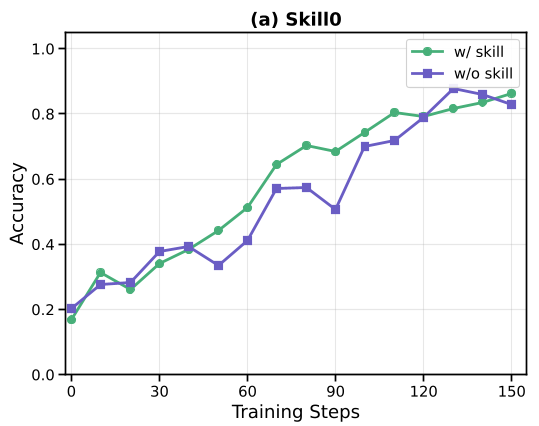 Figure 2: Performance comparison. Note how SKILL0 continues to improve its zero-shot (skill-free) capability far beyond standard RL baselines.
Deep Insight: Skills as Transient Scaffolding
The most fascinating discovery in the paper is the "Rise-then-Fall" pattern of skill helpfulness. Early in training, the model doesn't know how to use the skills ( is low). In the middle, it relies on them heavily to solve tasks ( peaks). By the end, the model has internalized the logic, and the skills become redundant ( drops to zero).
This confirms the authors' intuition: Skills are most valuable as a bridge during the exploration phase of RL.
Conclusion & Limitations
SKILL0 marks a shift toward self-sufficient intelligence. By internalizing tools and procedural knowledge, we move closer to agents that can act instantly without expensive retrieval loops.
Limitations: The method still depends on a high-quality initial SkillBank. If the starting skills are sub-optimal, the internalized policy will be too. Future work will likely look at "Skill Discovery," where the model generates its own training wheels before internalizing them.
Takeaway for the Industry: For production-level agents, stop focusing on better RAG prompts. Start focusing on RL-driven internalization to slash costs and improve reliability.