
Decoding the Echo of Feelings: A Bio-Technical Deep Dive into Speech Emotion Recognition (SER)
In-Depth Analysis of Speech Production, Auditory System, Emotion Theories and Emotion Recognition
This paper provides a comprehensive multidisciplinary survey of Speech Emotion Recognition (SER), integrating the biological mechanisms of speech production, human auditory perception, and psychological emotion theories. It explores the systemic pipeline of SER, covering acoustic feature extraction like MFCCs and classification via advanced machine learning and deep learning architectures.
TL;DR
Speech Emotion Recognition (SER) is evolving from simple pattern matching to a sophisticated emulation of the human bio-system. This paper provides a rigorous analysis of how our lungs, larynx, and brain’s limbic system collaborate to produce emotional signals, and how AI architectures—from MFCC feature extraction to Deep Learning classifiers—attempt to reverse-engineer this process.
Positioning: This work serves as a foundational theoretical bridge, connecting the "Why" of biological sound production with the "How" of digital signal processing (DSP) and machine learning.
The Anatomy of a Signal: From Lungs to Lexicon
The primary challenge in SER is that a speech signal is not just a carrier of words; it is a biometric signature. The authors emphasize that speech production is a three-part kinetic chain:
- Pressure System: The lungs and diaphragm provide the aerodynamic energy.
- Phonatory System: The larynx and vocal folds convert air into vibration.
- Resonatory System: The vocal tract (pharynx, oral/nasal cavities) acts as a filter.
The "emotional" content often resides in the Prosody—the suprasegmental features like pitch (F0), timing, and energy. For instance, anger typically increases subglottal pressure, leading to higher intensity and pitch shifts.
Biological Realism in Feature Engineering
The paper bridges the gap between the ear's anatomy and digital features. The Cochlea, a spiral tube in the inner ear, performs a natural Fourier Transform, decomposing sound into frequencies. High frequencies are processed at the base, and low frequencies at the apex.
This tonotopic organization is the direct inspiration for Mel-frequency Cepstral Coefficients (MFCC), the gold standard in SER. MFCCs represent the "shape" of the vocal tract, effectively capturing the resonance (formants) that changes when a speaker is under different emotional stresses.
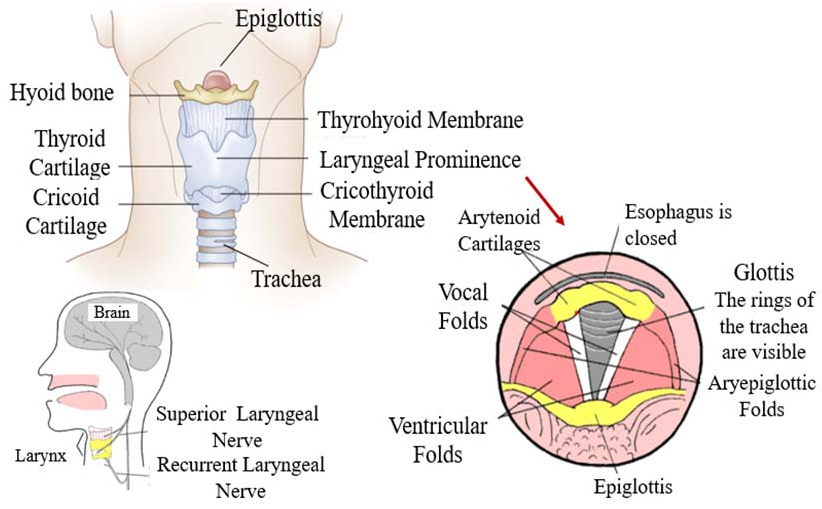
Mapping the Invisible: Emotion Theories in AI
To recognize an emotion, a machine must first have a "map" of what emotions are. The authors contrast two pivotal psychological frameworks:
- Discrete Categories: Ekman’s six basic emotions (Anger, Happiness, Fear, Surprise, Disgust, Sadness).
- Dimensional Spaces: Russell’s 2D (Valence-Arousal) and Mehrabian’s 3D (Valence-Arousal-Dominance) models.
The 3D model is particularly powerful for AI; it allows a system to distinguish between Fear and Anger—both are "high arousal" and "negative valence," but Anger is "high dominance" while Fear is "low dominance" (submissive).
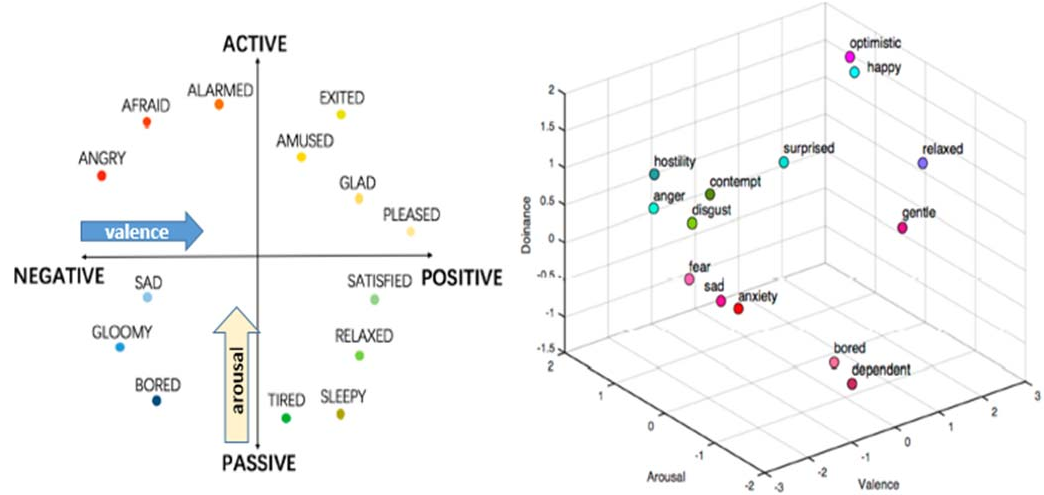
The Modern Pipeline: From Trad-ML to Deep Learning
The paper outlines the standard evolution of SER architectures:
- Preprocessing: Noise reduction via Wavelet Transforms or Empirical Mode Decomposition (EMD).
- Feature selection: Reducing dimensionality using PCA or LDA to prevent "the curse of dimensionality."
- Classification:
- Traditional: SVM and Hidden Markov Models (HMM) are lauded for their interpretability.
- Neural: CNNs are used for spectrogram analysis, while LSTMs/RNNs capture the temporal "flow" of emotion in a sentence.
A standout mention is the Brain Emotion Learning (BEL) model, an ANN architecture that specifically mimics the interaction between the amygdala (emotional reaction) and the orbitofrontal cortex (emotional regulation), offering a computationally efficient alternative to massive black-box transformers.
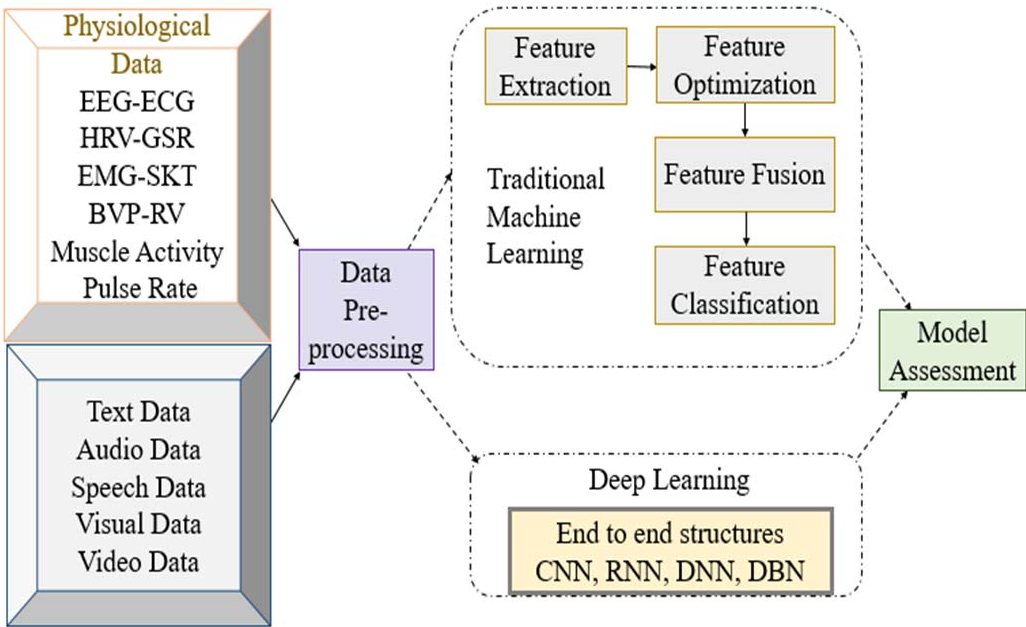
Critical Insight & Conclusion
The true value of this research lies in its insistence that SER cannot be solved by data scaling alone. By understanding the Limbic System and the mechanics of the Vocal Cords, researchers can develop "biologically plausible" AI that requires less data to achieve higher accuracy.
Future Outlook: The next frontier isn't just audio-only SER, but Multimodal Information Fusion—combining speech with physiological markers like heart rate (ECG) and brain waves (EEG) to create systems that can detect "masked" emotions that the voice alone might hide.