
Unlocking Inter-Divisional Synergy: A Hybrid Social Network Approach to Corporate Communication
In-house communication support system utilizing social network
This paper introduces an in-house communication support system that integrates the "Information Propagation Model" (IPM) for word-of-mouth information sharing with "Discussion Forums" (DF) for structured thematic debates. Tested in a real Japanese company, the system significantly improves horizontal, inter-divisional communication and strengthens human relations among employees.
TL;DR
This research tackles the "silo effect" in corporate environments by combining a word-of-mouth Information Propagation Model (IPM) with structured Discussion Forums (DF). By deploying this system in a real-world company, the authors demonstrated that unifying spontaneous sharing with curated discussion can bridge the gap between isolated departments and turn "stranger" colleagues into collaborators.
Background & Motivation: The Limits of E-mail
While 97% of Japanese companies utilize digital communication, nearly 60% still report insufficient inter-divisional interaction. The core issue is that traditional tools—like e-mail or basic BBS—require a pre-existing reason to reach out. If you don't know someone in the Engineering department, you are unlikely to start a thread with them.
The authors identify a secondary hurdle: Negative Users. Most Social Networking Services (SNS) like LinkedIn rely on active, self-starting users. Highly reserved employees often remain on the periphery, never expanding their professional network despite having valuable expertise.
Methodology: The Two-Pronged Strategy
The system's brilliance lies in its dual-layer architecture, designed to catch different types of users in its net.
1. The Information Propagation Model (IPM)
Think of this as "Digital Word-of-Mouth."
- Trust-Based: You only receive information from people you explicitly register as "neighbors."
- Traceability: Unlike a random rumor, you can see the exact path a message took to reach you.
- Logic: It allows information to hop across the social graph organically, reaching distant divisions through mutual acquaintances.
2. Discussion Forums (DF)
Where IPM is organic, DF is intentional.
- Strategic Allocation: Administrators assign users to forums based on age, post, and department—not social ties.
- Thematic Focus: Using prerequisite questionnaires, the system identifies "hot topics" (e.g., "how to improve office efficiency") to give people a reason to talk.
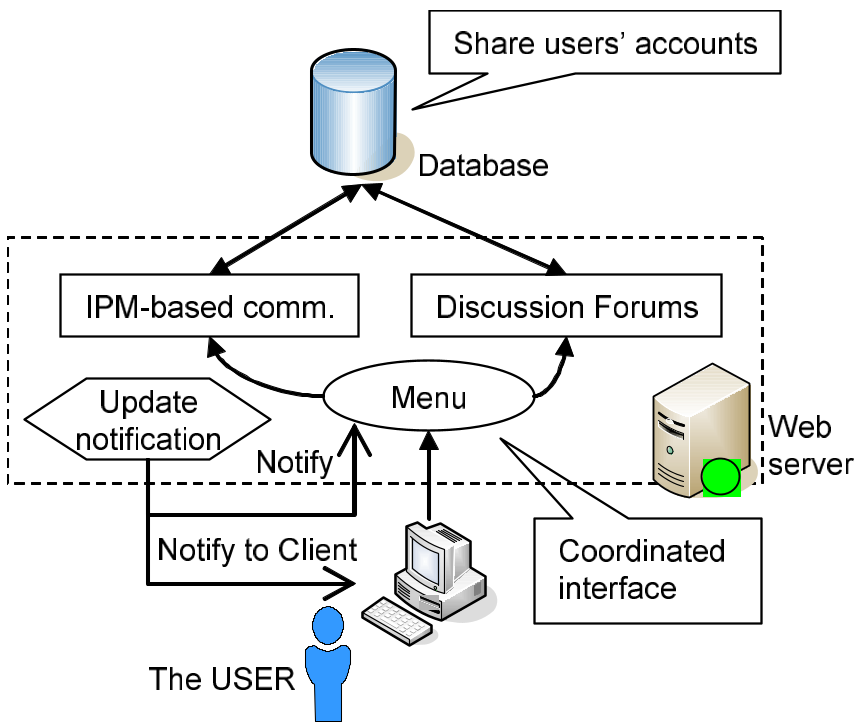 Figure: The system architecture combining the Web-based server and the IPM/DF logic.
Experimental Insights: Does it Actually Work?
The authors conducted a two-month field study at NTT DATA SANYO SYSTEM CORPORATION. They mapped the resulting social network (Figure 4), revealing a non-centralized, healthy distribution of connections.
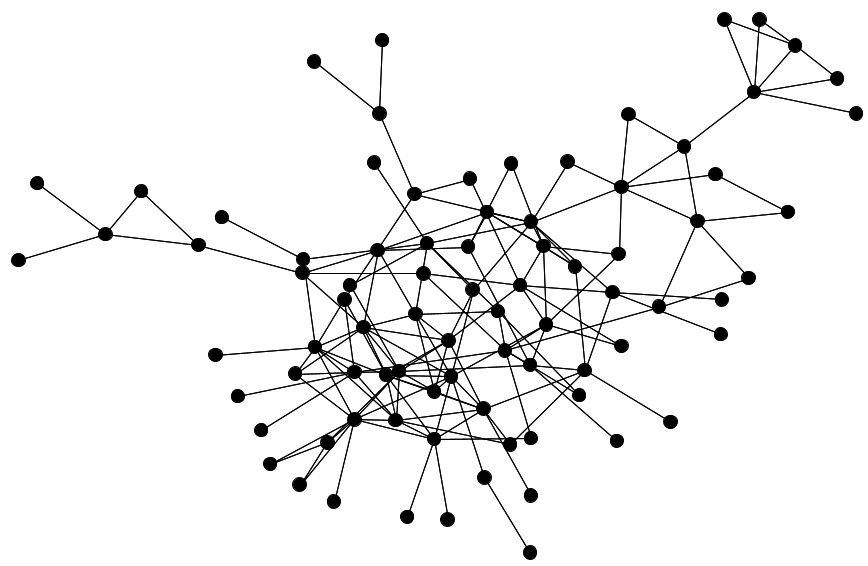 Figure: The actual social network constructed during the experiment, showing 83 participants.
Key Findings:
- Breaking the Silo: Users reported a noticeable impact on communication between far-flung branch offices and different divisions—areas typically ignored by daily business routines.
- Different Strokes for Different Folks:
- IPM was most effective for "Social Butterflies" (users with many neighbors) to discover new contacts.
- DF was a lifeline for "Isolated Users" (those with few neighbors), providing them a structured environment to build their first few connections.
- Synergy: The study proved that running Discussion Forums actually increased the frequency of spontaneous messages sent via the IPM (Accuracy p < 0.05).
Critical Analysis & Conclusion
Takeaway
The paper proves that horizontal communication doesn't happen by accident; it requires a mix of pull (IPM) and push (DF) mechanisms. The "Traceability" of the IPM provides the safety and trust necessary in a corporate culture, while DF provides the necessary nudge for introverts.
Limitations & Future Work
The system currently relies on a human administrator to curate forum themes and assign users. In a modern context, this is a clear bottleneck. One could imagine an LLM-based agent modernizing this by:
- Automatically identifying trending topics within the IPM.
- Using semantic analysis to pair users with complementary expertise but no social ties.
Despite being an earlier study, the fundamental insight remains relevant: to break down corporate walls, we must design for the social graph, not just the org chart.
References
- Takeuchi, S., et al. "In-house communication support system utilizing social network."
- Takeuchi, S., et al. (2003). "Human-Network-based Filtering." SAINT-2003.