
[arXiv 2026] In-Place TTT: Transforming Static LLMs into Dynamic Learners via MLP Repurposing
In-Place Test-Time Training
This paper introduces In-Place Test-Time Training (In-Place TTT), a framework that enables Large Language Models to dynamic adapt their weights during inference by repurposing existing MLP blocks as "fast weights." By utilizing a novel Next-Token Prediction (NTP) aligned objective and chunk-wise updates, it allows a 4B-parameter model to achieve SOTA performance on 128k context tasks without architectural modifications.
TL;DR
The "train-then-deploy" era of LLMs faces a fundamental wall: once the model is in your hands, it stops learning. In-Place Test-Time Training (In-Place TTT) breaks this wall by turning ubiquitous MLP blocks into dynamic "fast weights" that update during inference. It requires no architectural changes, supports massive parallelism, and significantly boosts long-context reasoning by aligning test-time updates with the logic of next-token prediction.
Problem & Motivation: The Static Weight Bottleneck
Context length is the "RAM" of LLMs. While In-Context Learning (ICL) allows models to remember tokens, the quadratic cost of self-attention makes this "memory" expensive and static. Previous Test-Time Training (TTT) attempts tried to solve this by replacing Attention with RNN-like TTT layers.
However, these methods faced a "Cold Start" problem:
- Incompatibility: You can't just plug a TTT layer into Llama-3 or Qwen without retraining from scratch.
- Inefficiency: TTT updates were traditionally sequential (token-by-token), killing GPU throughput.
- Misalignment: Using a simple "reconstruction" loss to update weights doesn't actually help the model predict the next word better.
Methodology: The In-Place Revolution
The authors' core insight is elegant: Don't add new layers; repurpose what's already there.
1. Repurposing MLP as Fast Weights
In a standard Transformer, the MLP block acts as a static key-value memory of the pre-training data. In-Place TTT treats the final projection matrix () of the MLP as "fast weights." During inference, the model runs a traditional forward pass, but also performs a gradient-based update on for every chunk of tokens it sees.
2. The NTP-Aligned Objective
Instead of the model trying to "reconstruct" the current token (which provides zero predictive value for the future), the authors introduce an LM-Aligned Objective. The target is derived from future tokens using a 1D-convolution.
Physical Intuition: The model is effectively performing a "mini-training session" during the forward pass, adjusting its internal knowledge to better predict the next token in the specific document it is currently reading.
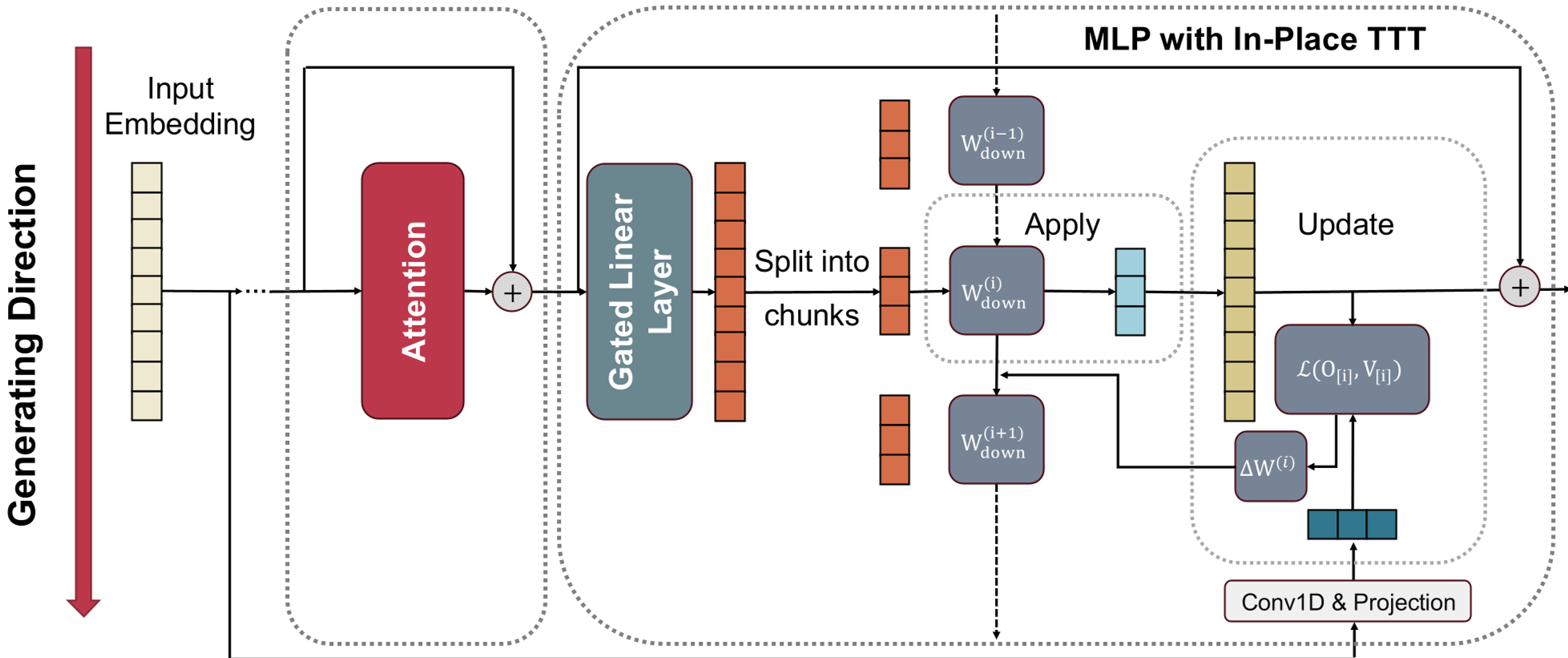 Figure 1: The In-Place TTT cycle: Apply-then-Update. The module processes chunks, adapting the MLP weights in-place to the local context.
3. Chunk-wise Hardware Acceleration
To solve the sequential bottleneck, the framework uses Parallel Scan algorithms. By processing tokens in chunks (e.g., 512 or 1024 tokens), the update becomes associative, allowing for high-throughput computation that saturates modern H800 clusters.
Experiments & Results: Beyond the Context Window
The authors tested the "drop-in" capability on Qwen3-4B and LLaMA-3.1-8B.
- Long-Context Superiority: On the RULER benchmark, the In-Place TTT version of Qwen3-4B significantly outperformed the baseline as context scaled to 128k and even 256k (extrapolation).
- Perplexity Gains: When trained from scratch (1.5B scale), In-Place TTT achieved lower sliding-window perplexity than the most competitive linear-complexity baselines like GLA and DeltaNet.
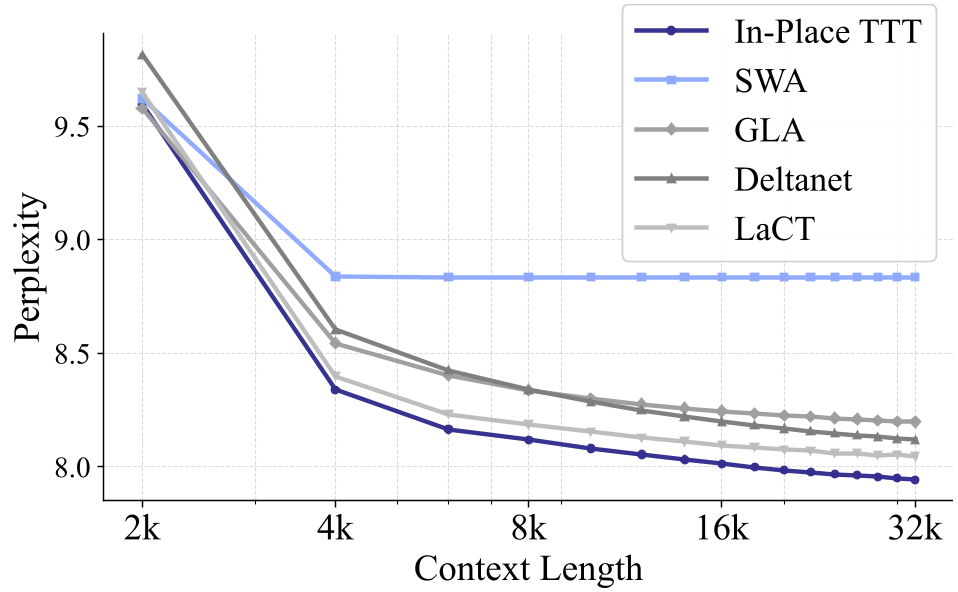 Figure 2: Validation Perplexity Comparison. In-Place TTT (Purple) consistently maintains better context compression than SWA or standard TTT methods.
Deep Insight: Why Why Does This Work?
Traditional attention stores information in the activations ( or with KV Cache). In-Place TTT stores information in the weights.
The theoretical analysis proves that an NTP-aligned target increases the specific logit of the correct next token while leaving unrelated logits untouched. This makes the MLP a "dynamic cache" that is much more expressive than a static KV-Cache. Essentially, the model is specializing itself to the document's style and terminology on the fly.
Critical Analysis & Conclusion
Takeaway: In-Place TTT is one of the most practical steps toward "Continual Learning." It proves that we don't need radical new architectures to achieve the benefits of TTT; we just need a smarter way to use the parameters we already have.
Limitations:
- Stability: Fast-weight updates can theoretically diverge. The authors mitigate this with a Frobenius norm clipping mechanism ().
- Memory: While efficient, storing the prefix sums for the parallel scan requires extra VRAM, though the paper shows this is negligible for inference.
Future Outlook: This framework opens the door for Zero-shot Domain Adaptation. Imagine a generic model becoming a medical expert after reading just a few thousand tokens of a clinical report, simply by updating its "fast MLP" weights.