
PWRM: Rescuing Reputation Systems from the Flaws of Numerical Ratings
On the inaccuracy of numerical ratings: dealing with biased opinions in social networks
This paper introduces the PairWise Reputation Mechanism (PWRM), a proactive framework for estimating entity reputation in social networks. By shifting from traditional numerical ratings to pairwise comparisons and leveraging social network structures, it achieves a more robust and objective reputation ranking that outperforms standard aggregation methods.
TL;DR
Numerical ratings are fundamentally broken due to human subjectivity and selection bias. This paper introduces PWRM (PairWise Reputation Mechanism), which abandons "star ratings" in favor of comparative queries (e.g., "Do you prefer A or B?"). By leveraging the underlying social structure and selecting heterogeneous users, the system builds a reputation ranking that is remarkably resistant to biased opinions and converges faster than traditional methods.
The Core Problem: Why 4 Stars Doesn't Mean 4 Stars
In current social networks like Yelp, Netflix, or MovieLens, reputation is built on the average of numerical ratings. However, the authors identify two critical failures:
- Selection Bias: Users usually interact with things they already expect to like. This results in a "Long Tail" of positive ratings that doesn't follow a normal distribution, unlike professional critics who review a broader, unbiased spectrum.
- Subjectivity & Granularity: Is a "3" from a pessimist the same as a "3" from an optimist? Mapping a complex feeling to a discrete number is cognitively taxing and inconsistent across different individuals and timeframes.
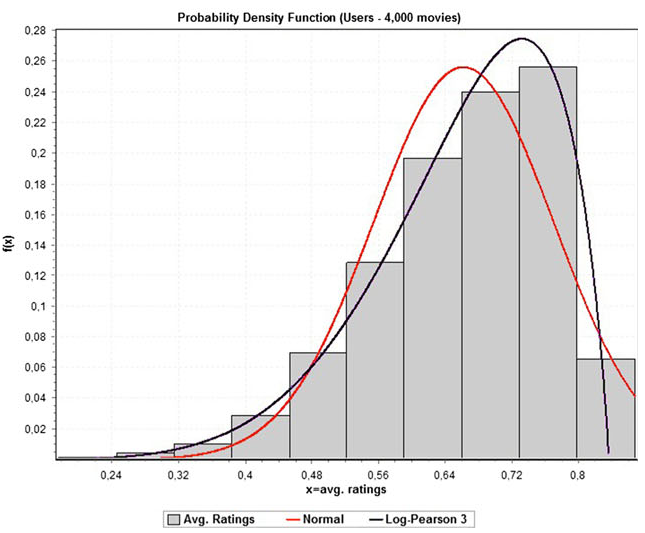 Above: User ratings (skewed/biased) vs. Critic ratings (closer to a normal distribution).
Methodology: The PWRM Framework
The authors propose a shift from Passive Numerical Evaluation to Active Pairwise Elicitation.
1. Matchmaking via Social Structure
Instead of waiting for ratings, the system proactive asks: "Which do you prefer: Movie A or Movie B?" To ensure the user can actually answer, the system uses the Social Structure (ss)—a function that identifies users who have interacted with both entities in the query.
2. The Heterogeneity Principle
Not all users are equal. To avoid "echo chambers," the system selects a heterogeneous group of users. It represents user profiles as n-dimensional vectors, calculates similarity using Tanimoto distance, and uses K-medoids clustering to pick representatives from diverse groups. This ensures the "global opinion" is captured without needing to query every single user.
3. Rank Centrality Aggregation
To turn these "A > B" wins into a global ranking, the paper employs a Markov Chain approach. Winning a match against a high-ranked entity grants more "reputation" than winning against a low-ranked one.
Note: The system uses a knock-out tournament structure to iteratively refine the ranking through sequential pairwise matches.
Experimental Proof: Robustness Against Bias
The most striking result of the study is how PWRM handles "noisy" users. The authors injected synthetic bias into real datasets (Flixster and HetRec-2011), creating cohorts of "optimists" (who always rate high) and "pessimists" (who always rate low).
- Numerical Systems: Their accuracy (Precision/Recall) tanked as biased users were added.
- PWRM: The performance remained almost constant. Because the comparison "A > B" remains true regardless of whether a user marks them as (5 vs 4) or (2 vs 1), the pairwise logic filters out the "scaling noise."
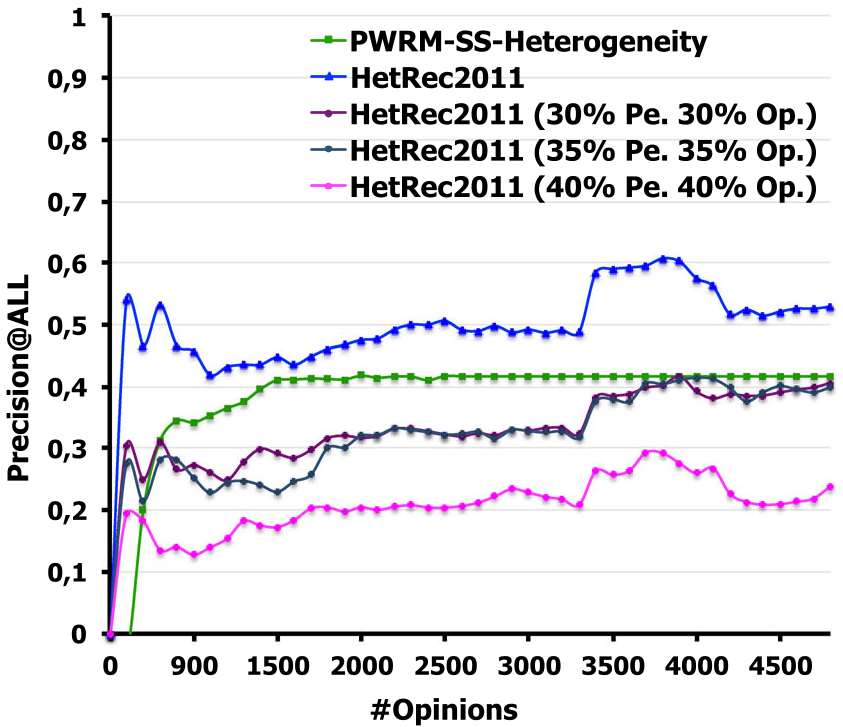 Experimental results showing PWRM maintaining precision even with significant biased user presence.
Critical Insight & Conclusion
The real value of this work lies in its proactive nature. Traditional reputation is reactive and prone to the "cold-start" problem (new items get no ratings). By actively querying users, PWRM can force-start the reputation building of new entities.
However, the authors acknowledge a hurdle: Incentives. While answering "A or B" is easier than assigning a star rating, users still need a reason to participate. Future work in this lineage likely involves merging these robust ranking mechanics with tokenomics or social incentives to maintain user engagement.
Takeaway: If you are building a platform where trust and quality are paramount, stop asking for 1-5 stars. Start asking for comparisons.