
[IEEE] Incentive-Based Coordinated Charging: Protecting the Grid via Thermal-Aware MPC
Incentive-based coordinated charging control of plug-in electric vehicles at the distribution-transformer level
The paper proposes a distributed, incentive-based coordinated charging control scheme for plug-in electric vehicles (PEVs) at the distribution-transformer level. It utilizes a Dual-Ascent method within a Model Predictive Control (MPC) framework to optimize charging schedules while strictly enforcing transformer thermal constraints.
TL;DR
Uncoordinated electric vehicle (EV) charging is a ticking time bomb for local distribution transformers. This paper introduces a decentralized control architecture that uses Model Predictive Control (MPC) and Dual-Ascent decomposition to translate transformer thermal limits into a dynamic "pseudo-price." This allows EVs to charge autonomously and optimally without melting the neighborhood’s transformer.
Background & Positioning
As PEV adoption grows, the "uncoordinated night charge" becomes a major threat to grid stability. Most existing research treats transformers as static boxes with fixed power ratings. This paper shifts the paradigm by focusing on transformer core temperature dynamics, essentially treating the grid's physical health as a first-class constraint in a distributed optimization problem. It sits at the intersection of Power Systems and Control Theory, moving away from utility-centric logic to a PEV-centric, incentive-based model.
Motivation: The Thermal Threat
The core problem isn't just "too much power"; it's "too much heat." Transformers have thermal inertia. A brief spike in power might be fine, but sustained overloading leads to insulation breakdown.
- Prior Work Flaw: Many decentralized models assume an infinite population of "price-takers." In a local cul-de-sac with 20-50 cars, one Tesla changing its charge rate does affect the local grid.
- The Solution Insight: We need a feedback loop where the transformer "talks back" to the cars via price increases whenever its temperature trend looks dangerous.
Methodology: Decentralized Coordination via Dual-Ascent
The authors model the system using two key dynamics:
- PEV Battery Model: A discrete-time state-of-charge (SOC) integrator.
- Transformer Thermal Model: A linearized discrete-time model based on heat capacity, coil resistance, and ambient temperature.
The Architecture
The beauty of this method is its Separability. All constraints (except the transformer temperature) are local to each car. By relaxing the temperature constraint into a Lagrangian multiplier (the pseudo-price ), the massive centralized problem breaks into small local optimizations.
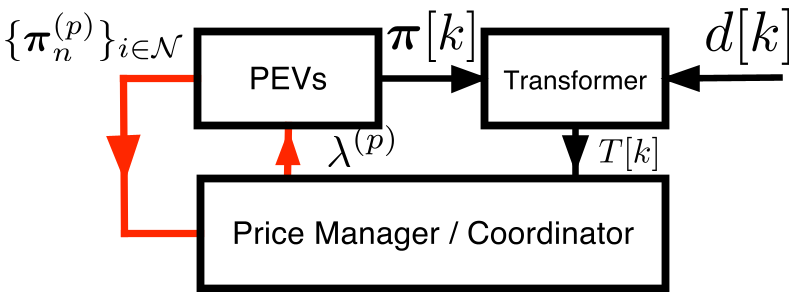
- The Coordinator: Monitors temperature and background load, then updates the price using a projected gradient step.
- The Vehicles: Receive the price and solve their own "cheapest path" to a full battery.
Experiments & Results
The authors simulated a heterogeneous fleet of 20 PEVs over a 12-hour hot summer night.
- Uncoordinated Charging: Total failure. The transformer temperature shot past the limit for over 3 hours, a scenario almost guaranteed to cause hardware damage.
- Coordinated Charging: The price signal successfully "valley-filled" the demand. When background load or initial charging pushed the temperature toward the 393K limit, the price spiked, nudging vehicles to delay their cycles until the transformer cooled or background demand dropped.
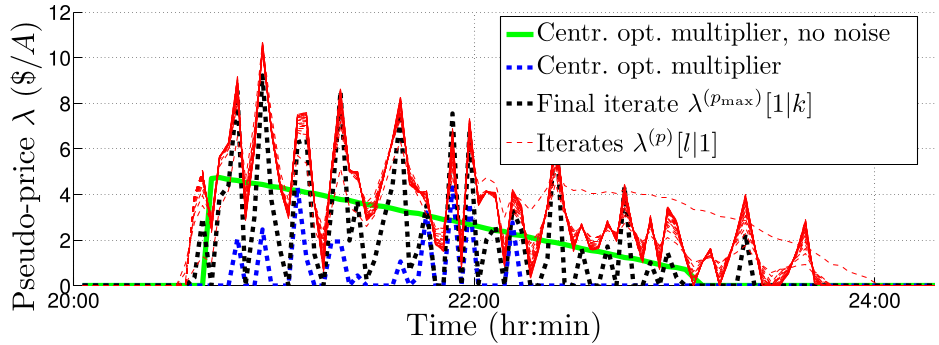 (a) Shows the temperature staying safely at or below the limit (solid vs. dashed line), while (c) shows the shifting of the current peaks.
Critical Insight & Limitations
This paper effectively bridges the gap between theoretical game theory and practical grid engineering. By using Receding Horizon Control, it introduces robustness against the "noise" of household appliances (background demand).
Limitations:
- Iterative Latency: The Dual-Ascent method requires multiple rounds of communication between the car and the grid for every time step. If the network is slow or the car's computer is weak, the sampling period (155s) might be too tight.
- Binary Incentives: It assumes car owners are perfectly "rational" and will follow the math-optimal price. Human behavior might be more erratic.
Conclusion
This study provides a roadmap for distribution utilities to avoid massive hardware upgrade costs. By implementing thermal-constrained MPC, we can squeeze more "juice" out of existing transformers while respecting the autonomy and privacy of EV owners. Future research into faster-converging algorithms like ADMM could make this ready for real-world deployment.