
Game Theory in the Social Wild: Taming Free-Riders and Attackers in P2P Streaming
12374_Incentive Cooperation Strategies for Peer-to-Peer Live Multimedia Streaming Social Networks.
The paper proposes a distributed game-theoretic framework to stimulate cooperation in P2P live multimedia streaming social networks. It introduces a "cheat-proof" and "attack-resistant" strategy that uses a credit-based mechanism and Gaussian-tail-based malicious detection to ensure system robustness against free-riders and malicious attackers.
Executive Summary
TL;DR: This paper tackles the fundamental conflict in P2P live streaming: everyone wants high-quality video, but nobody wants to pay the bandwidth cost of uploading. By modeling the system as a multimedia social network, the authors introduce a game-theoretic framework that makes cooperation the only rational choice. It effectively filters out "pollution" and "incomplete chunk" attacks using statistical detection, ensuring that the network remains robust even when half the participants are malicious.
Positioning: This work moves beyond simple "Tit-for-Tat" (BitTorrent style) by addressing the stringent timing constraints of live streaming and the heterogeneity of internet connections. It bridges the gap between theoretical game equilibrium and practical network protocol design.
The "Free-Rider" Dilemma
In a P2P social network, the system's scalability is its greatest strength—but its reliance on voluntary human dynamics is its greatest weakness. Prior works often assumed users were either perfectly honest or managed by a central billing authority. However, real-world users are strategic and rational:
- Free-Riding: Users download but don't upload.
- Cheating: Reporting false buffer maps to avoid being asked for data.
- Malice: Launching "Pollution Attacks" (sending corrupted data) or "Incomplete Chunk Attacks" (wasting a requester's time/quota).
Methodology: The Reciprocity Engine
The core of the paper is a Multiuser Attack-Resistant Strategy. It functions on two primary levels:
1. The Credit Line ()
Instead of requiring an exact 1:1 exchange in every round (which is impossible due to network jitter), each peer maintains a "Credit Line." Peer A will upload to Peer B only if the deficit ()—the difference between what A gave B and what B gave A—does not exceed a certain threshold.
2. Distinguishing Malice from Lag
One of the most elegant parts of this research is the Malicious User Detection. Since the Internet is inherently "lossy," a missing chunk isn't always an attack. The authors use a Bernoulli process leveled by the Central Limit Theorem to create a Gaussian boundary.
If the success rate of Peer B falls significantly below the expected probability , Peer A marks them as malicious and cuts them off.
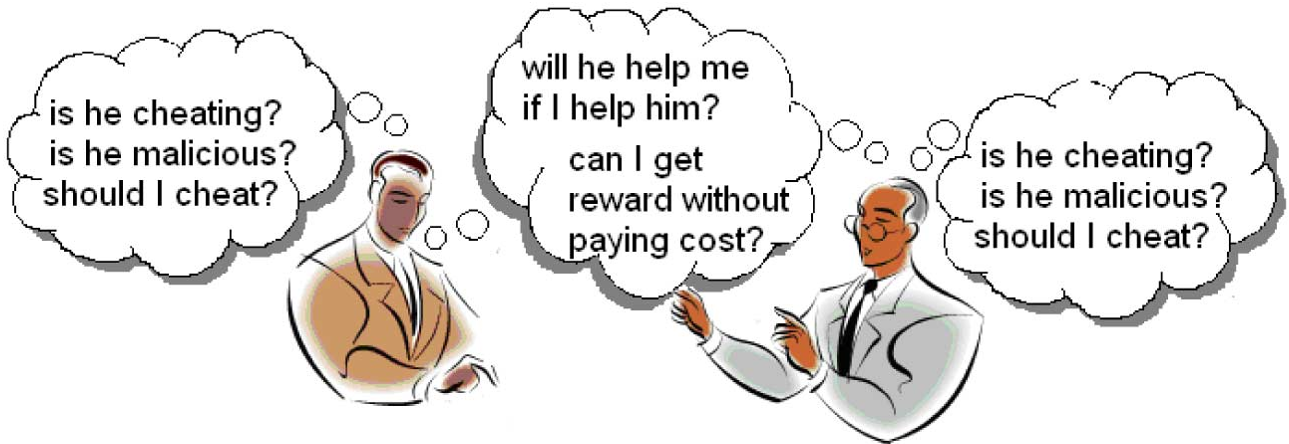 Figure: The Mesh-Pull architecture where peers exchange buffer maps and execute requests based on social incentives.
3. Handling Layered Video (SVC)
For Scalable Video Coding, where the base layer is mission-critical, the authors propose a weighted chunk-request algorithm. Peers prioritize chunks based on:
- Urgency: Distance to playback time.
- Decodability: Is the lower layer already present?
- Reliability: How likely is the supplier to actually deliver?
Experimental Proof: Robustness Under Fire
The authors simulated a network of 500 heterogeneous users (DSL and Cable). The results confirm the "sweet spot" for the credit line.
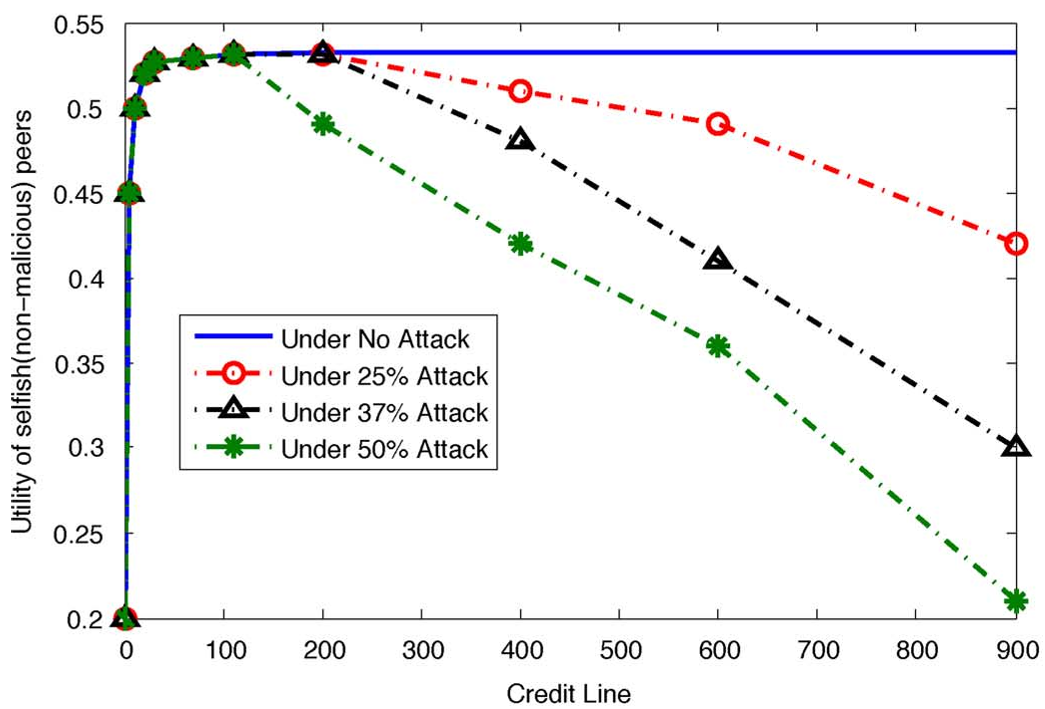 Figure: PSNR vs. Percentage of Attackers. Note how the "Attack-Resistant" strategy maintains stable video quality even as the network becomes increasingly hostile.
Key Findings:
- Saturating Cooperation: A credit line of ~50 chunks is sufficient to stimulate maximum cooperation.
- Anti-Free-Riding: Free-riders receive nearly zero utility because the "Reciprocity Engine" quickly identifies their lack of contribution and isolates them.
- Layered Efficiency: The SVC-aware request algorithm ensures that even in congested networks, the base layer (fluid video) is maintained.
Critical Insight & Conclusion
The genius of this framework lies in its asymptotic fairness. In an infinite game (or a long-duration live stream), the cost of helping others eventually averages out, making the "cost of cooperation" effectively zero for a well-behaved node, while the "cost of being malicious" leads to total exclusion.
Limitations: The model assumes users stay for a "reasonably long time." In highly transient networks (high churn), the statistical detection might trigger false positives before enough data is gathered.
Final Takeaway: By treating P2P nodes not just as endpoints, but as agents in a Social Network, we can design protocols that are self-healing. This paper provides a blueprint for distributed systems where trust isn't assumed—it is measured and earned.