
Monetizing the Social Ripple: Strategic Incentive Marketing via Multi-State Diffusion
Incentive Marketing Strategy under Multi-state Diffusion Model in Online Social Networks
This paper introduces an incentive marketing framework for Online Social Networks (OSNs) that utilizes a "Revised Multi-State Diffusion Model" (Revised-MSDM). It optimizes the trade-off between incentive costs and revenue gains by modeling user transitions through INACTIVE, AWARE, and ADOPT states.
TL;DR
The research proposes a strategic framework for maximizing revenue in Online Social Networks (OSNs) by moving beyond simple "seed selection." By introducing a Revised Multi-State Diffusion Model (Revised-MSDM), the authors quantify how financial rewards for social sharing influence the transition from being "Aware" of a product to "Adopting" it, uncovering an optimal "Sweet Spot" for marketing spend.
Problem & Motivation: Beyond the INFMAX Trap
Most academic work on viral marketing focuses on Influence Maximization (INFMAX)—the task of finding the most "popular" nodes to start a rumor. However, in the real world, "reach" does not equal "revenue."
The authors identify three critical gaps:
- Behavioral Neglect: Standard models (IC/LT) treat propagation as a binary state (Active/Inactive), ignoring the psychological gap between knowing a product exists and actually buying it.
- Static Pricing: Previous studies often ignored how rewards (discounts/cashback) can catalyze information spread.
- Influence Heterogeneity: Someone who has bought a product (ADOPT) usually has much higher persuasive power than someone who has just seen an ad (AWARE).
Methodology: The Revised Multi-State Diffusion Model
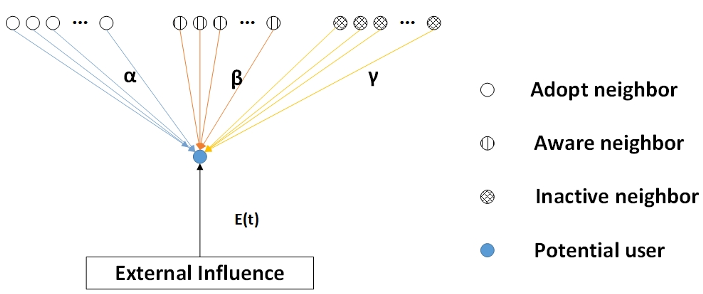
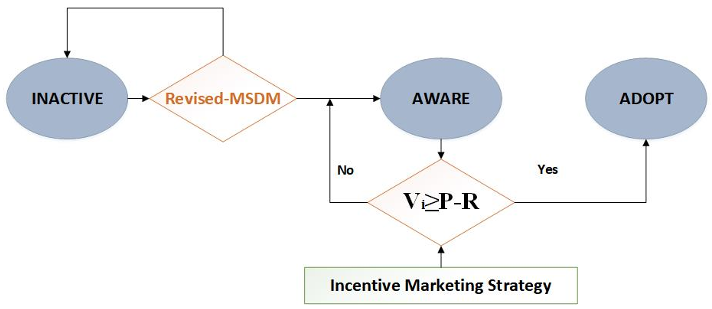
The core of this work lies in the Revised-MSDM, which maps the user journey through three distinct states:
- INACTIVE: The user is unaware of the product.
- AWARE: The user has received the invitation/ad but hasn't purchased.
- ADOPT: The user has purchased the product and is now a high-power influencer.
The Reward Mechanism
The framework introduces a reward for every new neighbor a user successfully activates. A user adopts the product if:
This creates a dynamic loop: Incentives increase the probability of adoption more users move to the ADOPT state these users exert higher influence the diffusion accelerates.
Experiments & Results
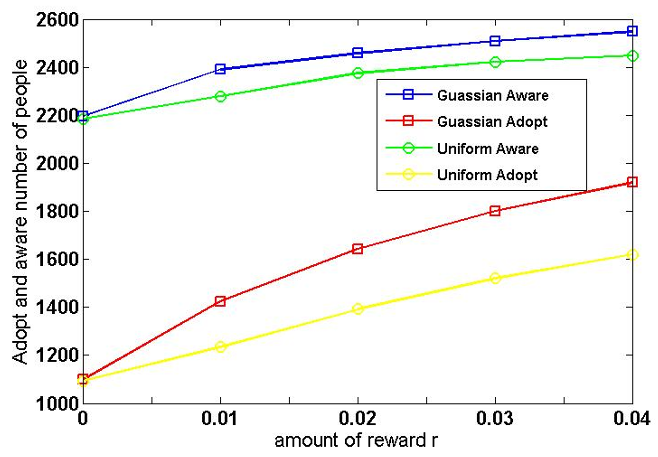
Using Facebook connectivity data, the authors tested the model against different reward factors ().
Key Insights:
- Diminishing Returns: As reward increases, the number of activated people increases, but the rate of growth slows down once the network reaches saturation.
- The Net Income Peak: The seller's net income does not grow linearly with . At , the net income is higher than the zero-reward baseline. However, if is too high (e.g., ), the cost of rewards outweighs the revenue from new buyers.
- Adopters are Catalysts: The simulation confirms that the presence of "Adopters" (those who actually bought the product) is the primary driver of rapid diffusion compared to mere "Aware" users.
Critical Analysis & Conclusion
Takeaway
The paper successfully shifts the focus from Influence (how many see) to Incentive Efficiency (how many buy per dollar spent). It provides a mathematical basis for "Referral Marketing" programs common in apps like Uber or Dropbox.
Limitations & Future Work
- Monopoly Assumption: The model assumes a single seller. In reality, multiple products compete for the same "social attention budget."
- Linear Valuation: The valuation function is relatively simple. Future iterations could benefit from integrating Deep Learning to predict (intrinsic value) based on user metadata.
- Fixed Budget: The authors suggest future work should focus on optimizing a fixed marketing budget across various channels (social links vs. traditional ads).
By quantifying the transition between awareness and adoption, this framework offers a robust blueprint for brands to engineer virality rather than just hoping for it.