
Tackling Moral Hazard in Crowdsourcing: A Multi-Tier Contract Theory Approach
Incentive Mechanism in Crowdsourcing with Moral Hazard
This paper proposes a performance-based incentive mechanism for mobile crowdsourcing to address the "Moral Hazard" problem. By leveraging contract theory, it designs a linear compensation package comprising a fixed salary, a short-term bonus based on data quality, and a long-term bonus derived from service benefits to maximize the principal's utility while ensuring continuous user participation.
TL;DR
To build a successful location-based service like Google Maps, platforms need a steady stream of user data. However, users often "shirk" (Moral Hazard) because their effort is invisible and costly. This paper introduces a performance-related compensation package using contract theory, combining fixed pay with short-term data quality rewards and long-term service benefits to ensure users remain motivated and the platform stays profitable.
Background: The Hidden Effort Problem
In mobile crowdsourcing, a principal (the platform) relies on agents (users) to collect data (e.g., traffic conditions). The "Moral Hazard" arises because the platform cannot directly observe how much effort a user puts in—they only see the resulting data quality, which is often "noisy" due to transmission interference or environmental factors. If the incentive is just a flat fee, users will naturally minimize their effort to save battery and protect privacy while still collecting the payment.
Problem & Motivation: Why Fixed Rewards Fail
Previous works, such as the Karma system, offered fixed rewards for joining. The authors argue this lacks continuous incentive. Once the reward is pocketed, the motivation to provide high-quality, real-time data vanishes. The challenge is: How do we design a reward system that forces the user's optimal choice of effort to align with the platform's goal of maximizing data quality?
Methodology: The Three-Pillar Compensation Package
The researchers derive a linear contract , where:
- (Fixed Salary): Guarantees a baseline to satisfy the user's risk-aversion.
- (Short-term Bonus): Tied to the immediate quality of data () provided by the user.
- (Long-term Bonus): Tied to the quality of the overall service (). This is a clever addition: it aligns the user's interests with the long-term success of the app they are helping to build.
The Mathematical Intuition
The paper assumes users have CARA (Constant Absolute Risk Averse) preferences. This means users dislike uncertainty. If the data quality is very "noisy" (high variance), the platform must shift the reward weight toward the fixed salary to keep the user engaged.
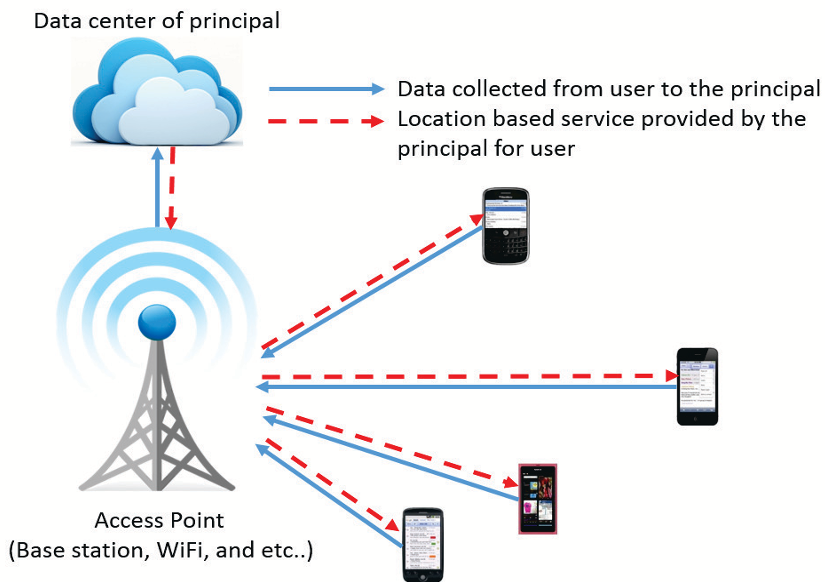 Fig 1: The Crowdsourcing Loop—Data flows from users to the principal, and services/incentives flow back.
Experiments & Results
Through simulations, the authors analyzed how parameters like risk aversion () and cost of effort () affect the system.
Key findings include:
- Risk Management: As the data quality becomes more volatile (higher standard deviation ), the platform strategically reduces the performance-based bonus () and increases the fixed salary () to maintain the user's "Individual Rationality."
- The Superiority of Multi-Bonus: Comparison with a "Single Bonus" model (no long-term reward) shows that including the service-related bonus () significantly boosts the principal's utility.
- The Trap of Opening Rewards: While "Opening Rewards" (fixed sign-up bonus) look good on paper for the principal's short-term utility, they fail to provide the continuous incentives necessary for live services.
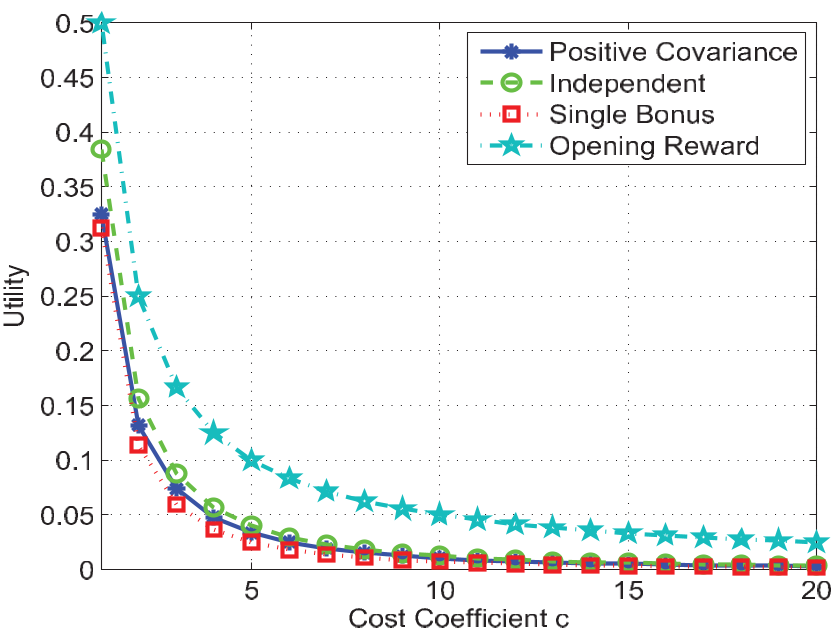 Fig 2: Principal's utility decreases as the user's cost coefficient increases, but the proposed multi-tier mechanism maintains a robust middle ground.
Critical Analysis & Conclusion
Takeaway
The study proves that Contract Theory is a powerful framework for mobile sensing. By treating users like "employees" with a mixed compensation package (salary + bonus + equity-like service benefits), platforms can solve the Moral Hazard problem.
Limitations & Future Work
- User Heterogeneity: The model assumes a somewhat "standard" user. In reality, different users have wildly different privacy costs and risk tolerances.
- Linearity Assumption: The authors used a linear contract for simplicity. Future research could explore non-linear contracts that might capture edge-case behaviors more effectively.
- Dynamic Environments: The current model is somewhat static; moving toward a dynamic contract that evolves as the service matures would be the next logical step.
This paper provides a solid economic foundation for anyone designing a reward system for data-driven platforms, emphasizing that long-term participation is earned through shared success, not just one-time payments.