
Engineering Influence: How Network Effects Redefine Crowdsourcing Incentives
An Incentive Mechanism for Crowdsourcing Systems with Network Effects
The paper proposes a novel incentive framework for crowdsourcing systems that integrates Network Effects as a source of intrinsic rewards. It develops optimal Fixed and Flexible Extrinsic Reward mechanisms to maximize crowdsourcer utility while accounting for both homogeneous and heterogeneous user participation dynamics.
Executive Summary
TL;DR: This research shifts the paradigm of crowdsourcing incentives from "paying for tasks" to "subsidizing participation dynamics." By integrating Network Effects—the intrinsic value users gain from a larger community—into the reward equation, the authors demonstrate that platforms like Uber or Waze can significantly reduce monetary payouts while increasing total contribution and user satisfaction.
Academic Positioning: This work bridges the gap between Network Economics and Mechanism Design, moving beyond traditional static Stackelberg games to account for the social value of scale.
The "Invisible" Reward: Why Traditional Payouts Fail
Most crowdsourcing research treats users as isolated agents motivated purely by money. However, real-world platforms like ResearchKit or Waze prove otherwise; thousands contribute for free because of a sense of "intrinsic reward" or the value derived from others' data.
The authors identify a critical oversight: Network effects are not constant. They evolve. As more users join, the intrinsic benefit grows, yet platforms traditionally pay a flat fee (Extrinsic Reward). This leads to an "Incentive Overkill" where the platform pays for value that the network is already providing for free.
Methodology: The Interaction of Two Reward Types
The paper introduces a framework where total user utility () is the sum of:
- Intrinsic Rewards: Benefiting from one's own effort and the collective size of the network ().
- Extrinsic Rewards: Monetary compensation ().
- Net Cost: The actual effort cost minus personal value-add.
1. Homogeneous vs. Heterogeneous Effects
The authors first tackle cases where everyone feels the same "community vibe" (Homogeneous). They then move to a complex Heterogeneous model where a user's social position determines their value.
2. The Logic of Subsidization
In the heterogeneous social graph, the crowdsourcer acts as a central optimizer. The mathematical core involves the Social Relationship Matrix (). The insight here is profound: The crowdsourcer should pay more to "influencers" (those with high impact on others) even if their individual costs are low.
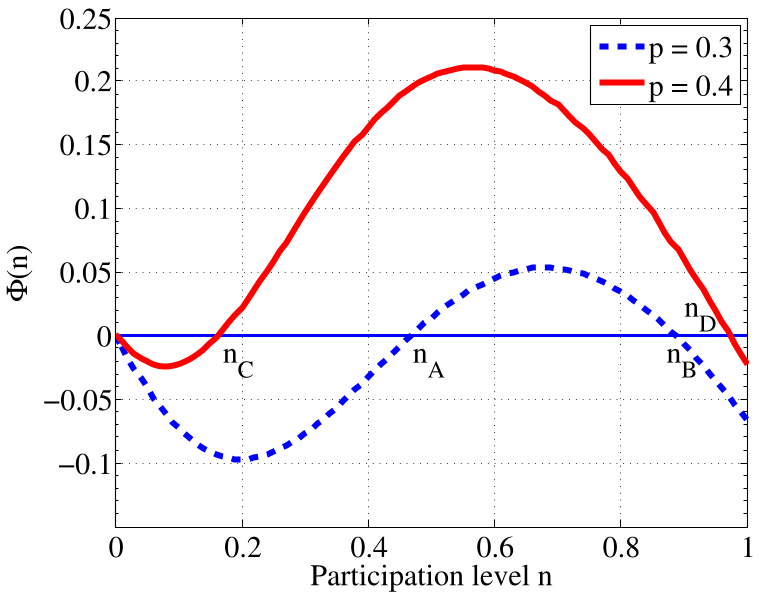 Figure 1: Stability Analysis. The paper defines stable vs. unstable equilibrium points (, ) where the participation level naturally settles based on the reward structure.
Key Results: The Flexible Win-Win
The study compares Fixed Rewards (everyone gets ) vs. Flexible Rewards (payment based on effort ).
- Efficiency: The flexible mechanism is vastly superior. It enables the crowdsourcer to "differentiate" payments.
- Utility Boost: As shown in the simulations, the crowdsourcer’s utility rises as network effects () strengthen.
- Real-world Validation: This mirrors Elon Musk’s early strategy with PayPal, where sign-up bonuses were high initially to kickstart the network effect and phased out as the network became self-valuable.
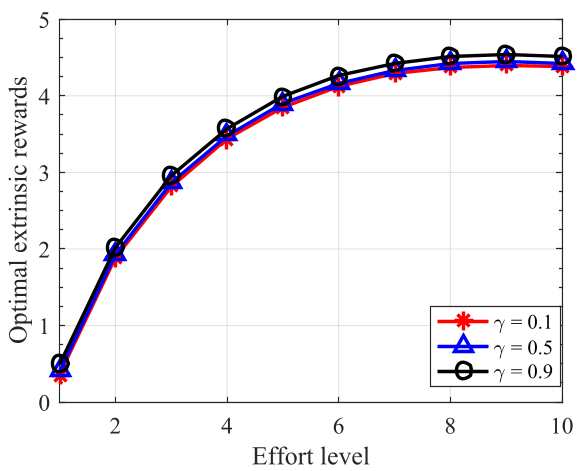 Figure 2: Comparing Fixed vs. Flexible Mechanisms. Notice how flexible rewards (right) drive significantly higher contribution levels and crowdsourcer utility.
Critical Insight & Future Outlook
Ablation of Cost: One of the most interesting findings is that in symmetric social networks, the optimal extrinsic reward becomes independent of the network effect itself—the "subsidy" and "cutting" effects cancel each other out.
Limitations: The model assumes the crowdsourcer knows the social graph () and cost parameters. In practice, this requires significant data mining or "Truthful Mechanism Design" where users are incentivized to reveal their true costs.
Conclusion: This paper is a call to action for platform architects to stop viewing users as mere "workers" and start seeing them as "network nodes." The highest-performing platforms of the future will be those that master the art of incentivizing the right people to influence the rest.