
Game Theory in the Wild: Incentivizing Crowdsourced Relays for LTE-A HetNets
Incentive mechanism design for crowdsourcing-based cooperative transmission
This paper proposes an incentive mechanism for crowdsourcing-based cooperative transmission in LTE-Advanced HetNets. It utilizes a Stackelberg Game where the Donor evolved nodeB (DeNB) acts as the leader offering rewards, and third-party Relay Nodes (RNs) act as followers adjusting transmission power to reach a unique Nash Equilibrium.
TL;DR
To solve the high cost of deploying Heterogeneous Networks (HetNets), this paper introduces a crowdsourcing paradigm. By treating third-party Relay Nodes (RNs) as rational players in a Stackelberg Game, the authors demonstrate an incentive mechanism where the base station (DeNB) maximizes throughput through rewards while RNs optimize their own profit through strategic power allocation.
Problem & Motivation: The "Selfish" Node Dilemma
In the evolution toward LTE-Advanced and beyond, Heterogeneous Networks (HetNets) are essential for coverage. However, the traditional "Operator-Buy-All" model is becoming economically unsustainable due to high CAPEX and OPEX.
The solution seems simple: Crowdsourcing. Why not use compact, third-party-owned relays? The catch is that these nodes are "selfish." Unlike operator-owned equipment, a third-party RN won't consume its battery or bandwidth for free. Existing literature often assumes nodes are unconditionally cooperative—a naive assumption in a real-world market. The authors identify a critical need for a mechanism that balances the DeNB's throughput goals with the RNs' profit motives.
Methodology: The Two-Stage Stackelberg Game
The paper models the network as a hierarchical game. The interaction is split into two logical stages:
1. The Leader's Move (DeNB)
The Donor evolved nodeB (DeNB) acts as the Leader. It announces a reward () for the transmission task. Its utility function is defined by the profit earned from increased spectrum efficiency minus the payout to RNs.
2. The Followers' Response (RNs)
The RNs are the Followers. They compete with one another in a Non-Cooperative Game to grab a portion of that reward. They must decide their transmission power () to maximize their utility (Reward - Cost) while meeting strict SNR constraints.
 Table 1: Simulation Parameters used to validate the Game Equilibrium.
The authors provide a rigorous proof for the existence and uniqueness of the Nash Equilibrium (NE) in the power determination game, ensuring that the DeNB can predictably calculate how RNs will behave for any given reward.
Experiments & Results: Win-Win Scenarios
The effectiveness of the mechanism was tested across two transmission modes: Amplify-and-Forward (AF) and Decode-and-Forward (DF).
- Coverage Expansion: The incentive mechanism consistently outperformed direct transmission (no relays) once the User Equipment (UE) moved beyond a certain distance (~200m).
- Optimality Verification: The "Reward vs. Utility" curves show a clear peak, confirming that the proposed algorithm finds the mathematical "Sweet Spot"—the exact reward that maximizes the operator's profit while keeping relays engaged.
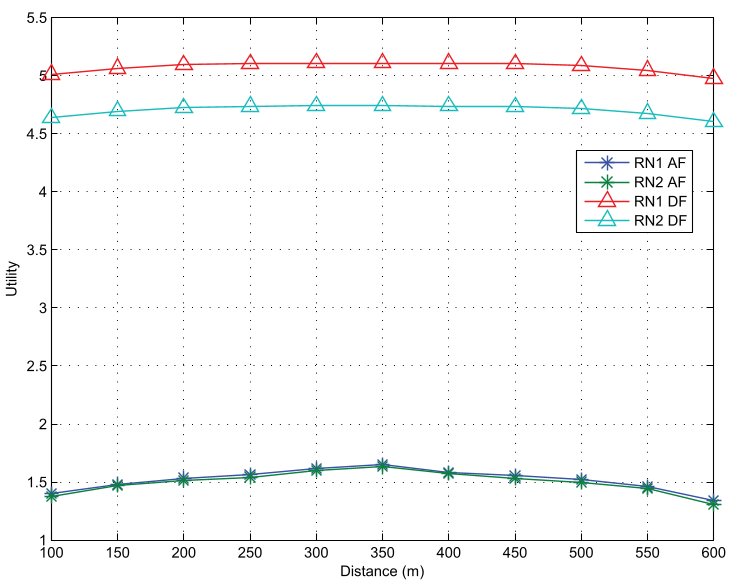 Fig 3: Comparison of RN utilities in AF vs. DF modes. DF generally offers higher utility for RNs under the same conditions.
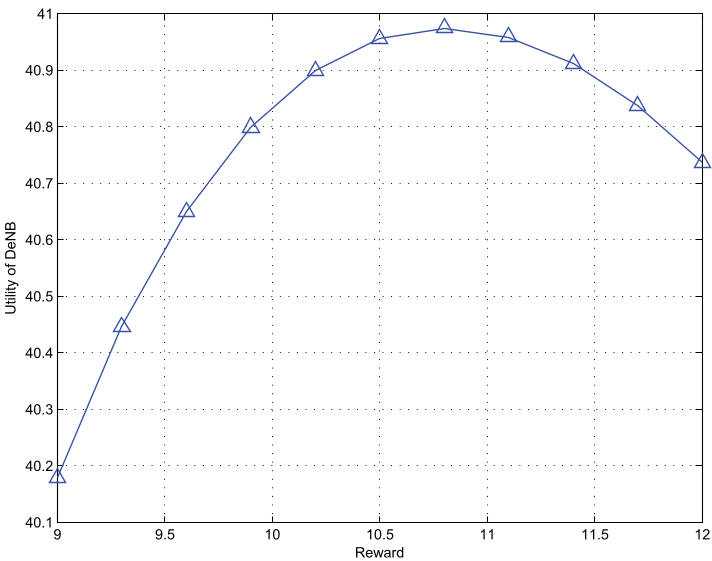 Fig 6: Validation showing that the calculated optimal reward (approx. 107) yields the highest utility for the DeNB.
Critical Insight & Conclusion
The core takeaway is that cooperation is a trade-off. By using the Stackelberg framework, the authors shift the problem from a "command-and-control" engineering challenge to a "market-design" economic challenge.
Limitations: The current model assumes a relatively static environment with fixed RN positions and known channel state information (CSI). In highly mobile 5G/6G scenarios, the overhead of constant reward renegotiation might become a bottleneck.
Future Work: The authors aim to expand this into multi-hop cooperative systems, where relays might also act as "sub-leaders" to further distant nodes, creating a tiered incentive hierarchy.