
Balancing Accuracy and Privacy: Next-Generation Incentives for Indoor Localization
Incentive Mechanism Design for Crowdsourcing-Based Indoor Localization
This paper presents two novel incentive mechanisms for crowdsourcing-based indoor localization, integrating differential privacy to protect mobile users' (MUs) trajectory data. The mechanisms utilize Stackelberg game theory and demand functions to balance the profits of the crowdsourcing platform (CP) with the privacy costs of users, achieving superior performance compared to traditional platform-centric models.
TL;DR
Building radio maps for indoor localization is a massive task. Crowdsourcing solves the labor problem but creates a privacy nightmare. This paper proposes two game-theoretic incentive mechanisms that use Differential Privacy to protect user trajectories while offering rewards that maximize platform profit and user participation.
The Motivation: Why Privacy Stops Crowdsourcing
Indoor localization (Wi-Fi fingerprinting) is essential for malls, airports, and stations. While researchers have moved toward Mobile Crowdsourcing (MCS) to build these maps, users hesitate for two reasons:
- Resource Drain: Sensing RSSI and barometer data consumes battery and compute.
- Privacy Risks: An activity trace can reveal which shops you visited, your habits, or even your identity through de-anonymization.
Existing models often treat privacy as a binary "on/off" switch. This paper treats it as a quantifiable cost in an economic game.
Methodology: The Three-Way Tug-of-War
The authors define a delicate ecosystem involving the Crowdsourcing Platform (CP), Mobile Users (MUs), and Service Customers (SCs).
1. Quantifying the "Cost" of Privacy
The paper utilizes -Differential Privacy. A lower means more noise is added to the trajectory, providing stronger privacy but lower utility for the platform. They propose a unique utility function: This ensures that utility is proportional to the trajectory length and the privacy budget .
2. Mechanism A: Fixed Reward (Incomplete Information)
In reality, a platform doesn't know how much a user values their privacy.
- The Game: A two-stage Stackelberg game where the CP (Leader) sets a global reward , and MUs (Followers) decide their trajectory length to contribute.
- The Key: Even without knowing individual privacy preferences, the platform leverages the probability distribution of user types to reach a Nash Equilibrium.
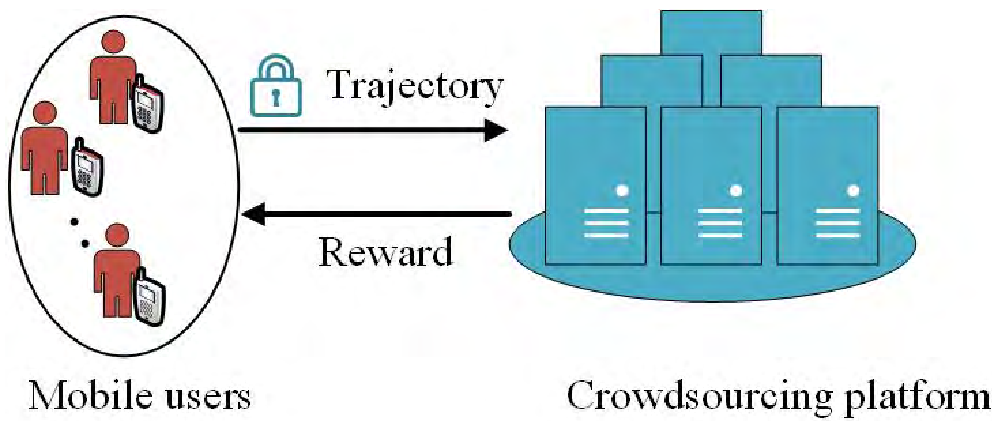
3. Mechanism B: Variable Reward (Complete Information)
If the CP knows the user's privacy sensitivity, it can offer a "price menu." This model introduces a Demand Function to account for Service Customers:
- Higher buying prices attract more users (higher quality).
- Higher service prices decrease demand from customers. The goal is to find the "sweet spot" using concave optimization.
Experimental Insights
The simulations yield a critical finding: Privacy protection doesn't have to hurt the bottom line.
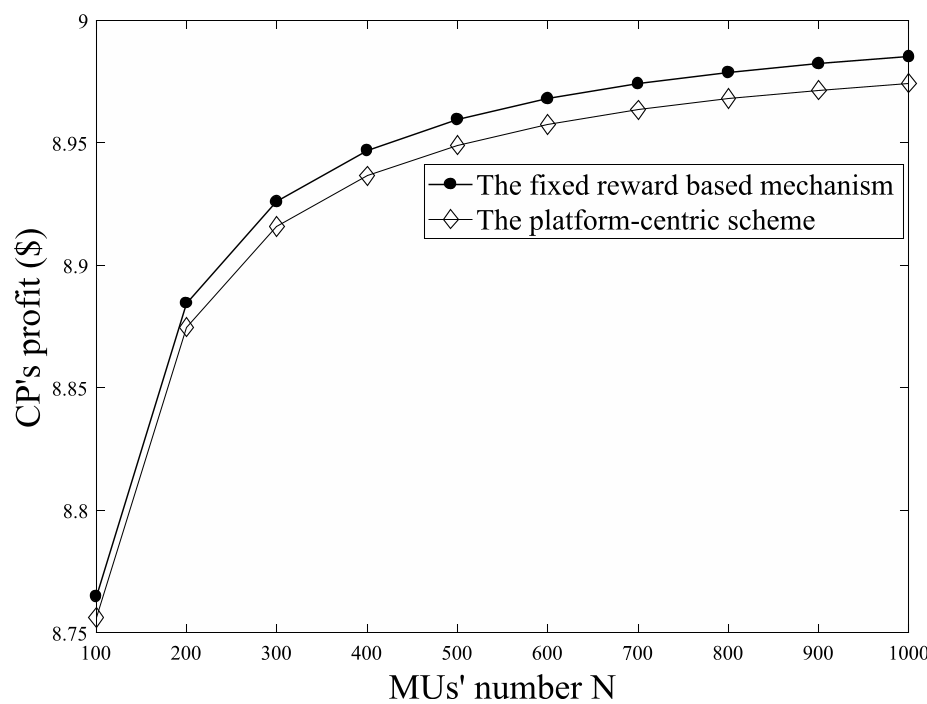
As shown in the Results, the proposed mechanism maintains a higher profit margin for the platform compared to traditional "Platform-Centric" models that ignore privacy. By accounting for the user's privacy cost, the platform can more effectively calibrate rewards to maintain high participation rates even as user numbers scale to 1,000+.
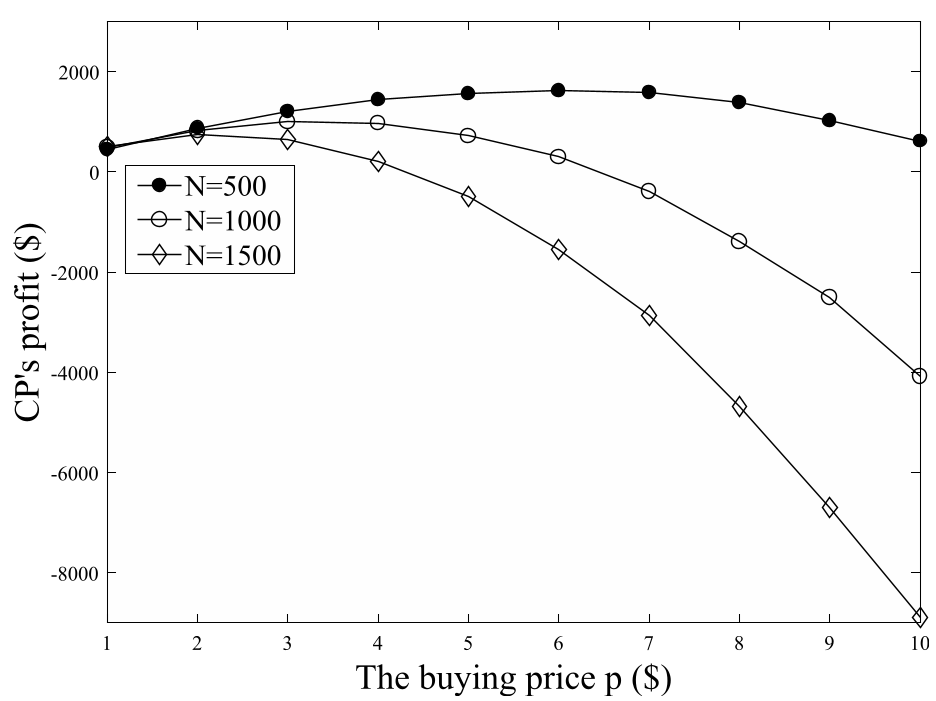
The search for the optimal reward () shows that as user sensitivity to privacy loss increases, the platform must adjust its incentive strategy to prevent a mass exodus of data contributors.
Critical Analysis & Conclusion
The core contribution of this work is the marriage of Differential Privacy with Game Theory in the specific context of indoor trajectories.
- Strengths: It moves beyond generic sensing tasks and addresses "U-Turn" faking by using peak detection algorithms for trajectory verification.
- Limitations: The model assumes a trusted CP in the variable reward scenario, which may not hold in decentralised environments.
- Future Work: The logical next step is exploring Local Differential Privacy (LDP), where noise is added on the device before the platform even sees the data, removing the need for a "Trusted" central entity.
This paper provides a robust blueprint for developers of indoor LBS to build sustainable, privacy-preserving ecosystems that users can actually trust.