
The Power of Autonomy: Reimagining Incentives for Heterogeneous Crowdsourcing
Incentive Mechanism Design for Heterogeneous Crowdsourcing Using All-Pay Contests
This paper introduces an optimal incentive mechanism (OPT) for heterogeneous crowdsourcing based on an asymmetric all-pay contest model. By utilizing a "prize tuple"—an array of reward functions tailored to each potential winner—the authors achieve a unique Bayes-Nash equilibrium that maximizes the crowdsourcer's profit in an incomplete-information setting.
TL;DR
In the world of mobile crowdsensing (e.g., Waze, Creek Watch), not all contributors are equal—some have better sensors, others have lower costs. This paper presents an asymmetric all-pay contest model that uses a dynamic prize tuple to maximize platform profit. The breakthrough is a property called Strategy Autonomy (SA), which simplifies the complex "guessing game" of workers, leading to massive profit gains and perfect system scalability.
The Problem: The "Effort Reservation" Trap
Traditional crowdsourcing usually offers a fixed reward (e.g., "$10 for the best data report"). In a heterogeneous world, this creates a strategic mess:
- Strategic Shielding: If a "strong" worker knows their competitors are "weak," they will exert only the minimum effort needed to win, rather than their best effort.
- Belief Complexity: To decide how much effort to put in, a worker must have complex probabilistic beliefs about everyone else's ability—a massive computational burden for a mobile device.
- Diminishing Returns: As more workers join, the revenue for the platform usually plateaus because individuals start competing for the same slice of the pie.
The Solution: The OPT Mechanism and Prize Tuples
The authors move away from fixed rewards. Instead of a single prize , they introduce a prize tuple . Here, the reward for winning is a function of the effort you actually exerted.
Architecture of the All-Pay Contest
In an "all-pay" setting, every participant "pays" by exerting effort (battery life, time, data), but only the winner gets the prize. This mirrors real-world crowdsourcing where you've already spent the effort by the time the "winner" is announced.
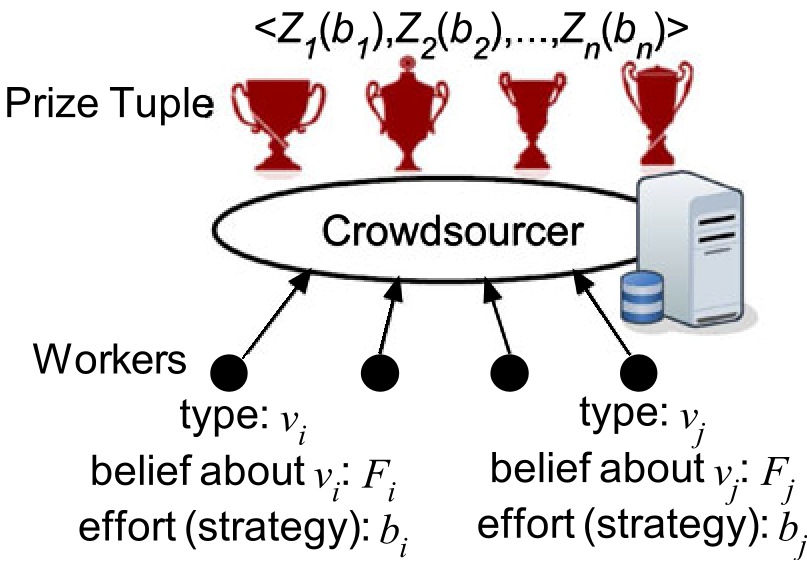 The interaction between the Principal (Crowdsourcer) and Heterogeneous Agents.
Counter-Intuitive Breakthrough: Strategy Autonomy (SA)
The most striking discovery is Strategy Autonomy. Specifically, the authors proved that under their OPT mechanism, a heterogeneous worker’s best strategy is independent of who they are competing against.
"An asymmetric auction admits a symmetric equilibrium."
Why does this work? The principal "endogenizes" the asymmetry. By setting the prizes correctly, the platform takes on the burden of balancing the competition. The workers no longer need to worry if they are competing against a pro or a novice; they simply optimize based on the platform's offered prize function.
Experimental Results: Scaling Without Limits
The OPT mechanism was tested against six other baselines (Symmetric and Fixed-prize auctions).
1. Profit Explosion
The OPT mechanism consistently outperformed fixed-prize auctions, especially as the principal's valuation of the task increased. In some scenarios, it provided profit where standard auctions resulted in a deficit.
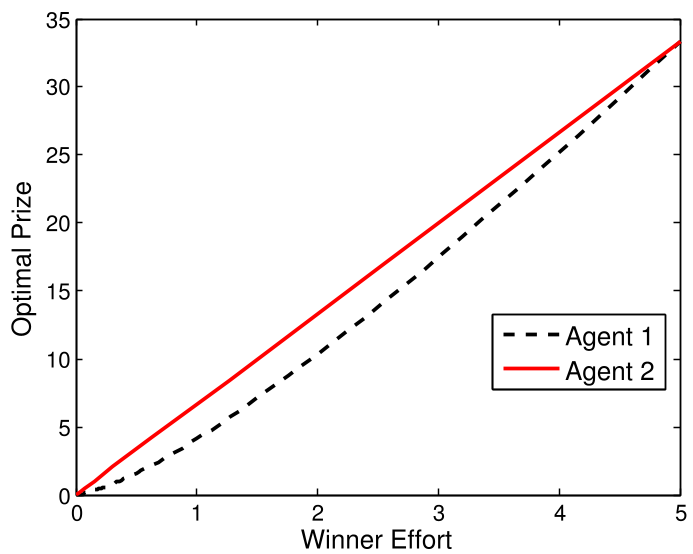 Comparative bidding strategies: Notice how agents in OPT exert significantly higher effort.
2. Neutralizing the Law of Diminishing Returns
In standard auctions (FIX-n), adding more workers eventually leads to a plateau in profit (Concave growth). However, because of SA, the OPT mechanism exhibits linear profit growth. The competition is so efficiently managed that every new worker adds a constant marginal value to the platform.
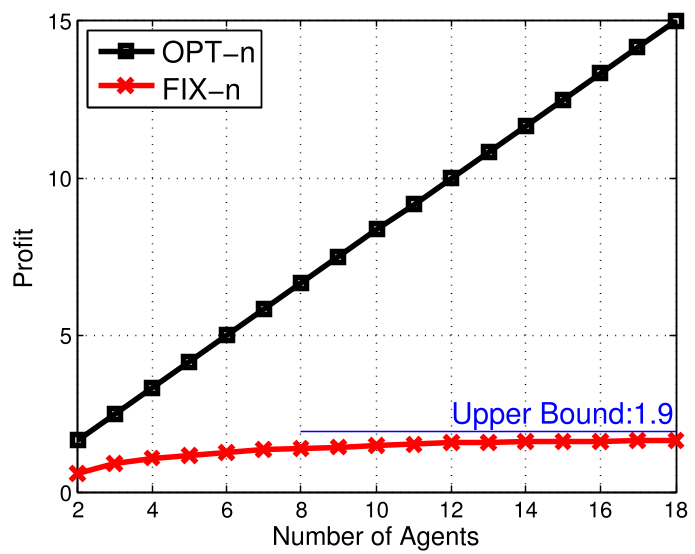 System Scalability: OPT-n (Linear) vs FIX-n (Concave/Saturating).
Critical Insight & Conclusion
This paper shifts the paradigm of crowdsourcing from "finding the right price" to "designing the right prize function."
- Value-First: By focusing on stronger agents (who matter more for total revenue) and incentivizing weaker agents to "threaten" the stronger ones, the mechanism maintains high competitive fire.
- Practicality: SA reduces the local computation for worker devices from to , which is critical for battery-constrained iPhones or IoT sensors.
- Limitation: One potential challenge is the "all-pay" nature itself—in some cultures, workers might be discouraged if they put in effort and get nothing back consistently. Future work on "multiple winners" could mitigate this risk.
Ultimately, this work provides a robust mathematical foundation for building global-scale sensing networks that are both profitable for the operator and simple for the participant.