
Socially-Aware D2D Caching: Balancing Incentives and Interference
An Incentive Mechanism Integrating Joint Power, Channel and Link Management for Social-Aware D2D Content Sharing and Proactive Caching
This paper presents a comprehensive incentive mechanism and resource management framework for social-aware Device-to-Device (D2D) content sharing and proactive caching in cellular networks. The core method utilizes a "Basis Transformation" optimization approach paired with a specialized reward scheme, successfully achieving significant improvements in social welfare and network capacity while ensuring incentive compatibility.
TL;DR
As cellular networks strain under the weight of social media traffic, this paper proposes a breakthrough framework that combines Proactive Caching with D2D Communications. By treating users not just as nodes, but as intelligent stakeholders with social influence, the authors develop a joint optimization method (Basis Transformation) and a truthful reward scheme that maximizes network efficiency while keeping "selfish" users incentivized to share.
Problem & Motivation: The Selfish Node Dilemma
Why is D2D offloading so difficult in the real world? It isn't just about signal-to-interference ratios; it's about human behavior.
- Selfishness: UEs (phones) consume battery and storage to share content. Without rewards, they won't participate.
- Information Asymmetry: Users might lie about their "power cost" to trick the Base Station (BS) into giving them higher rewards.
- Coupling: If you decide to cache a popular video (Proactive Caching), it changes who you can share with (Link Scheduling), which in turn changes the interference on the network (Power & Channel Allocation).
Most prior works treat these as separate problems. This paper argues they must be solved in a unified welfare-maximization framework.
Methodology: The Core Architecture
The authors propose a system where the BS acts as a central coordinator but respects the private costs of the UEs.
1. Joint Resource Management
The problem is NP-hard. To solve it, the authors introduce the Basis Transformation Method. Unlike a standard Simplex algorithm, this approach includes:
- Column Tests: Checking if a new power/link configuration improves welfare.
- Row Tests: Since changing a channel changes the underlying SINR constraints (the rows of our optimization matrix), the authors develop a dual-problem check to see if changing the "basis" (the set of active links) is theoretically sound.
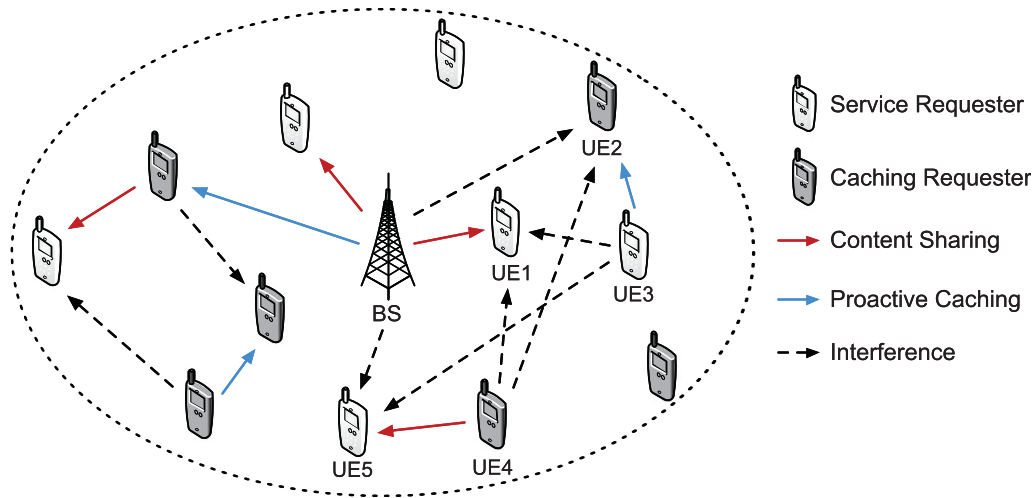
2. The Incentive Scheme (The Pricing Rule)
To ensure Incentive Compatibility (IC), the BS uses a "Blockage" principle for rewards. Essentially, a UE is rewarded based on the "alternatives" it blocks. If a UE is the most efficient choice, it is paid enough to cover its costs and keep it honest, but not so much that it drains the BS's utility.
Experimental Insights
The proposed mechanism was tested against "Random Proactive Caching" (RC) and "No Caching" (NC) benchmarks.
- Social Welfare: The proposed method showed a clear lead, especially when channel resources were scarce. As the spectrum becomes crowded, the "intelligence" of the link scheduling prevents the network from collapsing under interference.
- D2D Capacity: By using social influence (who travels where and who has the most "followers"), the system seeds content into the network before it's even requested, dramatically increasing the D2D success rate.
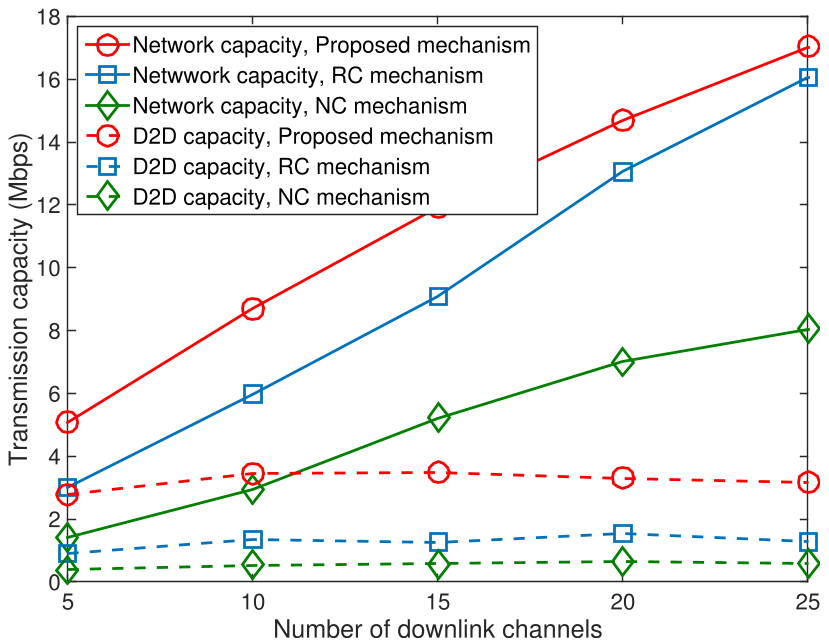 Fig: Our proposed mechanism maintains high social welfare even as the number of available channels fluctuates, outperforming standard coloring-based algorithms.
Critical Analysis & Conclusion
Takeaway
The genius of this work lies in the dual optimization. It doesn't just solve the math of interference; it solves the game theory of human participation. By using social metrics (Zipf distribution for popularity and mobility impact for UEs), the BS can "proactively" manage traffic rather than just "reactively" assigning channels.
Limitations
- CSI Overhead: The model assumes the BS has full Channel State Information. In high-mobility social scenarios, the delay in reporting CSI might degrade the precision of the power control.
- Complexity: While the Basis Transformation is polynomial-time, it still scales with , which might be taxing for real-time Millisecond-level scheduling in very dense 5G cells.
Future Work
This framework lays the groundwork for Mobile Edge Computing (MEC). If we can cache content socially, can we also "cache" computation tasks? The integration of social-aware D2D with task offloading is the next logical frontier.