
Designing Robust Incentives for Crowdsourcing: The Power of Bundling and Strategic Simplicity
Incentive Mechanism and Rating System Design for Crowdsourcing Systems: Analysis, Tradeoffs and Inference
This paper proposes a unified incentive mechanism and rating system for macrotasking crowdsourcing platforms (e.g., Elance, Fiverr). The methodology combines a "task bundling scheme" with a "winner-takes-all" reward allocation based on requesters' ratings to ensure workers are incentivized to provide maximum effort despite human biases. The authors demonstrate that their approach achieves over 99.95% of theoretical maximum system efficiency on real-world Elance data while maintaining minimal service delays.
TL;DR
In the world of high-stakes crowdsourcing (Macrotasking), human bias often ruins reward systems. This paper introduces a Task Bundling Scheme combined with a Rating System that enforces a Nash Equilibrium where workers always choose high effort. By analyzing real-world Elance data, the authors prove that even with biased requesters, a simple binary rating system and small bundles (n=2 or 3) achieve nearly 100% system efficiency.
Background: The Subjectivity Trap
Unlike microtasking (e.g., labeling an image as "dog" or "cat"), macrotasking involves complex deliverables like software development. Here, the requester's assessment is king. However, humans are notoriously inconsistent—some are "hard graders" while others are "easy." This creates erroneous ratings, which decouple effort from income, eventually leading to a workforce of "free-riders" who do the bare minimum.
Methodology: Game Theory Meets Human Bias
The core of the paper lies in reimagining the crowdsourcing transaction as an n-player game.
1. The Bundling Mechanism
Instead of paying for one task in isolation, the system bundles tasks together (). The administrator adopts a "Winner Takes All" approach: the worker with the highest rating in that bundle takes the collective reward. If there is a tie, rewards are split. This creates a competitive pressure that mathematically moves the "critical reward value" needed to maintain high effort downward.
2. Modeling the "Confusion Matrix"
The authors acknowledge that requesters make mistakes. They represent this using a Confusion Matrix (), where is the probability that a solution of true quality is rated as quality .
 Fig 1: Mathematical formulation of the rating process under threshold constraints.
3. Threshold-Based Rating Systems
Does more granularity help? The authors look at systems with rating points. They discover a profound tradeoff:
- More points = Lower critical reward (better for system efficiency).
- Fewer points = Lower cognitive load and fewer "rating errors."
Experiments: Real-World Evidence from Elance
Using a crawled dataset of over 156,000 transactions, the authors inferred the actual level of "confusion" and "noise" in Elance's rating system.
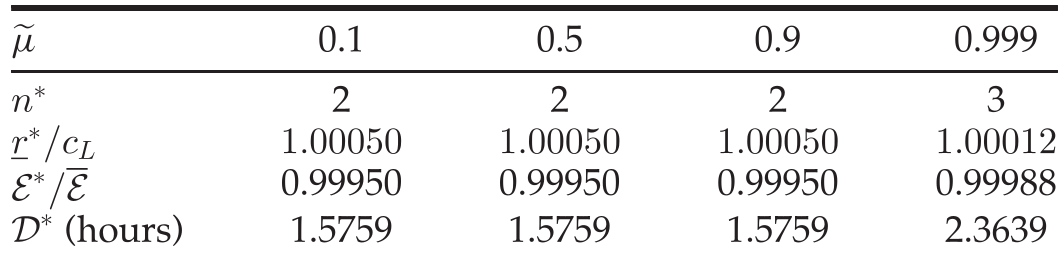 Fig 2: Tradeoff between tradeoff factor (μ), bundle size (n), and service delay.
Key Findings:
- Efficiency: The proposed mechanism hits 99.95% efficiency with a bundle size of just 2.
- Delay: The wait time to form these bundles is negligible—roughly 1.5 to 2.4 hours given Elance's task volume.
- The "Binary" Shock: Perhaps the most controversial finding is that Elance's 5-star system is redundant. A simple Satisfied/Not Satisfied (binary) rating would yield nearly the same economic efficiency while being much easier for requesters to provide.
Critical Insight: Why Does This Work?
The genius isn't just in the math, but in the Inductive Bias of the mechanism. By bundling tasks, the system effectively "filters" the noise of a single biased requester through the competitive lens of the group. If you are a worker, you no longer just care about being "good enough" for your requester; you want to ensure you are the best in the bundle, which drives the entire ecosystem toward the maximum contribution level ().
Conclusion & Future Look
The paper provides a rigorous mathematical foundation for what many platform designers suspect: complexity is the enemy of efficiency.
Future Outlook:
- Collusion Risks: While bundling prevents individual laziness, if a group of workers in a bundle colludes, the Nash Equilibrium could collapse back to free-riding (). Future work should investigate "Anti-Collusion" bundling.
- Multi-skilled Bundling: The model assumes similar task difficulty within a bundle. Adapting this to heterogeneous tasks with varying costs remains an open challenge.
By bridging the gap between game theory and human psychology, Xie and Lui have provided a roadmap for creating crowdsourcing systems that are not just efficient, but human-proof.