
Incentive Mechanism for Social Network Data Pricing: Balancing Privacy and Profit
Incentive Mechanism for Social Network Data Pricing under Privacy Preservation
The paper proposes a novel incentive mechanism for pricing social network data while ensuring node differential privacy. It introduces a two-part framework—a procurement mechanism for selecting data sellers under budget constraints and a query mechanism using an optimized flow-based Lipschitz extension to provide accurate edge-count estimates.
TL;DR
As personal data becomes the "new oil," social network users are demanding both privacy and compensation. This paper introduces a breakthrough mechanism that allows a data broker to buy aggregate social network statistics (like total edge counts) from users. It ensures Node Differential Privacy, stays within a fixed budget, and guarantees that users are paid fairly while incentivizing them to report their true privacy valuations.
Background: Why Social Graphs are a Privacy Nightmare
In a standard table, removing one row changes the result by at most one unit. In a social graph, removing one "central" node can remove hundreds or thousands of edges. This is known as high global sensitivity. Standard Differential Privacy (DP) would require adding massive amounts of noise to mask this, rendering the data useless.
The authors tackle two simultaneous hurdles:
- The Economic Hurdle: How do you pay users when you don't know how much they value their privacy?
- The Technical Hurdle: How do you keep the noise low enough to actually count edges accurately?
Methodology: The Procurement-Query Framework
The researchers proposed a dual-mechanism system named .
1. Procurement Mechanism () - The Auction
The broker has a budget . The mechanism sorts users by their reported privacy costs and selects the cheapest users. To ensure Incentive Compatibility (IC), the mechanism pays them a uniform price based on the valuation of the first excluded seller or the remaining budget—akin to a second-price auction logic. This ensures users won't benefit by lying about their privacy costs.
2. Query Mechanism () - The Privacy Shield
To solve the sensitivity problem, the authors used a Modified Flow-based Lipschitz Extension.
- Graph Projection: They project the original graph into a version where no node exceeds a degree threshold .
- Max-Flow Construction: They use a flow network to calculate the edge count on this bounded-degree graph.
- Laplace Noise: They add noise proportional to rather than the total number of nodes . Since , the accuracy improves dramatically.
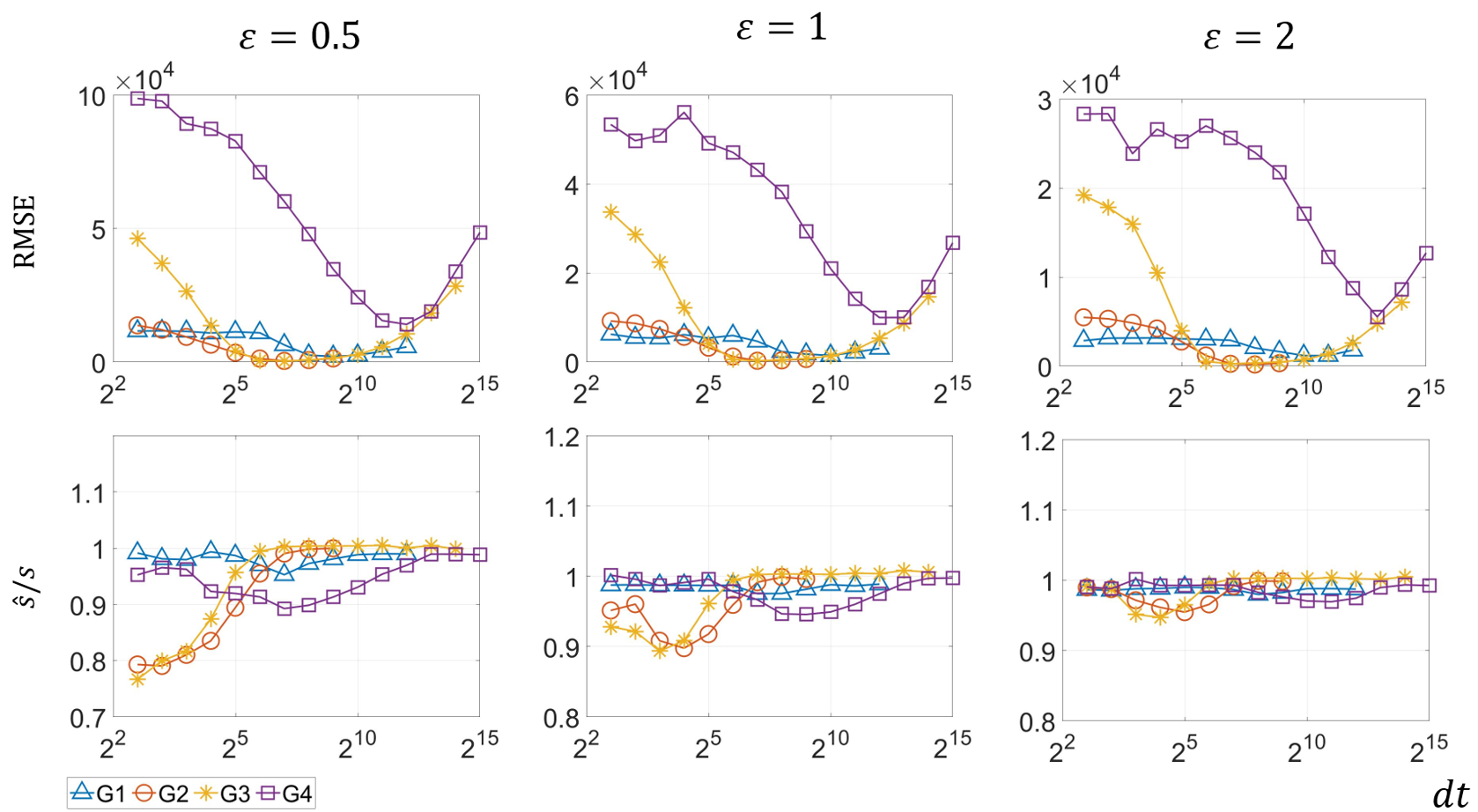 Figure: The interaction between degree thresholds and error rates (RMSE).
Experimental Insights
The team tested their approach on real-world data, including Facebook and GitHub social graphs.
- Optimal Thresholds: They found a "sweet spot" for the degree threshold (). If is too small, you lose too much real data (projection error). If it's too large, the noise becomes overwhelming (DP error).
- Robustness: Even when the budget was low (only buying data from 10% of users), the mechanism could still extrapolate the global edge count with high precision by assuming the sampled sub-network shared characteristics with the whole.
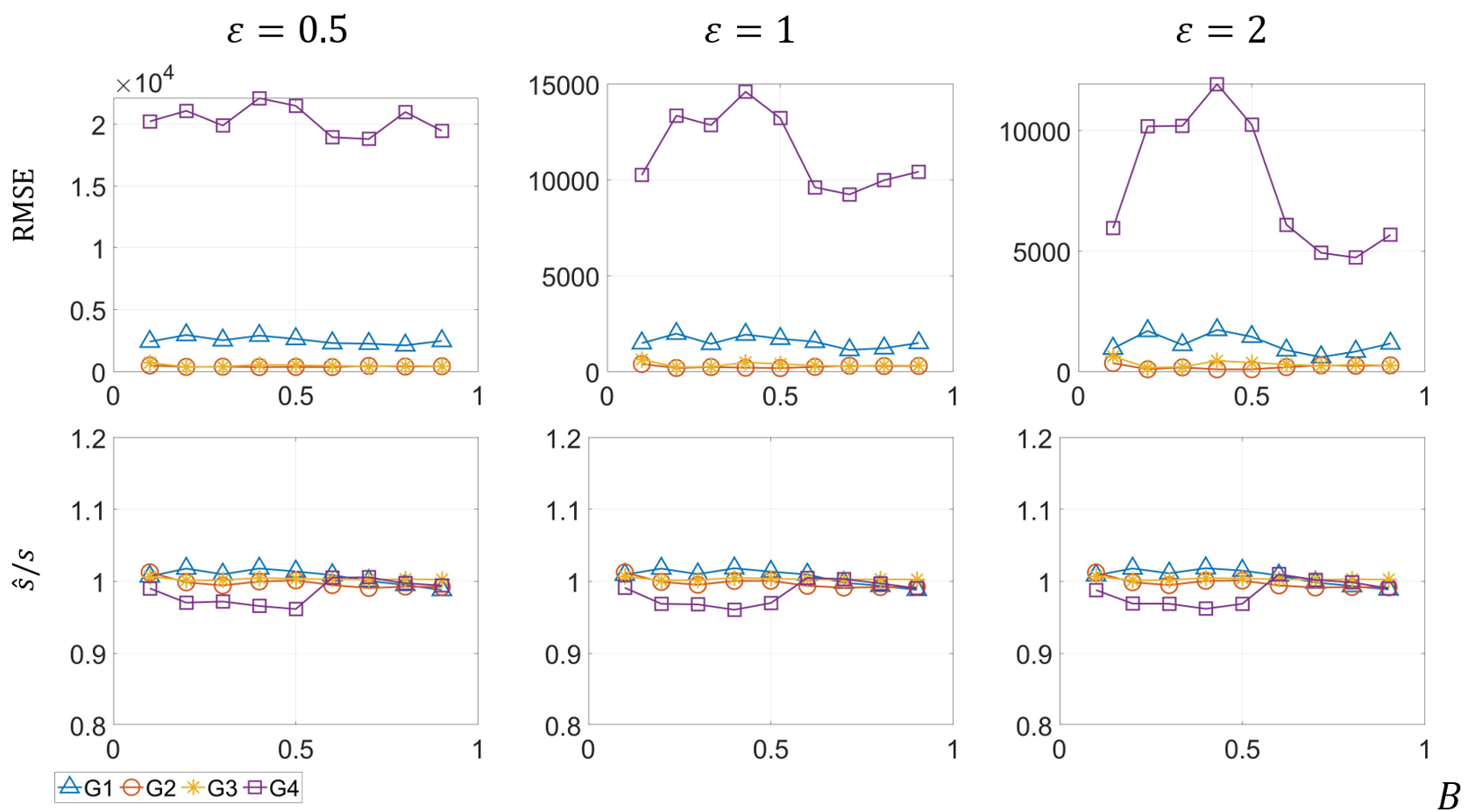 Figure: The ratio of estimated vs. true edges stays remarkably close to 1.0 across various budgets.
Critical Analysis & Future Directions
The paper successfully proves that is Individually Rational (users always benefit or stay neutral) and Budget Balanced.
Limitations:
- Verification: The model assumes social ties are "verifiable," meaning a user can't lie about having 1,000 friends if they only have 10.
- Independence: It assumes privacy valuations aren't correlated with the number of friends. In reality, "influencers" (high-degree nodes) might value their privacy much higher than average users.
Future Work: The next frontier is dealing with "correlated costs," where the network structure itself informs how much a user might demand for their data. As we move toward Web3 and decentralized data ownership, mechanisms like this will be essential for ethical data marketplaces.
Takeaway
This research moves beyond theoretical DP to create a "fair-trade" data economy for social networks. It proves that we don't have to choose between user privacy and data utility—we just need the right incentives.