Game Theory in the Pocket: Solving Selfishness in Mobile Social Networks
Incentive Mechanisms for Data Dissemination in Autonomous Mobile Social Networks
This paper introduces incentive mechanisms for data dissemination in Autonomous Mobile Social Networks (AMSNs) to overcome nodal selfishness. It proposes two distinct frameworks: a Data Pulling model using two-person cooperative games and a Data Pushing model utilizing "virtual checks" and online auctions, achieving significantly higher delivery rates while drastically reducing communication overhead compared to fully cooperative schemes.
TL;DR
In autonomous mobile social networks (AMSNs), nodes are often selfish, refusing to waste battery and storage to relay data for others. This paper presents a dual-model incentive framework—Data Pulling and Data Pushing—that uses Two-Person Cooperative Games and Online Auctions to motivate collaboration. The result? A network that performs as well as a fully "altruistic" one but with a fraction of the traffic overhead.
The Motivation: Why Being Nice Doesn't Scale
Current mobile data dissemination relies heavily on cellular or WiFi infrastructure. However, in emergency scenarios or high-cost environments, we rely on Opportunistic Connections (D2D). The "Price of Anarchy" in these networks is high: if everyone is selfish, the delivery ratio drops linearly.
Existing solutions like Tit-for-Tat (TFT) are often too rigid for intermittent connectivity, as they require strict bilateral balances that waste contact opportunities. The authors recognized that we need a way to quantify the value of a message so that a node knows exactly how much "expected credit" it stands to gain by carrying it.
Methodology: Putting a Price on Data
1. The Value Formula: Expected Credit Reward (ECR)
To make a selfish node behave rationally, the system must estimate a message's worth. The paper defines Overall Tightness (), which combines direct contact probability with "indirect tightness" (the chance of meeting someone who can reach the sink).
The value of a message for node is calculated as: Where is the appraisal (potential total sinks) and is the duplication degree. Essentially, the more copies there are in the wild, the less a single copy is worth.
2. The Bargaining Game
When two nodes meet, they don't just dump data. They engage in a Two-Person Cooperative Game. Using a heuristic approach to find the Nash Bargaining Solution, they exchange sets of messages that maximize the product of their utility gains. This ensures a "win-win" trade, leading the entire network toward Pareto Optimality.
3. Data Pushing and Virtual Checks
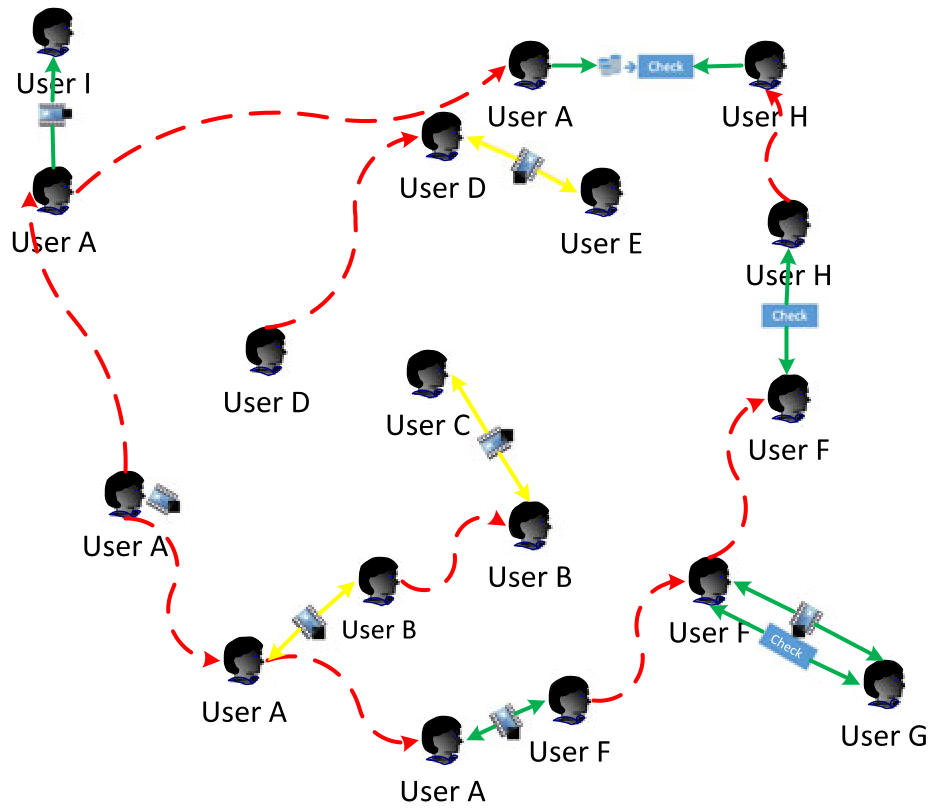
In "push" scenarios (like personalized ads), the provider pays. But how does a provider pay a relay node it never meets?
- Virtual Checks: A provider attaches a virtual check to a packet.
- Signed Rewards: When a destination receives the packet, it signs the check.
- Online Auctions: Relays can't always wait to meet the provider to cash in. They can "sell" these signed checks to other nodes via an Online Auction based on the Secretary Problem (Optimal Stopping Theory). This accelerates credit circulation, preventing nodes from "starving" of credits.
Experimental Mastery: Efficiency vs. Altruism
Using the Haggle (human) and DieselNet (bus) traces, the authors proved that the Incentive scheme is far superior to random or selfish behavior.
Key Findings:
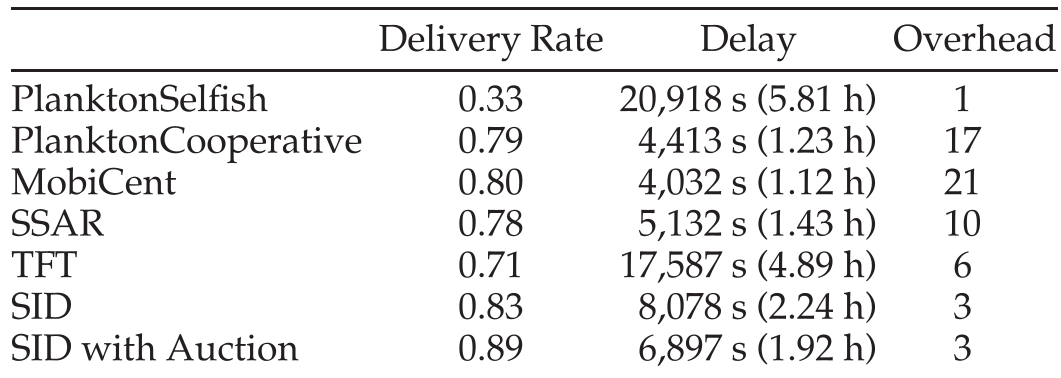
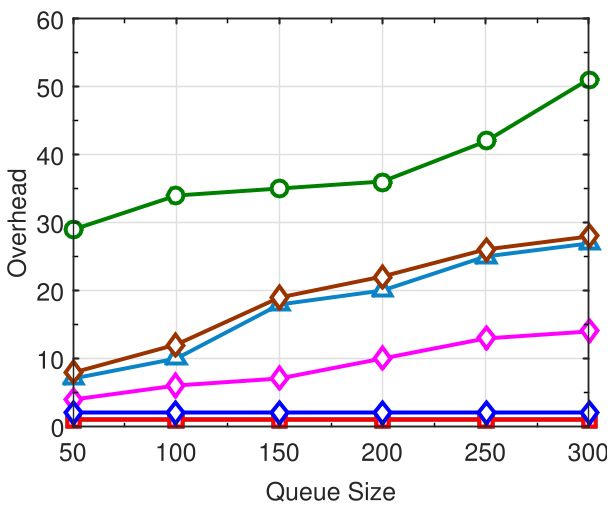
- High Delivery, Low Waste: While "Cooperative" (altruistic) nodes have slightly higher delivery rates, they produce 5x to 10x more overhead. The Incentive scheme only transmits what is valuable.
- Resilience: As traffic load increases, baseline schemes (like TFT) see a 20% drop in delivery rate due to buffer overflows. The proposed SID (Self-Interest-Driven) model remains stable because it naturally regulates message duplication.
- The Power of Auctions: Adding the auction mechanism improved the delivery rate from 0.83 to 0.89 by ensuring nodes always had credits to initiate new disseminations.
Critical Insights & Takeaways
This work effectively bridges the gap between game theory and mobile networking. The most profound insight is the use of the Secretary Problem for check auctions. In a decentralized network where you don't know who you will meet next, waiting for the "37% mark" to pick the best buyer is a mathematically elegant way to handle uncertainty.
Limitations: The model assumes that nodes cannot "cheat" or forge signatures. In a real-world adversarial environment, the computational cost of asymmetric cryptography for every packet trade might be a bottleneck not fully explored here.
Future Outlook: This framework is a precursor to modern blockchain-based incentivized mesh networks. By replacing "virtual checks" with "smart contracts," the same logic could power the next generation of decentralized crowdsourcing and edge computing.