
Breaking the Silence: Incentivizing Cooperation in Non-Cooperative Social Networks
An Incentive Scheme for Non-cooperative Social Networks under the Independent Cascade Model
This paper introduces a novel influence maximization framework for non-cooperative social networks by generalizing the Independent Cascade Model (ICM). It proposes a VCG-like incentive scheme to stimulate cooperation among selfish nodes, achieving optimal influence spread through game-theoretic mechanisms.
TL;DR
Most viral marketing research assumes that if you influence a friend, they will automatically try to influence their friends. This paper challenges that assumption by introducing Non-Cooperative Influence Maximization. By combining the Independent Cascade Model (ICM) with a VCG-like incentive scheme, the authors demonstrate how to mathematically bribe "selfish" users to ensure information spreads effectively across a network.
The Hidden Friction in Viral Marketing
The "Influence Maximization" (IM) problem is a classic in social network analysis: given seeds, how do we maximize the final number of active nodes?
However, there is a massive gap between theory and reality. Prior work assumes nodes are altruistic. In the real world, passing along a recommendation or an ad incurs costs:
- Time/Effort: The friction of sharing content.
- Social Capital: The risk of being seen as a "spammer."
- Privacy: Potential data exposure.
Because of these costs, ordinary users are often non-cooperative—they might receive the influence but refuse to pass it on. This paper treats "cooperativeness" as a strategic choice (represented by ) and asks: How can we design a payment system so that users choose to cooperate?
Methodology: From Selfishness to Synergy
1. The Non-Cooperative ICM
The authors modify the standard ICM. Instead of a fixed activation probability , the probability becomes: Where represents the cooperativeness of node . In a Nash Equilibrium without incentives, naturally drops to because any effort results in a negative utility for the node.
2. The VCG-Like Incentive Scheme
To flip the script, the authors propose a payment defined as:
- : Compensation for the effort cost.
- : A premium based on the node's marginal contribution.
This is brilliant because it aligns the user's selfish interests with the advertiser's global goal. If a node is highly "influential" (meaning the network would reach far fewer people without it), it receives a higher payment. The authors prove this mechanism is Incentive Compatible (IC), meaning the best strategy for every user is to be 100% cooperative ().
Note: The mechanism structure follows a standard VCG architecture where payments are tied to the "externalities" a player provides to the system.
Experiments & Results
The researchers tested their model on the Arxiv co-authorship network (4158 nodes, 26,850 edges).
The Cost of Non-Cooperation
As shown in the figures below, the final influence (active set size) scales dramatically with the cooperativeness level . If users are only 20% cooperative, even a large seed set fails to ignite a true cascade.
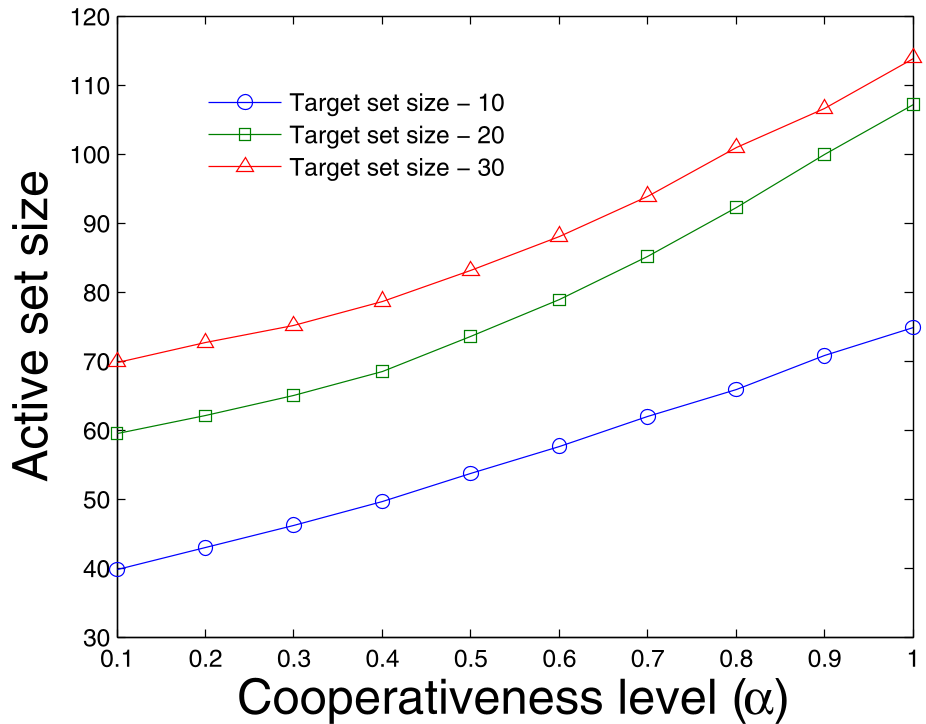 Fig 1: Influence spread as a function of cooperativeness () at 5% activation probability.
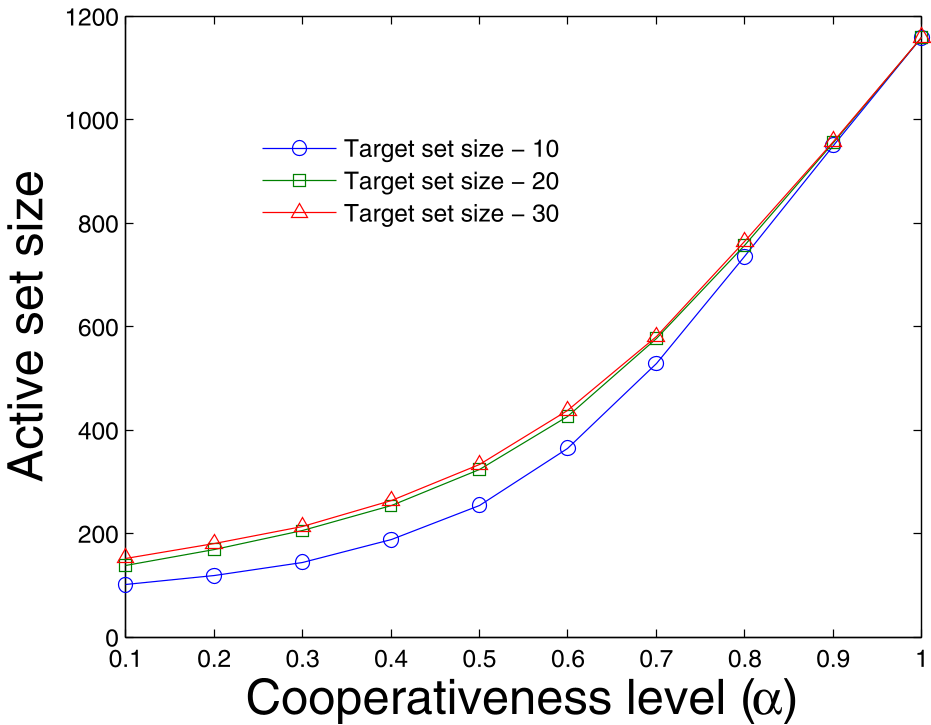 Fig 2: Influence spread at 20% activation probability. Notice how the benefit of cooperation is even more pronounced when the base influence probability is high.
The Budget Allocation Dilemma
A key takeaway from the experiments is the convexity of the influence-cooperation curve. While adding more seeds has "diminishing returns" (submodularity), increasing cooperation levels often yields "increasing returns" (convexity).
Strategic Insight: It is often better to have a smaller group of highly incentivized, cooperative seeds than a massive group of unmotivated, non-cooperative ones.
Critical Analysis & Conclusion
The strength of this paper lies in its rigorous application of game theory to a traditionally algorithmic problem. By proving that the non-cooperative influence function remains submodular, the authors ensure that greedy algorithms still work for seed selection even in this complex environment.
Limitations:
- Information Asymmetry: The model assumes the advertiser knows the cost parameters () and influence probabilities (). In practice, these are difficult to estimate for every node.
- Static Cooperativeness: The model assumes nodes decide their once, whereas social behavior is often dynamic and reactive.
Future Outlook: This research opens the door for Budget Optimization—finding the mathematical "sweet spot" between spending on influencers (seeds) versus incentivizing the "middlemen" who actually carry the message to the finish line.