
Quantity or Quality? The Strategic Math of Viral Marketing
Incentivizing strategic users for social diffusion: Quantity or quality?
This paper investigates the optimal strategy for social product diffusion by balancing the number of seeded users (quantity) and the amount of incentive provided (quality). Using an incentivized game-diffusion model based on noisy best-response dynamics, the authors characterize diffusion speed as a combinatorial optimization problem and identify a distinct phase transition in diffusion time across various network topologies.
TL;DR
In the world of social influence, should you spread your budget thin across many "influencers" or pay a premium to a select few? This paper reveals a strict hierarchy: Quantity is a prerequisite, but Quality is the accelerator. You must first hit a threshold number of seeds to "break" the network's resistance; once that threshold is crossed, increasing the individual incentive (quality) is far more effective than adding more seeds.
The Problem: Real People Aren't Robots
Most academic models of viral marketing suffer from a "Hard-Wired" bias. They assume that if you give someone a free sample (seeding), they automatically become a permanent, mindless evangelist for your brand.
The reality is more complex. Users are strategic. They weigh the benefits of switching to a new product against the "coordination cost" of leaving their friends behind on the old one. If the incentive you offer is low, their willingness to stay at the new state is fragile. This paper addresses the gap by treating seeded users as rational agents whose behavior scales with the incentive ().
Methodology: The Incentivized Game-Diffusion Model
The authors utilize a Networked Coordination Game. Every user wants to coordinate with their neighbors to maximize utility. The dynamics follow a "noisy best-response" (Logit response), meaning users usually choose the highest-payoff option but sometimes make "irrational" moves due to social noise.
The core contribution is the Potential Function (), which acts like a topographical map of the network's adoption state: Where:
- represents the resistance from neighbors still using the old product.
- is the inherent advantage of the new product.
- is the extra "bribe" or incentive given to seeded users.
Architecture of the Phase Transition
The "Diffusion Exponent" () determines the speed. If is high, adoption is glacially slow (exponential in terms of network noise). If , the product spreads like wildfire.
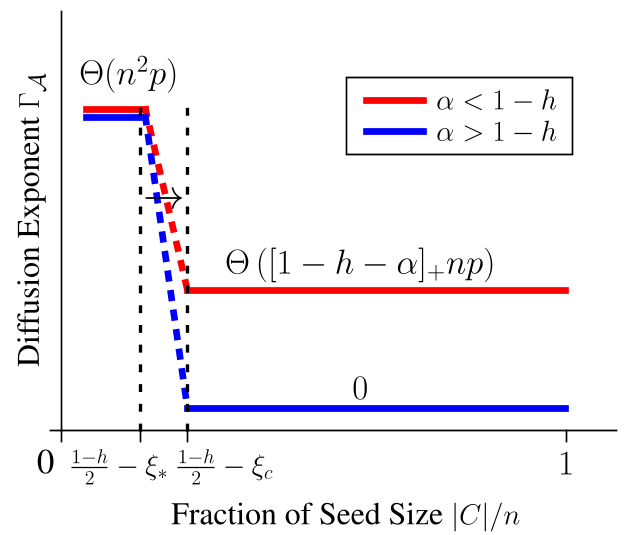 The figure illustrates how diffusion time hits a "cliff" only when the seed set size crosses a specific threshold.
Key Insights across Topologies
The researchers tested this on three graph types:
- Erdős-Rényi (Random): Highly symmetric. Any random subset of seeds works, but you must seed roughly of the population to see a change.
- Planted Partition (Clusters): Targeted seeding is required. You need to focus on larger clusters while maintaining balance across the community.
- Power Law (Hubs): Seeding the "hubs" (high-degree nodes) is the only way to significantly reduce diffusion time.
Experimental Proof: The "Facebook" Test
Using real-world Facebook ego-networks, the authors compared their General(k) algorithm against varying incentive levels.
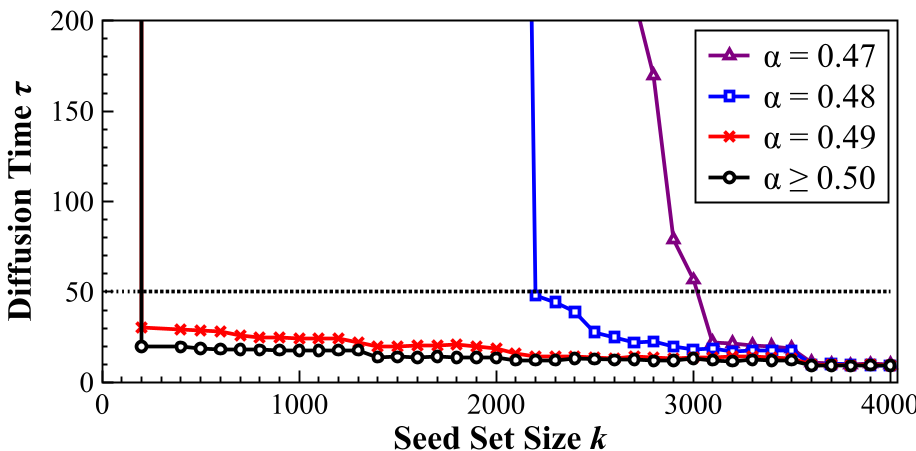 In the PPfacebook graph, notice the sharp drop in diffusion time when α (incentive) increases, but only after the seed set size (k) passes the ~190 mark.
The results were striking:
- Below the threshold: Increasing the incentive does almost nothing. The "Quantity" isn't enough to overcome the network's structural inertia.
- Above the threshold: A tiny increase in "Quality" (incentive) leads to an order-of-magnitude reduction in diffusion time.
Critical Analysis & Conclusion
This work provides a rigorous mathematical foundation for what many marketers feel intuitively: Don't half-seed a network.
The Strategic Takeaway:
- Identify the Topology: Are your users in an echo chamber (Clustered) or following a few influencers (Power Law)?
- Calculate the Critical Mass: Use the
General(k)approach to find the minimum number of seeds needed to create a "breach." - Spend the Rest on Quality: Once you have enough seeds to potentially tip the network, don't buy more. Instead, make the offer so good that those seeds become "aggressive" adopters.
Limitations: The model assumes a static network. In real life, ties break and form, and the "noise" in human decision-making might not always follow a clean Logit distribution. However, as a baseline for budget allocation, this "Quantity-then-Quality" rule is a powerful new heuristic for the advertising industry.