
Beyond Location: Integrating Social Network Graphs into Context-Aware Personalization
Towards a concept for inclusion of social network information as context information
This paper proposes a conceptual framework for integrating Social Network Information (SNI) into user context for personalized information supply. Using an empirical survey of 934 participants, the authors demonstrate that interpersonal relationships within Social Network Sites (SNS) significantly enhance the perceived trustworthiness and relevance of pushed recommendations.
TL;DR
In the realm of personalized services, we often talk about where you are and what you are doing. This paper argues we have missed the most critical piece: Who you are with. By leveraging the wealth of Social Network Information (SNI), the authors propose a framework that treats social relationships as a primary context variable, proving that 1st-degree social connections drastically increase the "trustworthiness" and "relevance" of information delivery.
Problem & Motivation: The Missing Social Link
While context-aware computing has matured in tracking location and time, the "Social Situation" remains an underutilized dimension. Prior work identified social relations as a context category, but practical implementation has lagged.
The authors' core research intuition is based on the phenomenon of Social Word-of-Mouth (WOM). In an era of information overload, users are overwhelmed by anonymous "push" notifications. However, a recommendation from a personally known contact carries inherent credibility. The challenge is: How do we formalize this social intuition into a technical system?
Empirical Evidence: The Power of the 1st Degree
Before building the concept, the authors validated their logic through a massive survey of over 900 users. The key takeaway? Social distance is the ultimate filter.
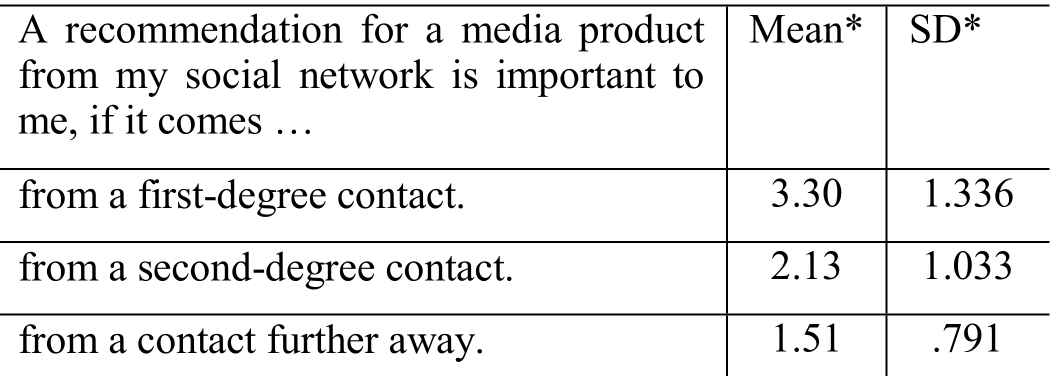
The statistical analysis (T-tests) confirmed three vital hypotheses:
- Trust is Social: Recommendations from SNS contacts are perceived as more relevant than anonymous ones (H1).
- Identity Matters: If the recommendation includes the sender’s profile info, its value increases (H2).
- The Inverse Square Law of Socializing: The importance of a recommendation drops precipitously as you move from 1st-degree to 2nd-degree connections (H3).
Methodology: The Two-Sided Enhancement Concept
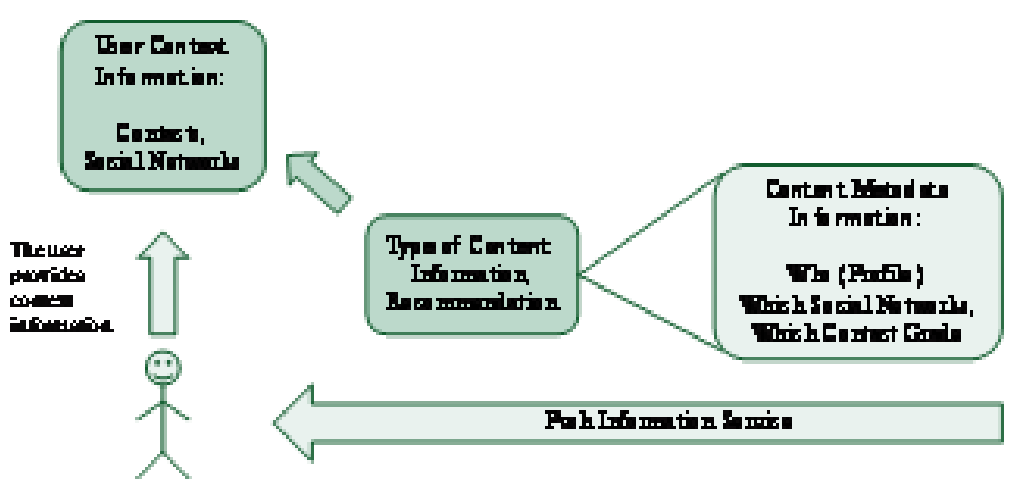
To solve this, the paper proposes a dual-path architecture to upgrade context-aware systems:
1. User Profile Enhancement
Instead of a static list of interests, the user's context profile must be "Socially Aware." This involves:
- Storing which SNS the user belongs to.
- Mapping 1st-order social contacts directly into the context-matching engine.
2. Content Metadata Enhancement
Information shouldn't just be "Content"; it should be "Content + Source." The authors suggest augmenting every piece of information with:
- A link to the creator/reviewer’s social profile.
- Cross-referencing the sender with the receiver's social hierarchy.
Critical Analysis & Conclusion
The "Takeaway"
The most significant contribution of this work is the quantifiable proof that Source Credibility (Trustworthiness + Expertise) is a function of social graph distance. For developers of push services or recommendation systems, the "Social Degree" is perhaps more predictive of engagement than the content's topic itself.
Limitations & Future Work
The paper openly acknowledges significant hurdles:
- Privacy & Ethics: Collecting social graph data via APIs (like Facebook’s at the time) creates massive privacy risks.
- Legal Challenges: Users may reject "contact-scraping" even if it leads to better recommendations.
- The "Cold Start" for Social: What happens when a user has a small or private social network?
Looking forward, this concept lays the groundwork for what we now see in modern algorithmic feeds—where "Your friend liked this" is a primary signal for content ranking. The next frontier involves automating this "Social Metadata" tagging without violating the fragile boundary of user privacy.