
Incognitus: Reclaiming Privacy in the Age of Algorithmic Surveillance
Incognitus: Privacy-Preserving User Interests in Online Social Networks
Incognitus is a privacy-preserving browser extension designed for Online Social Networks (OSNs) like Facebook. Using a combination of k-anonymity-inspired obfuscation and an offline browsing mode, it allows users to follow and interact with sensitive content without disclosing their specific interests to the service provider.
TL;DR
OSN providers know exactly who you are based on what you follow and how long you look at a post. Incognitus is a Firefox extension that breaks this tracking loop. It uses a "noise injection" strategy to hide your subscriptions and a local "delta-update" mechanism to let you browse sensitive content offline, effectively blinding the platform's behavioral trackers.
Context: The Social Broadcast Trap
Modern Online Social Networks (OSNs) have evolved into primary news sources. However, this "Social Broadcast" model is a privacy nightmare. Even if you don't "Like" or "Share" a post, the provider monitors:
- Which photos you expand.
- How many seconds you spend reading a political post.
- Which links you click.
Current defenses like disposable accounts are easily bypassed by Browser Fingerprinting and Cookie Synchronization. The researchers behind Incognitus argue that if we can't hide from the network, we must hide within it.
Methodology: Obfuscation and Isolation
The architecture of Incognitus rests on two pillars designed to provide anonymity.
1. Subscription Obfuscation
When a user wants to follow a sensitive page (e.g., a specific political party or medical group), Incognitus automatically selects "noise" pages from a community-curated Sensitive Page List (SP). The provider sees simultaneous subscription requests, making it impossible to distinguish the genuine interest from the decoys.
2. The Offline Mode & Delta Approach
The most innovative part of the system is how it handles interactions. To prevent the provider from seeing which page you are actually reading:
- Background Fetching: Incognitus periodically downloads "deltas" (new updates) for all pages.
- Request Interception: When you browse the sensitive page, the extension intercepts the HTTP requests and serves the content from the local disk.
- Link Transcoding: URLs are rewritten on-the-fly to point to local assets, ensuring that clicking a photo doesn't trigger a server-side log.
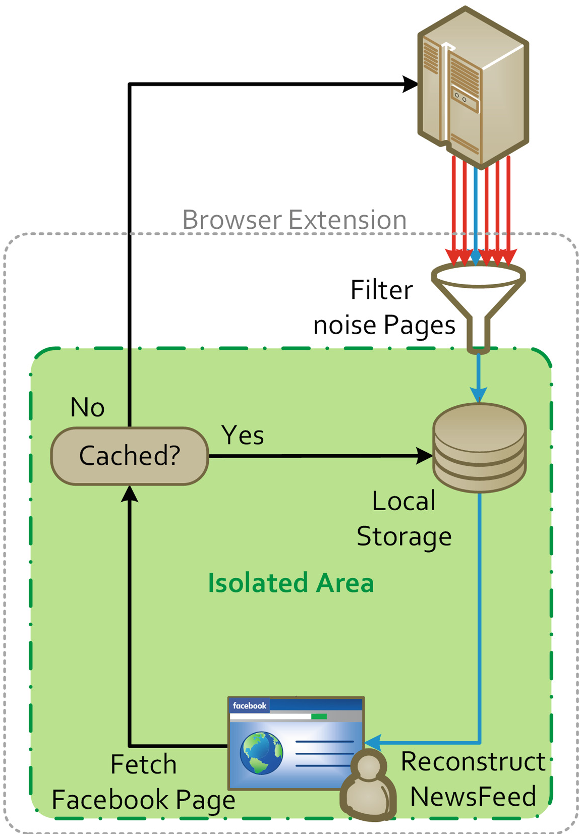 Figure 1: High-level design showing the delta-update mechanism and local storage flow.
Performance vs. Privacy
The researchers evaluated the system using a Firefox prototype. The core trade-off involves Bandwidth and Latency.
- Bandwidth: As expected, consumption increases linearly with . However, because the system uses a "Delta Approach" (only downloading what is new), the long-term overhead is surprisingly low.
- Latency: The initial "cold start" for a page with takes about 22 seconds to fetch all noise content. But once cached, the browsing experience is instantaneous since the data is served locally.
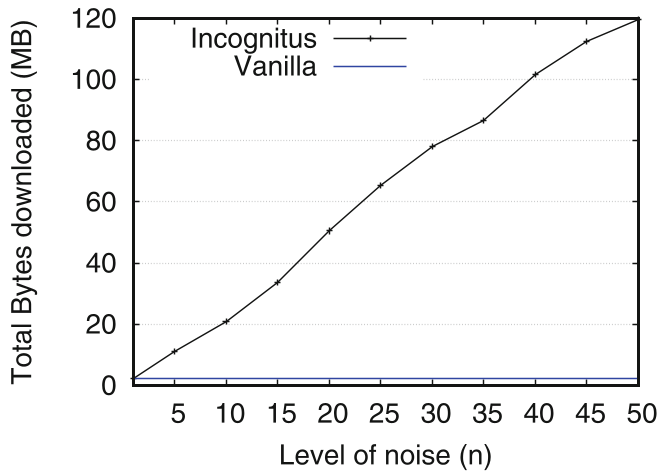 Figure 2: Total bytes downloaded vs. Noise Level (k). Note the linear growth which remains practical for broadband users.
Critical Insight: Why This Works
The "Delta Approach" is the secret sauce. By decoupling the time of download from the time of consumption, Incognitus breaks the temporal correlation that OSNs use to build interest profiles. Even if the provider sees you downloading 10 pages, they don't know which one you are reading at 10 PM on a Sunday.
Limitations & Future Outlook
While powerful, Incognitus faces a few challenges:
- Dynamic Content: Highly interactive components (like live polls or real-time comments) are harder to cache and serve locally.
- Adversarial Providers: If an OSN provider becomes "dishonest" and actively changes page structures to break extensions, a cat-and-mouse game ensues.
- The "SP" List: The system relies on a community-maintained list of sensitive pages. The robustness of the anonymity depends on the diversity and size of this list.
Conclusion
Incognitus represents a shift from "Anonymity" (which is failing in the era of fingerprinting) to "Obfuscation." By making the cost of monitoring too high and the data too noisy, it gives users a practical "Incognito Mode" for their social life.