
Incompressible Knowledge: Hacking the Black Box of Frontier LLMs
Incompressible Knowledge Probes: Estimating Black-Box LLM Parameter Counts via Factual Capacity
The paper introduces Incompressible Knowledge Probes (IKPs), a tiered benchmark of 1,400 factual questions designed to estimate the parameter counts of black-box LLMs. By leveraging the log-linear relationship between factual capacity and model size (calibrated on 89 open models with R2 = 0.917), it provides effective capacity estimates for major proprietary models like GPT-5.5 and Claude 4.7.
TL;DR
How do you measure something you can't see? As frontier AI labs shutter their technical reports, researchers are turning to "Incompressible Knowledge Probes" (IKPs) to peer inside. By measuring exactly how much long-tail "obscure" knowledge a model has memorized, this paper creates a thermometer for parameter counts. The verdict? Scaling hasn't stopped; it's simply that our benchmarks are measuring the wrong things.
The "Densing Law" Illusion
There is a growing sentiment that "scaling is dead" because a 7B model today can beat a 70B model from two years ago on reasoning tasks. This paper argues that this is an illusion caused by compressible procedural skills. Reasoning, syntax, and logic are functions that can be made more efficient through better architectures—this is the Densing Law.
However, the fact that "USTC Hackergame started in 2014" cannot be calculated. It is a piece of incompressible information that must be stored in weights. By isolating these facts, we can see the true state of scaling.
Methodology: The Obscurity Ladder
The author created 1,400 probes spanning 7 tiers of obscurity (T1 to T7). While T1 tests universal facts (the capital of France), T6 and T7 target the "long tail"—researchers with 10 citations or obscure river mouths in Russia.
The Calibration Curve
By testing 89 open-weight models (from 135M to 1.6T parameters), the author found a near-perfect log-linear fit (). Every 10× increase in parameters adds roughly 14.7 percentage points of accuracy.
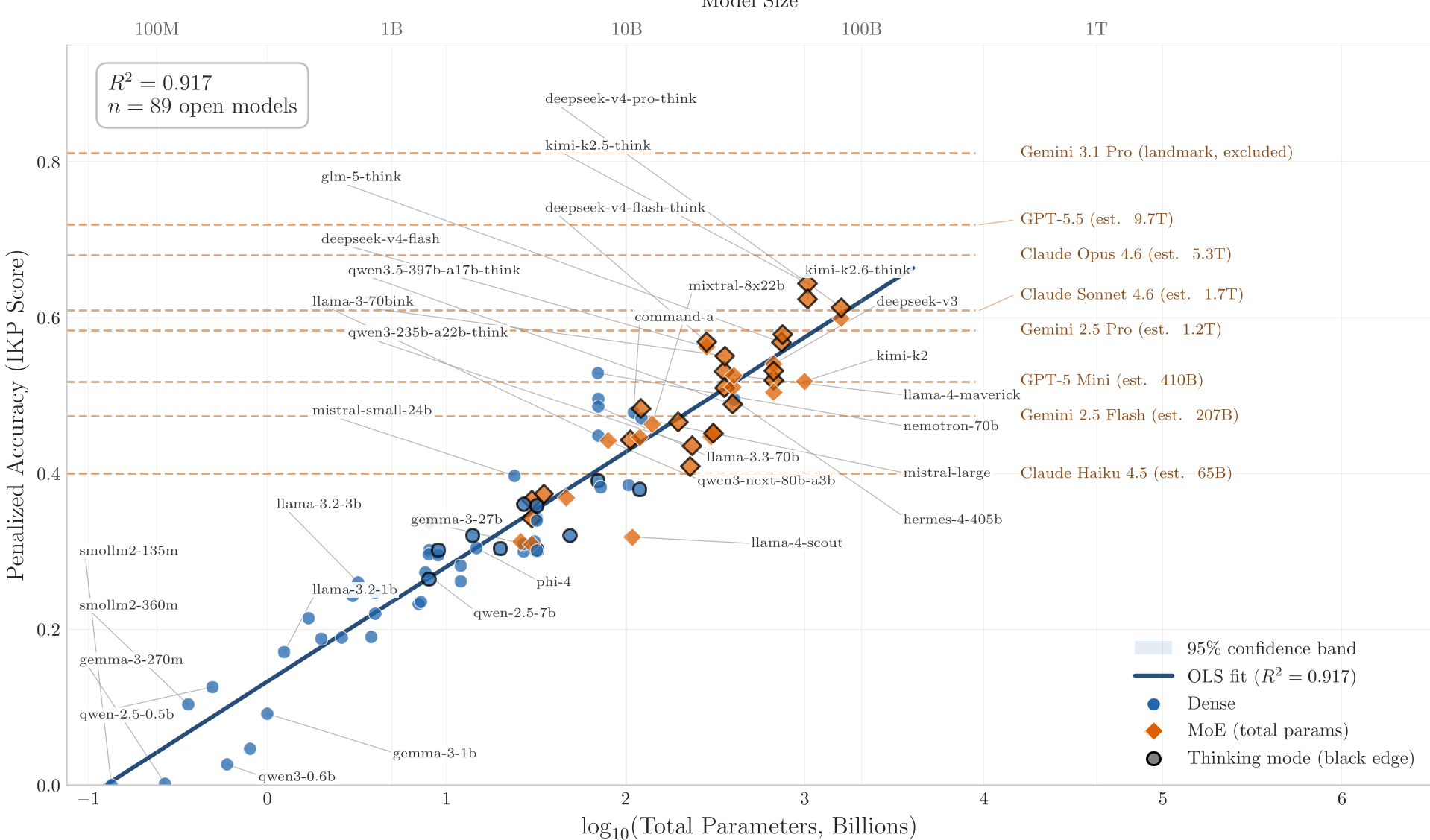 Figure 1: The gold standard. Open-weight models (blue/orange) anchor the line, allowing proprietary models (dashed lines) to be plotted by their accuracy alone.
Key Insight: MoEs and the "Total Params" Rule
A recurring debate in AI is whether Mixture-of-Experts (MoE) models should be judged by their total or active parameters. This paper provides empirical proof: Total parameters predict knowledge capacity () much better than active parameters (). Facts are distributed across the entire expert bank, not just the ones firing during a single token prediction.
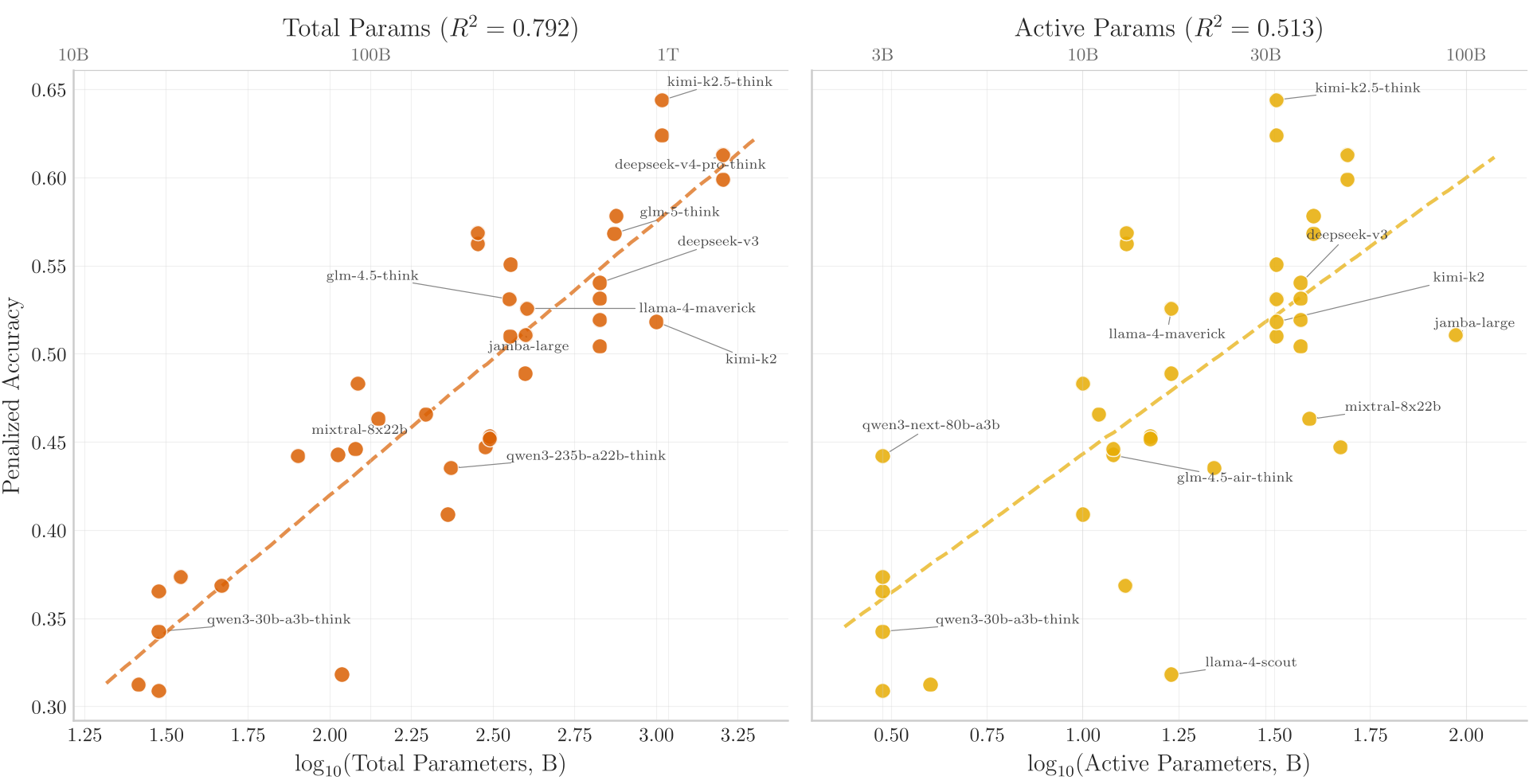 Figure 2: Total parameters (left) create a cohesive scaling law for MoEs, whereas active parameters (right) create a noisy, unreliable signal.
The Frontier Estimates
Applying this "Knowledge Thermometer" to the world's most powerful APIs yields striking results:
- GPT-5.5: Estimated at ~9.7 Trillion parameters.
- Claude Opus 4.6: Estimated at ~5.3 Trillion.
- o1/Grok-4/Opus 4.7: Clustering in the 3.0T to 4.1T range.
Crucially, the "Pro" tiers of models (like GPT-5 Pro) show almost no increase in factual knowledge over their base versions. This confirms they are likely the same weights with more inference-time compute or better "procedural" alignment.
The T7 Cliff: The Ceiling of Human Knowledge
Perhaps the most profound discovery is the T7 Cliff. No model in existence—not even those with trillions of parameters—can crack 1% accuracy on T7 probes. These facts exist on the web but are so rare that current pretraining recipes cannot absorb them. This suggests there is a "Knowledge Frontier" that scaling has yet to conquer.
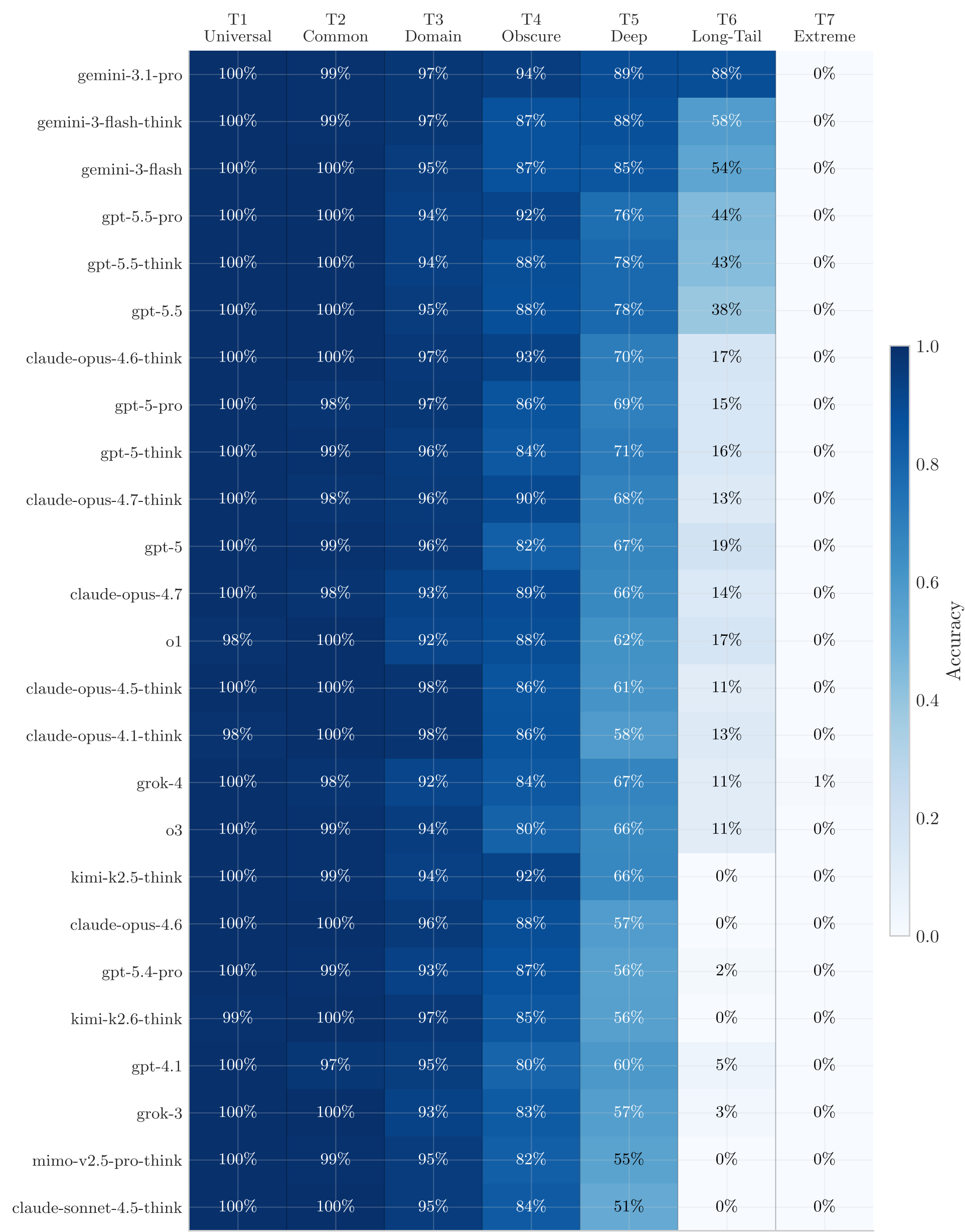 Figure 3: The step-function of knowledge. As models grow, they "unlock" tiers. T6 is the current battleground for giants; T7 remains a void for all.
Critical Analysis & Takeaways
- Safety Tuning as a Tax: Heavily safety-tuned models (like Claude Sonnet 4) often score lower than their predecessors. Why? Because they've been trained to refuse. This creates a "Refusal Tax" that can hide tens of percentage points of real capacity.
- Incompressibility is Real: The study rejects the Densing Law for facts (). You cannot "architect" your way into knowing more rare facts without adding more weights.
- Future of Benchmarking: As reasoning benchmarks saturate, factual capacity remains the most honest metric for evaluating the true scale of the "World Model" we are building.
Conclusion
We are not at the end of scaling. We are at the end of compressible scaling. To capture the full breadth of human knowledge—the tiny, obscure, long-tail facts that make an expert—we still need bigger buckets.