
SRSIM: Boosting Flying IoT Performance through Social Ties and Strategic Matching
Inconspicuous Manipulation for Social-Aware Relay Selection in Flying Internet of Things
This paper introduces a Social-Aware Relay Selection with Inconspicuous Manipulation (SRSIM) scheme for Flying IoT. It combines matching theory with inter-device social ties (SIoT) and a novel preference manipulation strategy to optimize UAV relaying.
TL;DR
In the rapidly evolving landscape of Flying Internet of Things (Flying IoT), selecting the right relay UAV is critical for long-range communication. This paper proposes SRSIM, a distributed approach that leverages Social-Awareness and Inconspicuous Manipulation in matching theory. It moves beyond simple physical link metrics to consider device "social ties," achieving a Pareto-optimal stable matching that increases transmission rates by ~8% without sacrificing system stability.
Background & Motivation: Why "Social" UAVs?
Most existing UAV relay strategies focus purely on physical parameters like SNR and distance. However, in an autonomous Flying IoT, a relay UAV (RV) may be unwilling to assist due to high workload or lack of "relationship" with the source.
The authors adopt the Social Internet of Things (SIoT) paradigm, identifying four key relationships:
- OOR (Ownership): Do the drones belong to the same owner?
- CWOR (Co-work): Are they collaborating on the same mission?
- CLOR (Co-location): Are they frequently in the same proximity?
- SOR (Social): What is their interaction frequency?
By treating these ties as a "stimulus," the system can better predict the probability of a relay successfully executing a service request.
Methodology: The Art of "Inconspicuous Manipulation"
The core of this work lies in solving the relay selection problem as a one-to-one matching game. While the classical Gale-Shapley (GS) algorithm ensures stability, it isn't always Pareto-optimal for the proposers (the source UAVs).
1. The Strategy: "Manipulating Less for More"
Instead of complex, NP-hard coalition strategies, the authors propose a lightweight manipulation:
- A Source UAV (SV) temporarily moves its current partner to the top of its preference list.
- This "distortion" is used to construct a rotation digraph.
- If a directed cycle (rotation) is found, it indicates that a group of UAVs can "trade" partners to each reach a more preferred state without breaking the overall stability of the system.
2. Architecture & Logic
The process is decoupled into two phases: Channel Selection (using multi-agent learning) and Relay Selection (using the proposed SRSIM).
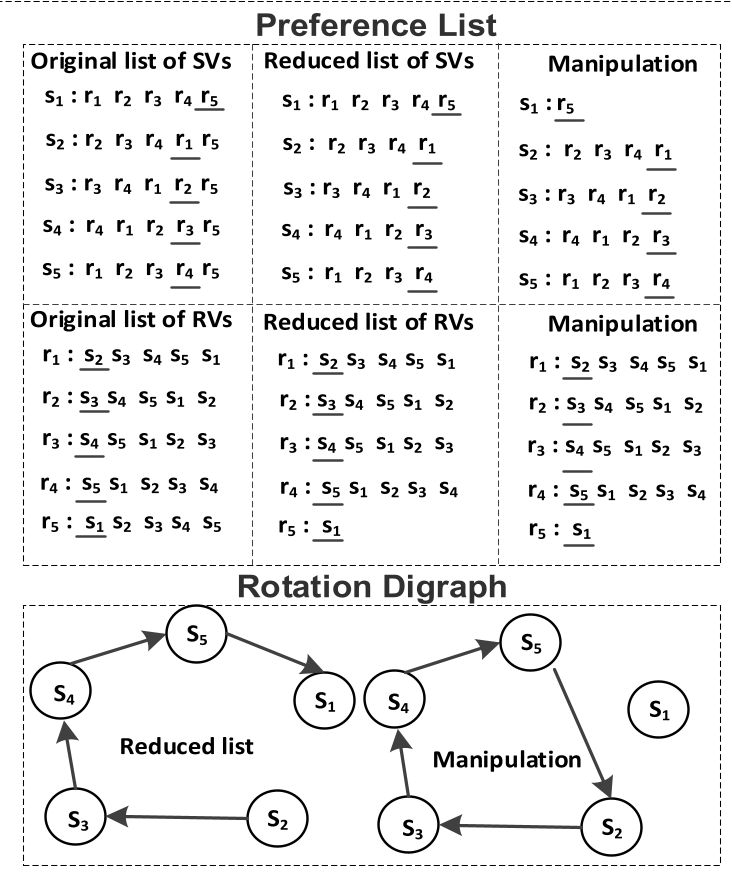 Figure 1: Illustration of rotation digraphs. By permuting preferences, a directed circle (s2 → s3 → s4 → s5 → s2) is exposed, allowing for Pareto improvement.
Experiments & Results
The authors validated SRSIM in a 3D simulated environment (2km x 2km x 2km).
Key Insights:
- Throughput Gains: SRSIM consistently outperforms standard stable matching algorithms. As the number of UAVs increases, the ability to find and eliminate rotations leads to a nearly 8% improvement in sum transmission rate.
- Reliability vs. Efficiency: While manipulation focuses on rate, the inclusion of social ties (CWOR, SOR, etc.) ensures that the reliability (probability of execution) remains high.
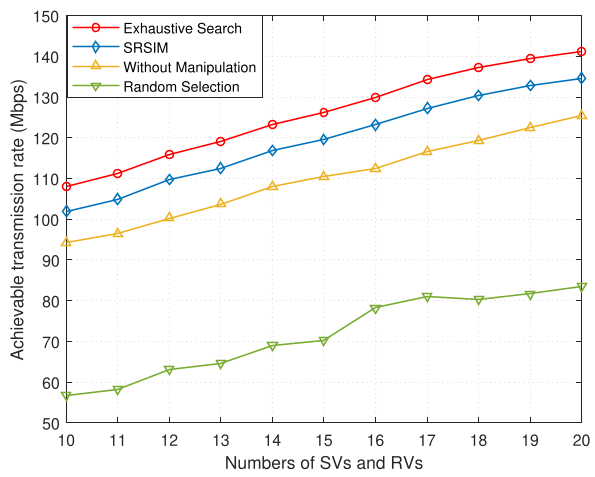 Figure 2: The sum transmission rate increases linearly with the number of UAVs, with SRSIM maintaining a clear lead over non-manipulated benchmarks.
Critical Analysis & Conclusion
Takeaway: The genius of this paper is the "Inconspicuous" part of the manipulation. By making minimal changes to preference lists, the authors bypass the typical computational complexity associated with finding optimal matchings in dynamic networks.
Limitations: Reality is often more chaotic than the "Line of Sight" (LoS) model assumed here. In urban environments, signal shadowing and high-speed Doppler effects might require more frequent re-matching, potentially increasing the overhead of the rotation search.
Future Outlook: This framework opens doors for "Game Theoretic AI" in drone swarms, where individual agents can strategically adjust their "social preferences" to optimize the global network state without needing a centralized controller.