
Informatics as an Evolutionary Story: Bridging the Gap Between History and Technology
Incorporating History in Secondary Education Informatics Courses
This paper proposes a pedagogical framework for integrating computing history into secondary school informatics curricula. It introduces a "Network Approach" that connects technical concepts with historical events through a four-step methodology (Brainstorming, Connecting, Comparing, Challenging) to foster critical reflection and deeper conceptual understanding.
TL;DR
Modern informatics education often feels like a snapshot of the "now," ignoring the decades of trial, error, and genius that led to our current digital tools. This paper proposes a Network Approach to weave computing history directly into secondary school informatics. By shifting from rote memorization of dates to a contextualized understanding of "Who, Why, and How," educators can help students see technology not just as a tool, but as a human endeavor shaped by societal needs.
Background: Why History Matters in the Lab
Informatics in secondary schools is often squeezed into tight schedules, forcing teachers to prioritize "How-To" skills (coding, database management) over the "Way of Thinking." However, without historical context, students view technical artifacts as static. The authors argue that history is the "missing link" that connects technological background (the bits and bytes) with conceptual background (the underlying philosophy).
The Pain Point: The Missing Connection
Existing history curricula (in the US, UK, and Austria) rarely mention informatics except as a footnote to "Modern History." Conversely, informatics curricula lack a cohesive framework. The challenge is: How do we teach history to a non-specialist, teenage audience without boring them or falling behind on technical requirements?
Methodology: The "Network Approach"
The core of the paper is a four-step pedagogical cycle designed to move students from superficial awareness to critical application.
1. The Orientation Matrix
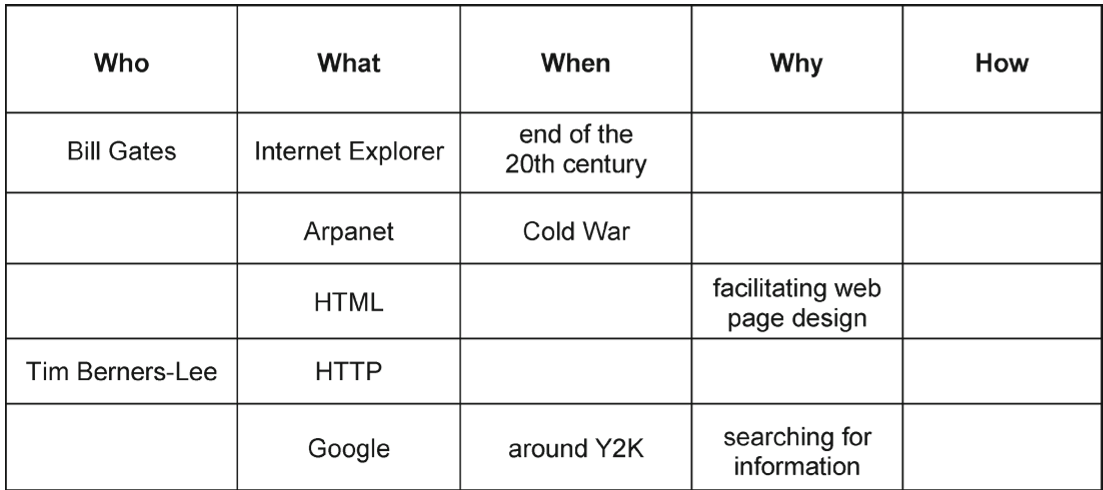
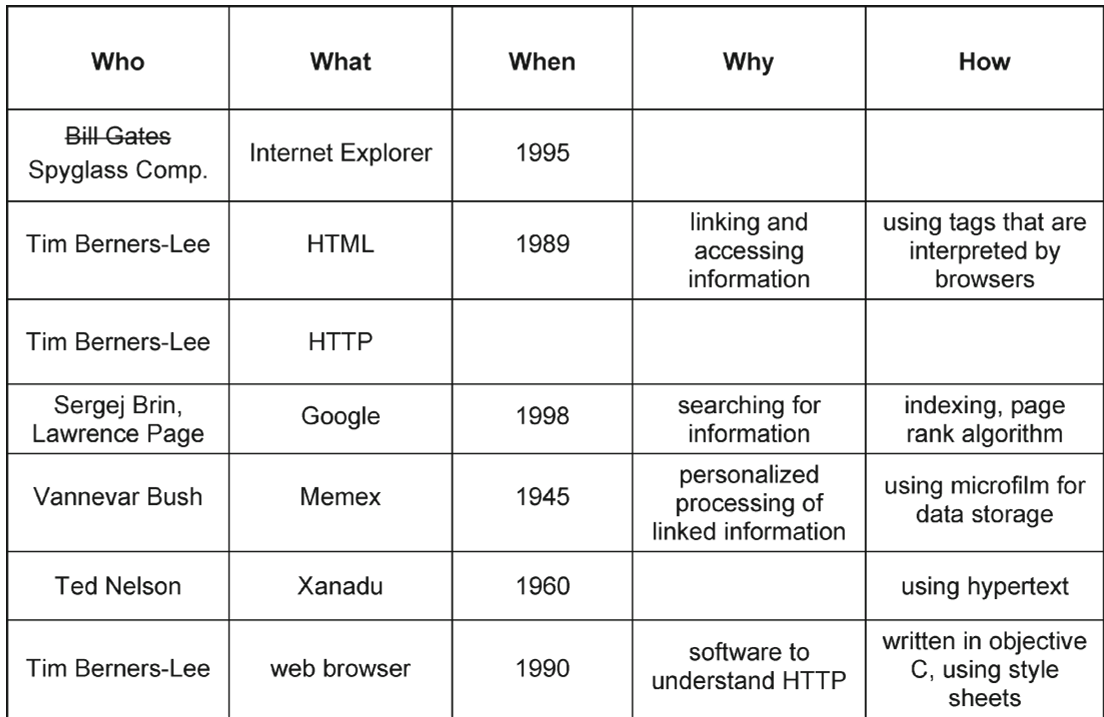
To avoid teaching history as a linear list of names, the authors introduce a matrix that tracks the development of concepts. Instead of just "Tim Berners-Lee," the matrix asks "Why" (facilitating information sharing) and "How" (using HTTP/HTML).
2. The Four-Step Cycle
- Brainstorming: Collecting students' prior knowledge (e.g., about Microsoft or Google) to create immediate relevance.
- Connecting: Filling in the "blanks" with historical stories—such as how the Cold War influenced the birth of the Arpanet.
- Comparing: Contrasting technical evolutions (e.g., the Internet vs. the Apollo space program) or viewing traditional catalogs as the precursors to modern indexing.
- Challenging: Applying insights to current issues, such as comparing the "Digital Revolution" to the "Industrial Revolution" or analyzing Internet censorship through the lens of history.
Experiments and Insights
The application of this framework revealed a significant "Personalization" effect. By telling the stories of protagonists (the "Archimedes in a bathtub" moments of computing), the subject becomes less abstract.
One illustrative example provided by the authors is the evolution of web searching. By comparing simple array-searching algorithms to Google's PageRank, students understand that certain technical solutions were only possible because of specific historical and social prerequisites.
Key Outcomes:
- Engagement: Students began asking deeper questions about the "why" of technology rather than just the "how."
- Cross-Subject Value: The framework helps students develop critical thinking applicable to both history and technical design.
- Inductive Bias: Viewing technical concepts like "structured dissection" (CSS vs. HTML) as fundamental ideas of both informatics and general life.
Critical Analysis & Conclusion
Takeaway
The history of informatics shouldn't be a separate unit; it should be the framework through which all informatics is taught. This paper successfully demonstrates that even within a strict curriculum, historical "interjections" can enhance, rather than hinder, technical learning.
Limitations
The authors acknowledge a major bottleneck: the lack of "story-ready" materials for teenagers. Most computing history literature is either too technical or too broad. Furthermore, this approach requires informatics teachers who are also well-versed in historical narratives—a rarity in current teacher training programs.
Future Outlook
As we enter the era of ubiquitous AI, the "Network Approach" is more vital than ever. Understanding the lineage of neural networks and the ethics of past information-sharing systems will be crucial for the next generation of digital citizens to navigate a world where technology and society are inseparable.