
Beyond the Celebrity Noise: Incorporating Popularity in Social Topic Models
Incorporating popularity in topic models for social network analysis
This paper introduces specialized topic model extensions for Social Network Analysis (SNA) that explicitly account for "popularity bias." The authors propose three distinct architectures—the Polya-Urn, Two-Path, and Weight models—to disentangle interest-driven follows from popularity-driven follows, achieving a state-of-the-art 9.41% reduction in perplexity on Twitter datasets.
TL;DR
When applying Latent Dirichlet Allocation (LDA) to social networks, popular users act like "stop words" that pollute every topic. This paper introduces a Two-Path Topic Model that explicitly separates popularity-driven following behaviors from genuine interest-driven follows. By modeling this "popularity bias," the authors achieve a 9.41% improvement in perplexity, creating much cleaner and more representative social interest groups.
The Problem: The "Justin Bieber" Effect in SNA
In traditional NLP, we remove stop words like "the" or "is" because they appear everywhere and carry no topical weight. In Social Network Analysis (SNA), "following" a user is the equivalent of a word in a document. However, we cannot simply delete popular users like Barack Obama or Justin Bieber. They are "popular" across almost all demographics, meaning they appear in the "following lists" of tech geeks, music fans, and politicians alike.
If you run a standard LDA on this data, these celebrities will appear in the top-10 list for every topic, essentially acting as noise that masks the true latent interests of the community. This is what the authors call Popularity Bias.
Methodology: The Two-Path Architecture
The core innovation is the transition from a single-stream generative process to a dual-path mechanism.
1. The Popularity Component
Instead of assuming every follow edge is born from a topic, the authors introduce a popularity path.
- Topic Path (): The user follows someone because of a shared interest (e.g., following a coder because you like Python).
- Popularity Path (): The user follows someone simply because they are famous (e.g., following a celebrity because "everyone does").
2. The Two-Path Model
The model uses a Bernoulli distribution to decide which path an edge takes. By assigning a higher probability to the popularity path for high-degree nodes, the model "soaks up" the noise into a global popularity distribution, leaving the topic distributions to focus on niche, high-signal relationships.
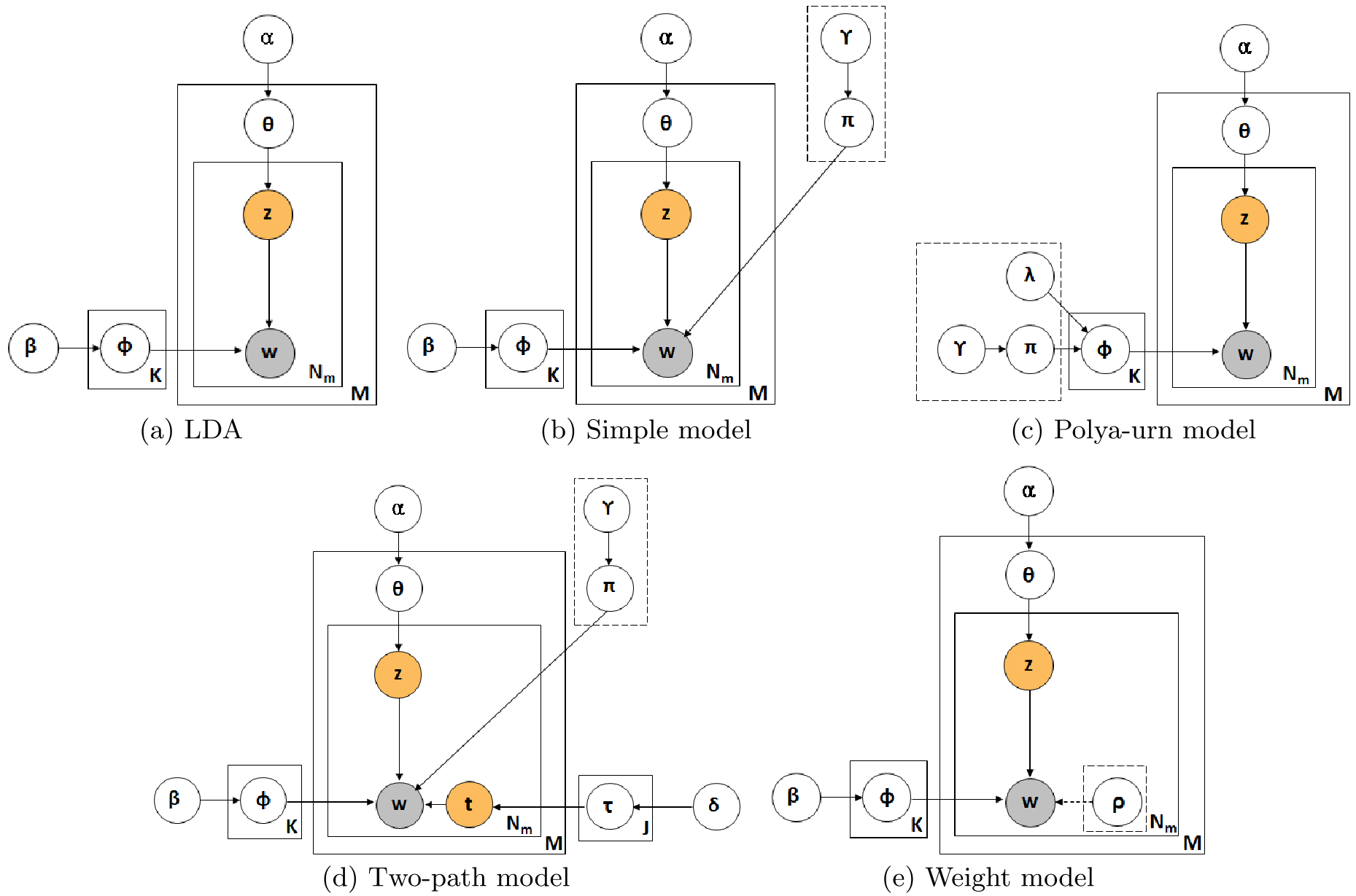 Figure 1: Comparison of standard LDA (a) vs. the proposed Two-Path Model (d) and Weight Model (e).
Experiments & Real-World Impact
The authors tested their approach on a massive Twitter dataset containing 10 million edges.
Quantitative Results
The Two-Path Model emerged as the clear winner. Perplexity (a measure of how well the model predicts unobserved data) dropped significantly:
- 9.41% lower than standard LDA.
- 6.35% lower than the previous SOTA (base-f2step).
Qualitative "Cleansing"
The most striking result is seen in the topic clusters. In a "Technology" topic, standard LDA included barackobama and stephenfry. The Two-Path model successfully shunted these users into the popularity component, resulting in a technology cluster populated exclusively by relevant figures like jack (Jack Dorsey) and jason (Jason Calacanis).
 Figure 2: Top-10 writers for a Technology topic. Left: Standard LDA (polluted by celebrities). Right: Two-Path Model (clean tech-focused users).
Critical Insight: Popularity vs. Activeness
One counter-intuitive finding in the paper is that while Writer Popularity (incoming edges) is a massive source of bias, Reader Activeness (outgoing edges) is not. Following thousands of people doesn't necessarily make a user "topic-insensitive." This suggests that the signal for interest remains robust even in highly active users, whereas the signal for "target" nodes is easily drowned out by sheer fame.
Conclusion
This work demonstrates that in social systems, popularity is not just a frequent occurrence—it is a structural feature of the data distribution. By explicitly modeling this via the Two-Path mechanism, researchers can extract much finer-grained community structures. This approach has broad implications for recommendation engines, where the goal is often to surface "relevant" niche content rather than just the "most popular" items.
Limitations: The model requires Gibbs sampling, which can be computationally expensive on billion-scale graphs, though the "Weight Model" variant offers a more efficient (albeit slightly less accurate) alternative.