
Deciphering Where You Head Next: Integrating Spatial, Temporal, and Social Context in LBSN Recommendations
Incorporating Spatial, Temporal, and Social Context in Recommendations for Location-Based Social Networks
The paper introduces a novel context-aware recommendation framework for Location-Based Social Networks (LBSNs). It enhances traditional User-User Collaborative Filtering (CF) by integrating three specific dimensions: spatial proximity, temporal check-in dynamics, and social network influence, achieving state-of-the-art performance on Foursquare datasets.
TL;DR
This research addresses the inefficiency of "context-blind" recommendation algorithms in Location-Based Social Networks (LBSNs). By augmenting traditional Collaborative Filtering with a multi-layered contextual framework—focusing on where you are, when you last checked in, and who you follow—the authors significantly boost recommendation accuracy, specifically improving Top-1 prediction rates by over 160% through spatial weighting alone.
Moving Beyond Simple Collaborative Filtering
In the world of Amazon or Netflix, distance doesn't matter; a digital book or movie is a click away. In LBSNs like Foursquare or Gowalla, the "item" is a physical venue. Traditional Collaborative Filtering (CF) only looks at overlapping histories. But what if you are in a new city? Or what if your coffee preference has shifted over the last two years?
The authors identify three fatal flaws in vanilla CF for LBSNs:
- Spatial Neglect: Recommending a great restaurant 500 miles away is useless.
- Temporal Decay: A check-in from 2010 shouldn't carry the same weight as one from yesterday.
- Social Isolation: Friendships and group outings are leading indicators of future visits, yet CF often treats all "similar" users equally regardless of social ties.
The Tri-Contextual Framework
The core contribution is a unified prediction formula that modifies the standard CF prediction with three innovative weights.
1. The Temporal Layer
Instead of binary ratings (checked in or not), the model uses a preference value that accounts for frequency and recency.
- Intuition: It forces the model to "forget" old interests and prioritize sustained, recent behaviors.
2. The Social Layer
The similarity measure is adjusted using a social weight . Users who are explicitly friends are prioritized, especially if they have checked into the same locations at the same time (indicating "co-visitation").
3. The Spatial Layer (The Heavy Hitter)
The model applies a Gaussian weighting function to candidate locations based on the distance from the user’s last known location.
- Short-range vs. Long-range: Crucially, the model adapts to different travel patterns—using separate mean travel distances for quick, consecutive check-ins versus long-haul travels.
 Above: The diverse datasets (Foursquare, Brightkite, Gowalla) used to validate the robustness of the framework.
Performance Breakthroughs
The results reveal a clear hierarchy of importance among contextual factors.
- Spatial Influence is King: When spatial context was added, Top-1 accuracy skyrocketed by 165%. It acts as a powerful filter that removes "impossible" candidates that confuse standard CF.
- The Power of Combination: While individual layers (Temporal or Social) improved Mean Average Precision (MAP), the integrated "Combination" model consistently achieved the best balance of ranking quality and hit rate.
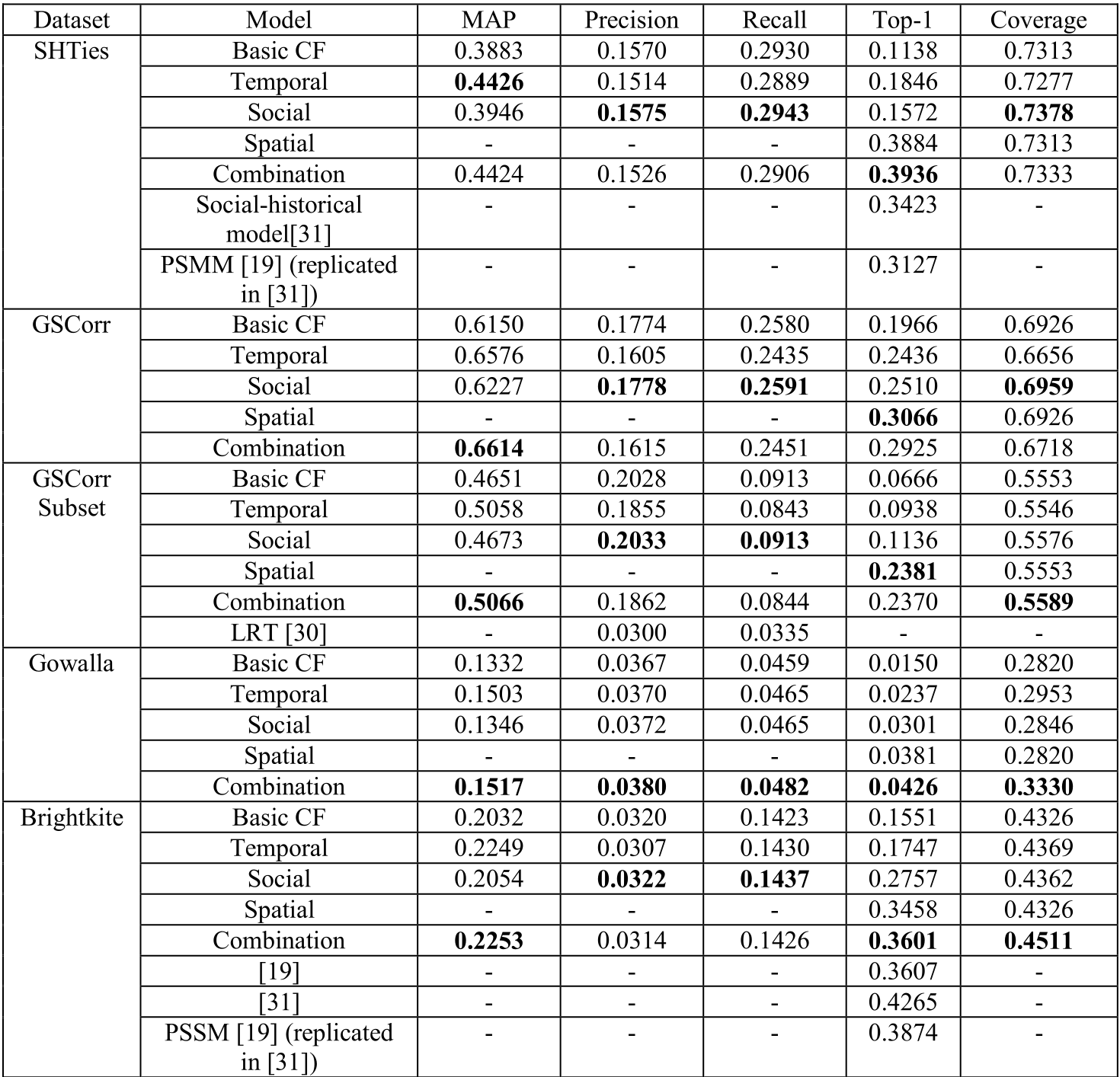 Above: Comparative results showing the "Combination" approach significantly outperforming basic CF across all major metrics.
Critical Analysis: Why This Works
The reason this modular approach succeeds where others fail is its ability to handle Data Sparsity. Most users only visit a fraction of a city's venues. By using spatial and social filters, the model effectively reduces the "search space" for the algorithm, allowing it to focus its limited data on the most probable candidates.
However, there is a trade-off detected: The temporal filter tends to decrease overall "Precision" while increasing "MAP." This suggests that while temporal context is great at putting the very best result at the top, it might exclude secondary locations that the user still occasionally visits.
Conclusion & Future Outlook
This paper proves that for LBSNs, context isn't just "extra info"—it is the foundation of relevance. The dominance of the spatial factor suggests that future recommenders should perhaps treat geography not as a feature, but as a hard constraint.
Future Path: The authors suggest moving toward Adaptive Weighting. Instead of manually setting the importance of Social vs. Spatial factors, the next generation of AI will likely use reinforcement learning to "learn" how much context matters for each specific user based on their unique mobility patterns.