
Word-of-Mouth Mobile Crowdsourcing: Decentralizing the Human Intelligence Network
Increasing Awareness of Physical, Cyber, and Social Interactions
The paper introduces Word-of-Mouth (WoM) Mobile Crowdsourcing (MCS), a decentralized recruitment paradigm where initial crowdworkers recursively recruit others through social and physical networks. It establishes a research architecture for both Internet-scale and local-scale operations to handle time- and location-constrained tasks.
TL;DR
Traditional Mobile Crowdsourcing (MCS) often suffers from a "centralization bottleneck" where platforms struggle to find the right workers for hyper-local or time-sensitive tasks. This paper introduces Word-of-Mouth (WoM) MCS, a paradigm that turns every crowdworker into a recruiter. By leveraging daily physical encounters and digital social networks, the system can "go viral" to find specialized participants, ensuring higher data quality and faster response times even when the central cloud is unreachable.
The Motivation: Why Direct Recruitment Fails
In a world of ubiquitous smartphones, we still struggle with "distributed intelligence" problems—finding a lost child in 30 minutes, or getting real-time tags for a local event. The current "Direct Mode" (e.g., Amazon Mechanical Turk or traditional sensing apps) requires the platform to know everyone. This is inefficient because:
- Locality Ignorance: The platform might not know who is actually next to the event right now.
- Infrastructure Dependence: If the cellular network is congested or down, the task fails.
- Trust Gap: People are more likely to participate in high-effort tasks if asked by a friend (social tie) than by an anonymous server.
Architecture: Internet vs. Local Scale
The authors propose a multi-layered architecture that operates on two scales:
- Internet-connected Mode: Exploits online social networks (OSNs) for wide-area tasks.
- Local Mode: Uses Device-to-Device (D2D) communications (Bluetooth, Wi-Fi Direct) and the Store-Carry-Forward (SCF) mechanism. This is the "tactical" layer where task dissemination happens via physical encounters.
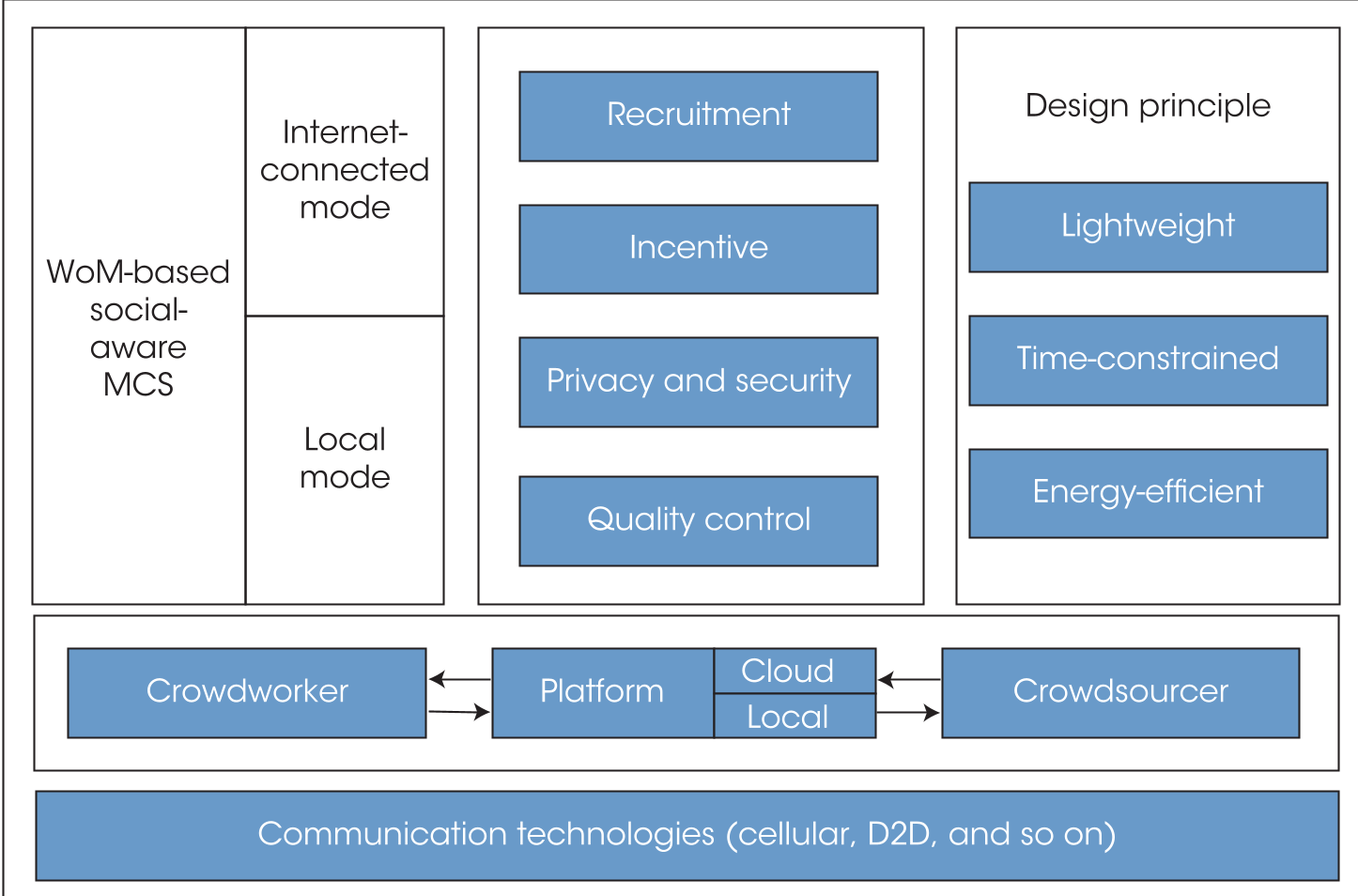
The Core Challenges: More Than Just "Sharing"
Transitioning from direct recruitment to a word-of-mouth model isn't just a UI change; it requires solving deep technical hurdles:
1. Peer Recruitment & Selection
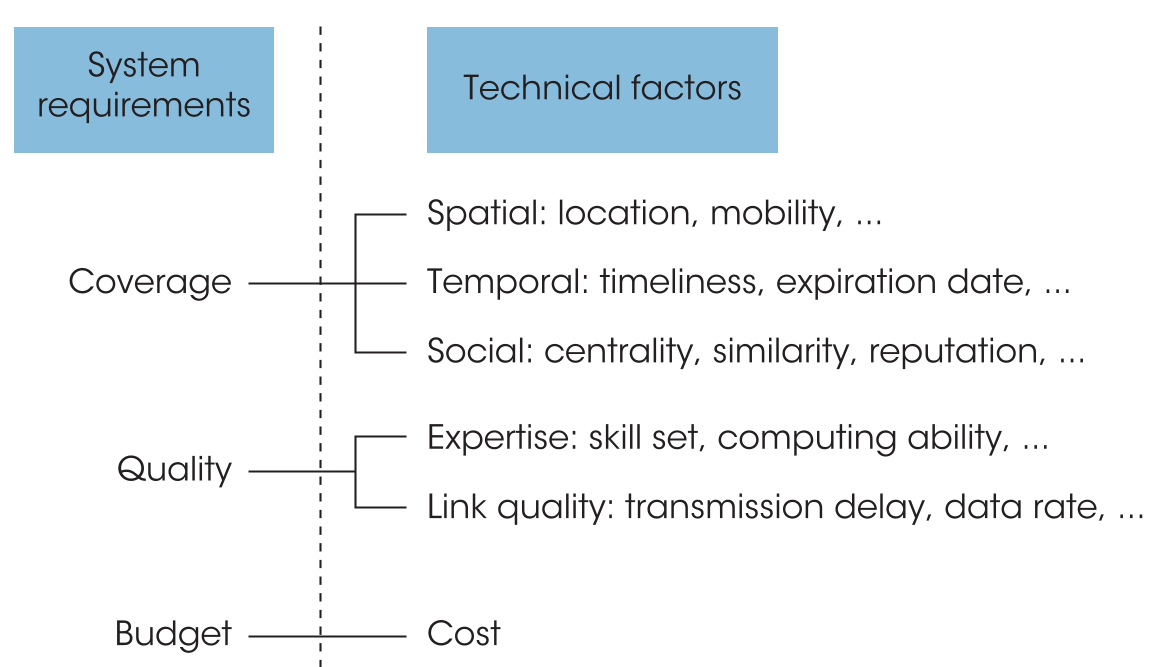
How do you pick the "seeds" (initial workers)? The paper suggests a mix of Offline Selection (context-aware, using predicted mobility) and Online Selection (instantaneous decisions based on real-time encounters). The strategy must balance spatial, temporal, and social factors to satisfy the budget.
2. The Incentive Dilemma (Incentive Trees)
If I recruit you, and you recruit someone else, how do we split the reward?
- The Problem: A fixed budget means more participants = less pay per person.
- The Solution: Recursive incentive structures (like those used in the MIT Red Balloon Challenge) reward the "referral chain." However, the authors argue for Graph-based mechanisms to handle complex social interactions rather than simple trees.
3. Privacy vs. Trust
WoM MCS is a privacy minefield because it tracks your mobility and your social circle. The authors highlight P3Coupon, which uses probabilistic sampling—only recording a fraction of the recruitment chain to maintain "plausible deniability" for individuals while still allowing the platform to calculate overall rewards fairly.
Data Quality: The Social Feedback Loop
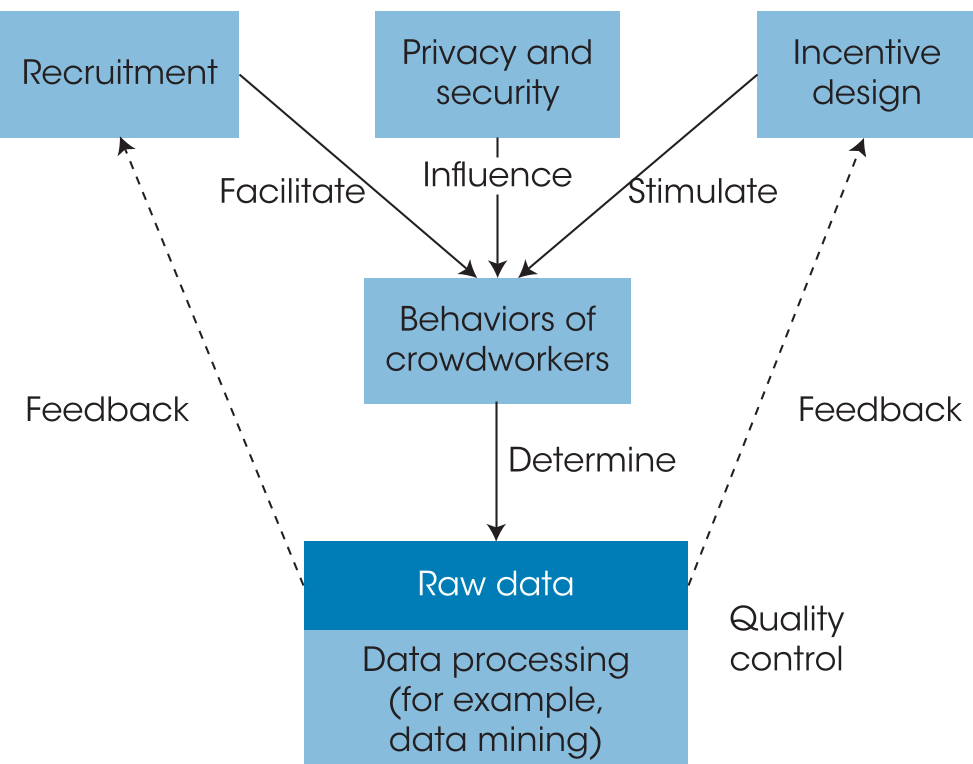
The paper provides a unique insight: in WoM mode, quality impacts the reputation of the entire solicitation chain. If you recruit a malicious worker, your reputation as a recruiter suffers. This creates a natural filter where workers are incentivized to only solicit peers they trust to provide high-quality data.
Critical Analysis & Future Outlook
The "Word-of-Mouth" approach is brilliant because it mimics how information naturally flows in human society. However, two major hurdles remain:
- Energy Efficiency: Continuous D2D scanning for "encounters" can drain a smartphone battery in hours. The authors suggest "non-intrusive" scheduling, but the hardware reality remains a bottleneck.
- Rationality vs. Reality: Most mechanisms assume users are perfectly rational "agents." In reality, social factors (nepotism, laziness, or emotional context) often override economic incentives.
Takeaway: WoM MCS is the future of "Cyber-Physical-Social" systems. It turns the crowd from a passive sensing layer into an active, self-organizing intelligence network capable of operating in the most challenging physical and digital environments.