
Hyperbolic Social Embeddings: Solving the Accuracy-Diversity Dilemma in Recommendations
Increasing recommendation accuracy and diversity via social networks hyperbolic embedding
This paper introduces a social-based recommendation and routing framework that leverages Hyperbolic Embeddings to simultaneously improve recommendation accuracy and diversity. By mapping social network connections and user preferences into a two-dimensional hyperbolic plane, the authors develop a "follower similarity" measure and a context-aware routing algorithm that outperforms traditional Collaborative Filtering.
TL;DR
Researchers have developed a new framework that uses Hyperbolic Geometry to map social networks and user interests. By embedding users in a non-Euclidean space (the Poincare disc), they created a routing algorithm that not only ensures product recommendations reach the most interested people but also increases the diversity of those suggestions without sacrificing accuracy.
The Core Challenge: Beyond the Filter Bubble
Most recommendation engines use Collaborative Filtering (CF) to find "look-alike" users. While effective, this often leads to two problems:
- The Information Silo: Users only see what they already like, missing out on "long-tail" or niche products.
- Routing Inefficiency: In social-selling (like Groupon or eBay), forwarding a deal through a social graph often results in "link rot" or spamming uninterested friends because the network distance doesn't reflect interest similarity.
The authors argue that the "Accuracy-Diversity Trade-off" is not a law of nature, but a limitation of the Euclidean space we use to model similarities.
Methodology: High-Stakes Geometry
The paper introduces a twofold innovation: Follower Similarity and Hyperbolic Routing.
1. Follower-Based Similarity
Instead of just looking at item ratings, the authors define two new ways to weight social connections:
- Non-Rating Based: Similarity is based on the number of common items two users have interacted with, regardless of the score.
- Rating Based: Similarity is inversely proportional to the difference in ratings for common items.
2. Hyperbolic Embedding
Social networks are naturally hierarchical and "tree-like." Euclidean space (flat geometry) is terrible at representing trees without massive distortion. By using a Hyperbolic Plane, the authors can embed the graph such that:
- Every node has a neighbor "closer" to the destination (Greedy Routing).
- Success rates for message delivery reach 100%.
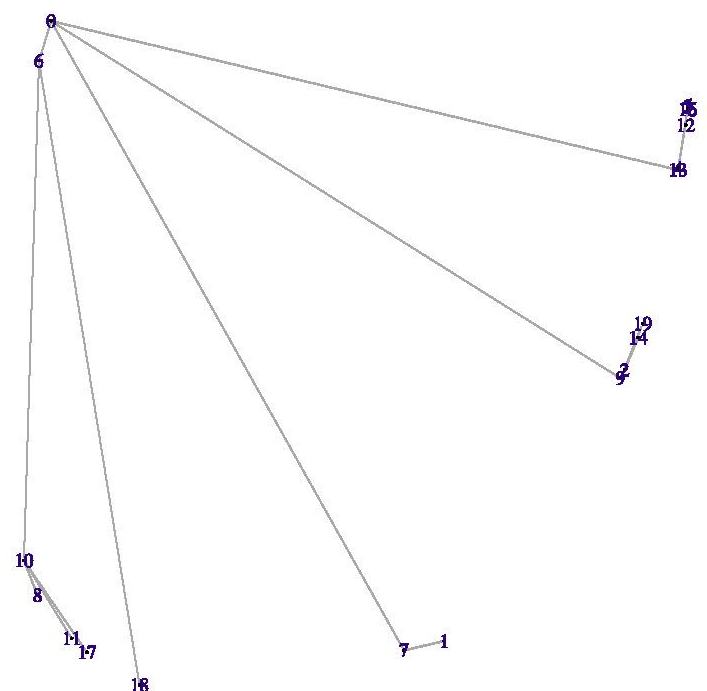 Figure 5: The greedy hyperbolic embedding of a social network in the Poincare disc, where distances expand exponentially near the edge.
Experiments and Results
The researchers tested their model against the gold standard: Douban.com real-world data.
Accuracy-Diversity Trade-off
Using the proposed "Follower-R" (Rating-based) and "Follower-NoR" (Non-rating based) metrics, they compared performance against traditional Cosine Similarity.
- The Verdict: The hyperbolic follower networks achieved a higher "Pareto front." They provided more diverse recommendations for the same level of accuracy compared to Cosine Similarity.
- Path Relevance: In synthetic tests, the "Path Preference" (a proxy for user satisfaction and profit) increased by 94% compared to standard greedy routing.
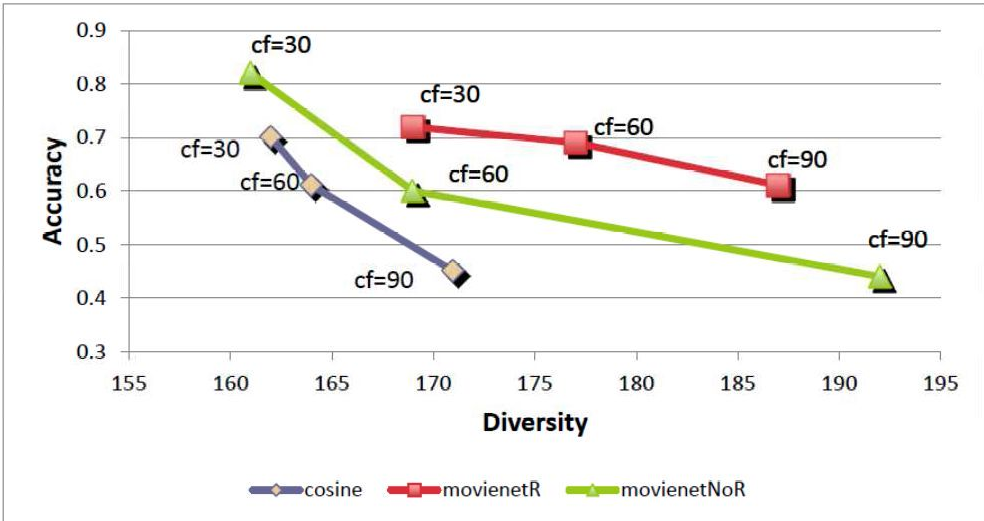 Figure 7: The experimental results showing that the proposed follower-based metrics (FollowerR and FollowerNoR) outperform standard Cosine Similarity in the accuracy-diversity balance.
Critical Insight: Why Hyperbolic?
The physical intuition here is powerful. In a hyperbolic space, the "area" of a circle grows exponentially with its radius. This perfectly mimics the growth of a social network where the number of "friends-of-friends" explodes as you move away from a central node. By aligning the recommendation engine with the natural curvature of social data, the authors reduce the mathematical "stress" of the embedding, leading to better predictions.
Summary & Future Outlook
This work demonstrates that the geometry of the embedding space is just as important as the recommendation algorithm itself.
- Takeaway: If you want diversity, use the Non-Rating Based follower similarity. If you want pure accuracy, stick to the Rating-Based approach.
- Limitations: The current model uses a static snapshot of preferences; future work could explore how these hyperbolic coordinates shift as user tastes evolve in real-time.