
Increasing Trust in Meta-Heuristics: The MAP-Elites Approach to Urban Logistics
Increasing trust in meta-heuristics by using MAP-elites
This paper introduces a framework to enhance human trust in meta-heuristic optimization by employing the MAP-Elites (Multi-dimensional Archive of Phenotypic Elites) algorithm. It focuses on solving the "Micro-Depot Problem" in urban logistics, transforming the "black-box" optimization process into a transparent, navigable map of high-quality alternative solutions.
TL;DR
Meta-heuristic algorithms often act as "black boxes" that experts find difficult to trust. This paper proposes using the MAP-Elites algorithm to not only find the "best" solution but to map out an entire landscape of high-quality alternatives. By providing a traceable history of how solutions evolved and interactive tools to explore trade-offs, the authors aim to bridge the gap between algorithmic stochasticity and human decision-making.
Problem & Motivation: The "Black Box" of Evolution
In fields like logistics and scheduling, domain experts often view Evolutionary Algorithms (EAs) with skepticism. The reason is twofold:
- Iterative Opacity: The path from a random starting point to a final optimized schedule is guided by stochastic operators (mutation/crossover) that are hard to justify logically to a human observer.
- Lack of Agency: Users are often presented with a single "optimal" solution. If that solution contradicts their intuition, they have no easy way to explore "nearby" alternatives or understand why their preferred strategy was discarded.
The authors argue that trust can be built through inductive trust—repeated successful interaction—and by making the internal decisions of the algorithm explainable.
Methodology: Illuminating the Solution Space
Instead of searching for a single global optimum, the authors use MAP-Elites.
The Core Mechanism: Quality-Diversity (QD)
MAP-Elites partitions the search space into "bins" based on phenotypic characteristics. For the Micro-Depot Problem (MDP), these dimensions are:
- Pollution (CO2 emissions)
- Distance (km)
- Number of Couriers
- Total Timespan
As the algorithm runs, it populates these bins. If a new solution is found for an occupied bin, it only stays if its "fitness" (Total Financial Cost) is better than the current occupant.
 Figure 1: Thermal map visualization of a 4D elite archive, showing how the algorithm "illuminates" different niches of the solution space.
Traceability: The Solution Timeline
To solve the "Why this?" question, the authors record the ancestry of each bin. Every time a bin is updated with a better solution, the event is logged. A user can look at a specific solution and see a linear timeline (Table 1 in the paper) showing exactly how it was refined over time and which parent solutions contributed to its success.
Experiments: Solving the Micro-Depot Problem
The authors applied this to an urban logistics scenario where goods are moved from a central depot to micro-depots, then delivered by walking couriers or cargo bikes.
Interactive Exploration
To prevent "choice paralysis" (given the 160,000 potential bins), the authors propose Parallel Coordinate (PC) plots. This allows the user to say, "Show me only solutions that use fewer than 6 couriers and have low CO2," and see the resulting trade-offs in distance and time immediately.
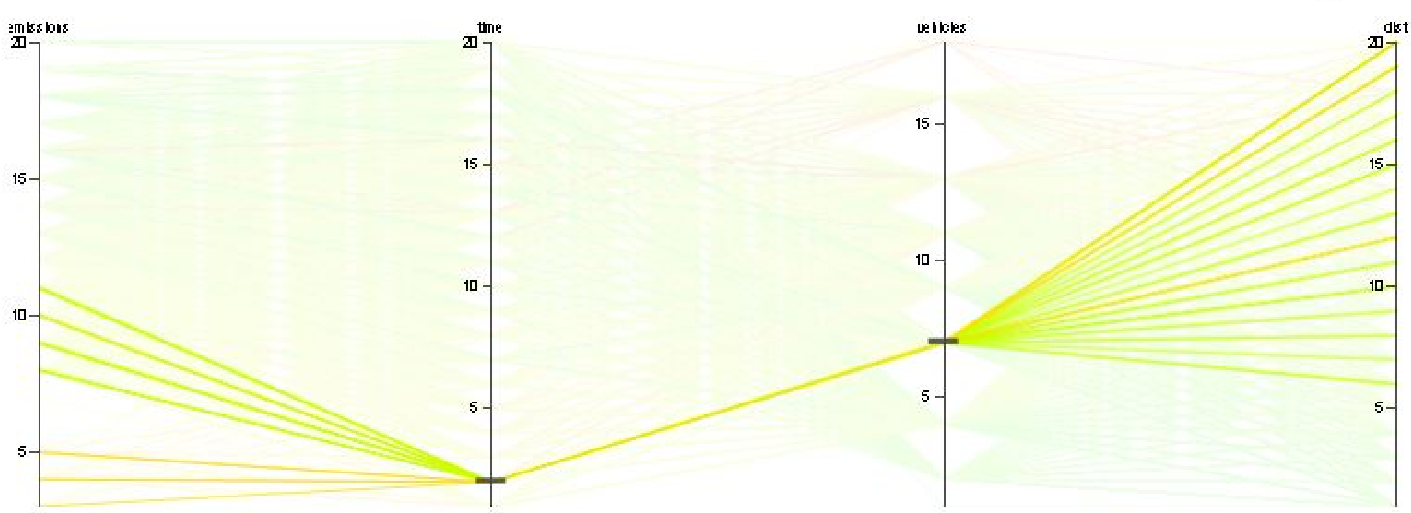 Figure 2: Interactive Parallel Coordinate plot allowing users to filter the archive and focus on solutions that meet specific practical constraints.
Critical Analysis & Conclusion
The strength of this work lies in its shift from Optimization as a Result to Optimization as a Process.
Key Takeaways:
- Diversity is a Feature: In real-world logistics, the "mathematically optimal" solution might be brittle. Having a diverse archive of elites allows for operational flexibility.
- Explainability via Evolution: Tracing the "history" of a bin provides a narrative that is much easier for humans to digest than raw fitness scores.
Limitations: The paper is a position paper; while the framework is conceptually sound, it lacks empirical user studies to prove that experts actually feel more trust when using these tools. The authors acknowledge this and plan to perform split tests comparing MAP-Elites visualizations against standard Pareto fronts.
Future Outlook: This approach could be highly influential in Human-In-The-Loop (HITL) AI, where the goal is to augment human expertise rather than replace it.