
Marketing Attribution: Beyond Heuristics to Incremental Causal Effects
Estimating the incremental effects of interactions for marketing attribution
This paper introduces an algorithmic framework for Marketing Attribution that employs an econometric approach to estimate the "true incremental effect" of marketing channels. By utilizing logistic regression and a counter-factual model (Average Treatment Effect), the authors successfully attribute orders and revenue to specific touchpoints, outperforming traditional rule-based methods like "Last Touch."
TL;DR
Marketers have long struggled to answer: "Which ad actually caused the sale?" This paper moves past simplistic rules like "Last-Click" by applying econometric counter-factual modeling. By estimating the probability of purchase with and without a specific interaction, the authors reveal the true incremental value of channels—discovering that some under-appreciated channels like Email and Search Ads are significantly more valuable than they appear.
Background: The Attribution Dilemma
In a typical digital journey, a user might click a search ad, view a social post, and receive an email before finally navigating "Directly" to the site to buy. A Last-Touch model gives 100% of the credit to the "Direct" visit. This is fundamentally biased; it mistakes the final step for the entire motivation. The industry needs a way to see the "incremental" contribution of each touchpoint.
Methodology: The Counter-Factual Framework
The core of the paper is a transition from correlation to causal intuition. The authors treat marketing interactions as "treatments" in a medical trial.
The incremental effect for a channel is calculated as:
Why this matters:
- Logical Grounding: It answers the question: "If I stopped spending on this channel, how many sales would I actually lose?"
- Flexibility: While the authors use Logistic Regression to estimate these probabilities, the framework allows for more complex models like Random Forests or Neural Networks to capture non-linear synergies between channels.

Automatic Segment Detection
The paper doesn't stop at global attribution. It introduces an automated way to find audience segments (like Geography or Device Type) where attribution patterns differ significantly. They use the Akaike Information Criterion (AIC) to determine if adding segment-specific parameters improves the model's predictive power without overfitting.
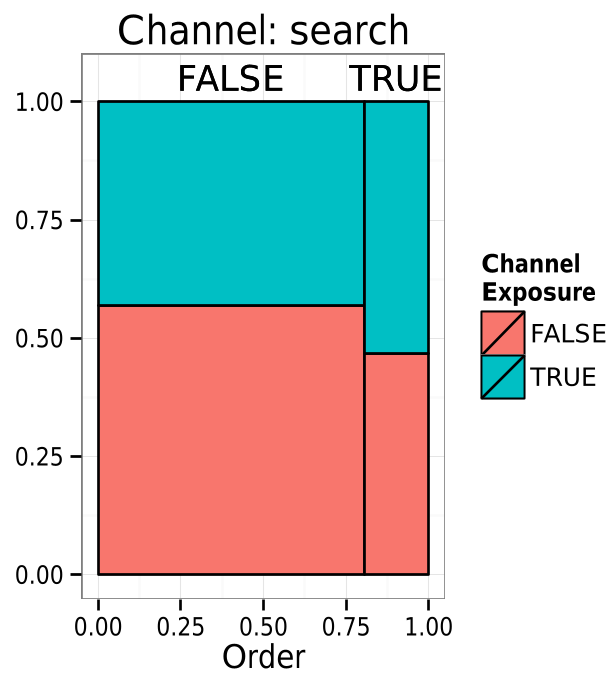 Fig 1: Visualization of contingency tables showing how interactions with Search and Display ads correlate with actual purchase status.
Experimental Insights: Exposing Rule-Based Biases
Using data from 26 million visitors in the travel industry, the results were eye-opening:
- Direct Channel Overvaluation: Under "Last Touch," Direct navigation was the king. Under the proposed Data-Driven model, its importance dropped because those users likely would have converted anyway due to prior interactions.
- The "Email" Effect: The data-driven model showed that Email had 3x the impact than what Last-Touch suggested.
- Revenue vs. Orders: "Travel Agents" contributed massive revenue values even if they weren't the "Final Click," suggesting they attract higher-spending customers.
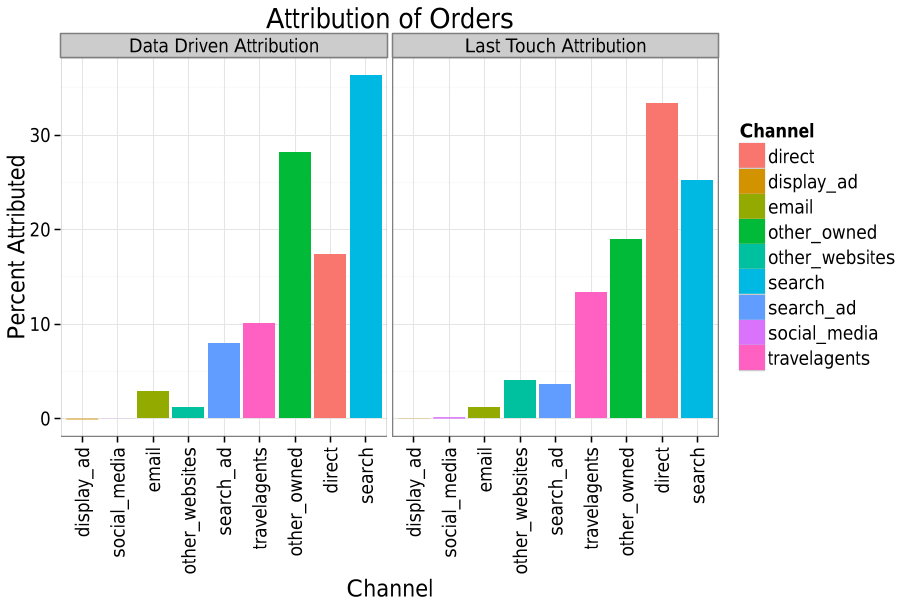 Fig 2: Comparison between Last-Touch (Rule-based) and Data-Driven Attribution. Note the significant shifts in 'Search Ad' and 'Email' importance.
Critical Analysis & Conclusion
Takeaway
The value of this work lies in its interpretability. Unlike black-box models, it provides results in "incremental orders" and "incremental revenue," which are the primary languages of business stakeholders.
Limitations
- The Halo Effect: The model currently focuses on digital touchpoints. It struggles with "Offline-to-Online" effects (e.g., a TV ad causing a Search query).
- Causal Assumptions: The approach assumes there are no unobserved variables influencing both the marketing exposure and the purchase decision—a common challenge in observational data.
Future Outlook
The next step is the integration of Media Mix Modeling (MMM) with this individual-level attribution. By bridging the gap between top-down aggregate spending and bottom-up user journeys, marketers can finally achieve a holistic view of budget efficiency.