
IcLEOD: Unmasking Deeply Hidden Anomalies in Evolving Social Networks
Incremental Local Evolutionary Outlier Detection for Dynamic Social Networks
This paper introduces IcLEOD, an incremental algorithm specifically designed to detect Local Evolutionary Outliers (LEOutliers) within dynamic, weighted social networks. By focusing on the evolution of a node's "Corenet"—a localized substructure balancing topology and edge weights—the method identifies abnormal behavioral shifts relative to an object's immediate neighborhood across network snapshots.
TL;DR
In the vast, shifting landscape of social networks, traditional "global" anomaly detection misses the nuance of local behavior. A teacher leaking an exam paper might look normal compared to the whole faculty, but abnormal compared to their specific team of paper setters. This paper introduces IcLEOD, an incremental algorithm that identifies these Local Evolutionary Outliers (LEOutliers) by tracking the evolution of a node's weighted local neighborhood—the "Corenet"—with high efficiency and precision.
Background & Motivation: The Local-Global Paradox
Social networks are not just collections of dots; they are hierarchical structures where nodes belong to small groups, which in turn belong to larger communities. Most prior work (like CEOD) focuses on Global Outliers—nodes that deviate from a community's average trend.
However, the authors point out a critical blind spot: an object might follow a global trend while violating the principles of its local context.
- The Problem: Global normalization hides local variance.
- The Challenge: Massive graph sizes (millions of nodes) make re-calculating everything at every time step (snapshot) computationally impossible.
- The Insight: By defining a Corenet—a localized substructure that considers both who you are connected to and the strength of those connections—we can pinpoint anomalous "evolutionary shifts" without looking at the whole graph.
Methodology: Building the "Corenet"
The methodology consists of two sophisticated phases:
Phase I: Discovering the Corenet
The authors argue that standard "Egonets" (1-hop neighbors) are too simple. They propose Closeness Related to the Core, a metric that calculates the "closeness transmission" along paths. A node 2 hops away might be "closer" to you than a direct acquaintance if the relationship weights are significantly higher.
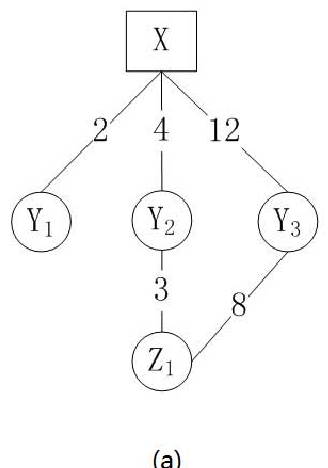
The Corenet is defined as the top-k closest neighbors that reside within a 2-hop radius (Super-egonet). This prevents "closeness drift" where irrelevant distant nodes are pulled in.
Phase II: Incremental Scoring
Instead of re-analyzing the whole graph when a bridge is added or a weight changes, IcLEOD identifies the Incremental Nodes Collection (IC)—only those nodes whose Corenet could possibly have changed.
The Outlying Score is then calculated by comparing the Corenet at time and :
- Retention Loss: Are old neighbors disappearing or becoming more distant?
- Sudden Novelty: Are new neighbors appearing with suspiciously high closeness but low historical structural ties?
Experiments & Results
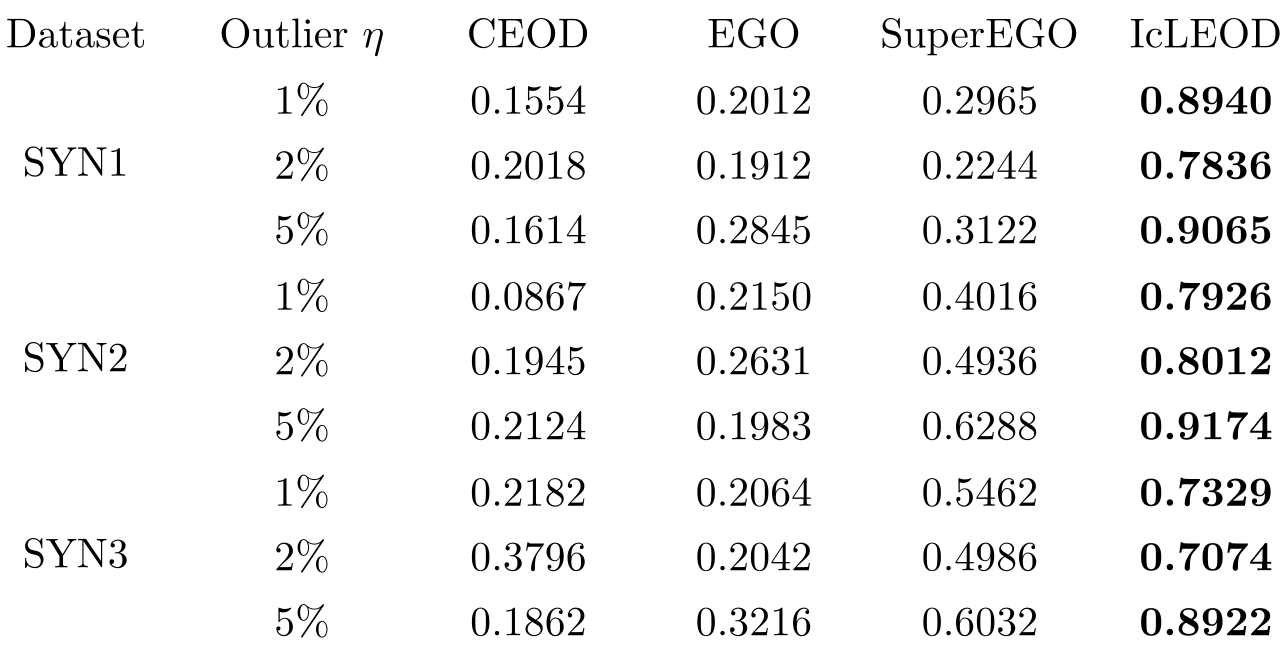
The authors tested IcLEOD against three baselines: CEOD (Community-based), EGO (1-hop), and SuperEGO (2-hop structure only).
High Precision in Local Context
As shown in the table below, IcLEOD maintains an F1-score between 0.70 and 0.91, while baselines often fall below 0.30. This confirms that without considering edge weights and localized evolution, most local outliers remain "invisible."
Efficient Scalability
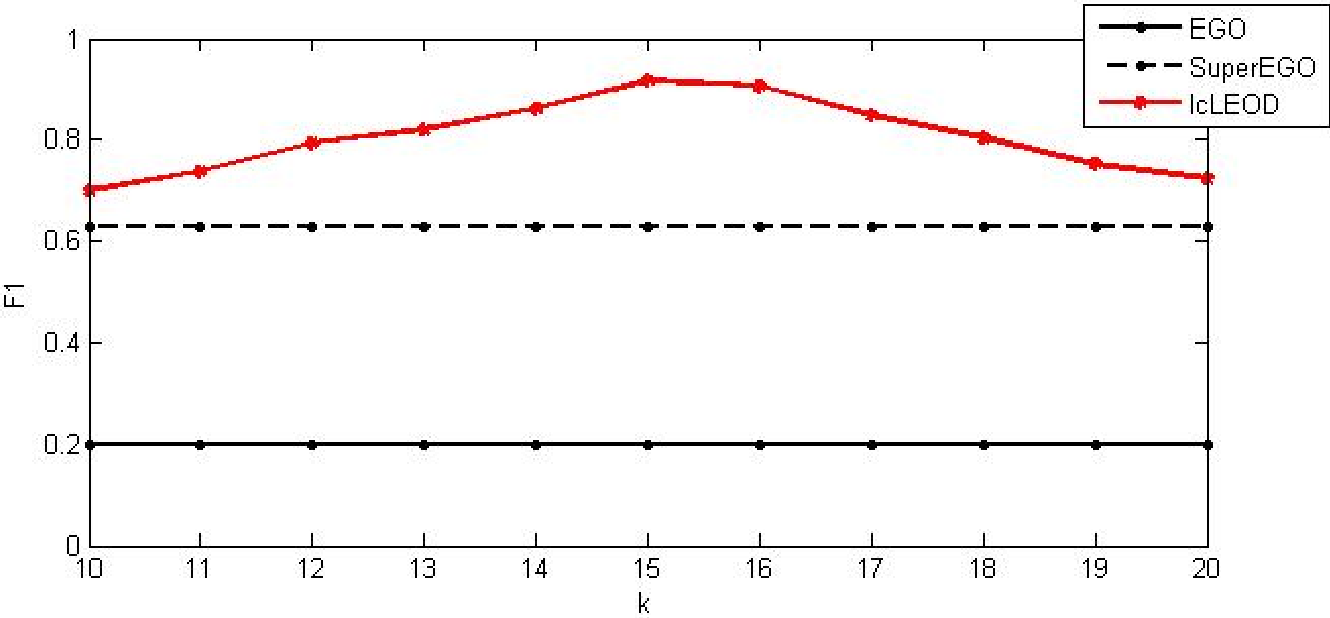
One of the most impressive feats is the algorithm's time complexity. Because it only processes the IC (affected nodes), the computation time scales linearly with the number of changes, not the total size of the graph. For a network of 10,000 nodes, detection takes less than 20 seconds.
Real-World Case Study: Alexander Tuzhilin (DBLP)
The authors applied IcLEOD to the DBLP co-authorship network. It identified researcher Alexander Tuzhilin as an outlier between 2001 and 2008. The reason? He shifted his entire research focus from Association Rules to Recommendation Systems, completely replacing his "Corenet" of co-authors. While a global view might just see him as a "busy researcher," the local view captures this drastic career pivot as an evolutionary anomaly.
Critical Insight & Conclusion
The value of the IcLEOD framework lies in its Inductive Bias: it assumes that in a social network, your "true" peer group is defined by interaction strength, not just immediate adjacency.
Takeaways for Practitioners:
- Focus on the Delta: When monitoring dynamic systems, only process what changed and its immediate radius.
- Weight Matters: Unweighted graphs are lossy abstractions; the strength of the edge is often more informative than the existence of the edge itself.
While IcLEOD is powerful, future work could integrate more complex "neighbor types" or temporal decay factors to further refine what constitutes a "normal" shift versus a suspicious one.