
IncreSTS: Cracking the Real-Time Code for Social Media Comment Streams
IncreSTS: Towards Real-Time Incremental Short Text Summarization on Comment Streams from Social Network Services
This paper introduces IncreSTS, a fully incremental algorithm for real-time short text summarization on social network comment streams. By employing a novel incremental clustering framework and specialized similarity measures, it groups similar comments into "opinion groups" and visualizes them through key-term clouds.
TL;DR
Social media "explosions"—where a single post garners thousands of comments in minutes—create a massive information overload. IncreSTS is a specialized algorithm that clusters these rapid-fire, informal short texts incrementally. It allows users to see a "live" summary of opinions without the system needing to re-calculate everything from scratch every time a new comment arrives.
The Problem: The Chaos of the "Social Stream"
Most clustering algorithms were built for static documents or slow-growing datasets. Social Network Services (SNS) present three unique hurdles:
- Velocity: Comments pour in at a rate that makes batch processing (re-clustering everything) impossible for real-time UI.
- Sparsity: A comment like "Love this!" has very few features for a machine to work with.
- Noise: Over 90% of comments are "outliers" (slang, emojis, or unique gibberish) that shouldn't derail the main summary.
Methodology: The "Local Optimum" Strategy
Rather than trying to find the mathematically perfect global cluster (which changes every second), IncreSTS focuses on Radius-Constrained Clustering.
1. Smart Text Pre-processing
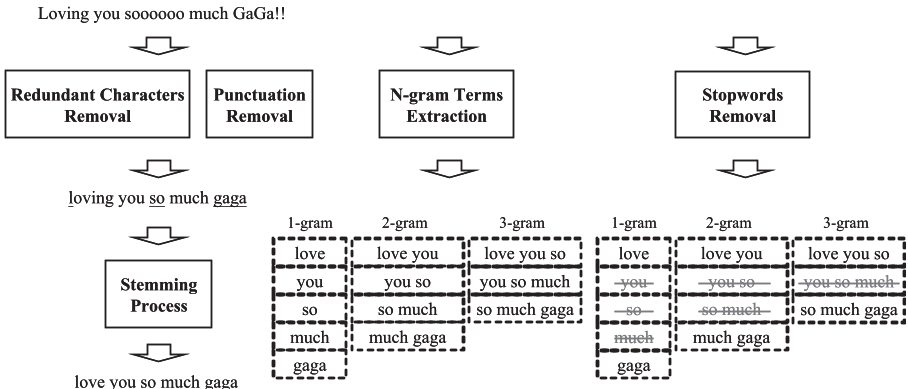
The authors don't just use standard NLP. They've built heuristics specifically for "Internet-speak," such as redundant character removal (turning "soooooo" into "so") and n-gram extraction where stopwords are only removed if the entire phrase is a stopword.
2. The Incremental Pivot
When a new comment () arrives, IncreSTS doesn't look at all possibilities. It follows a 3-step logic:
- Assignment: See if it fits within the "Radius" () of an existing large cluster.
- Absorption: Check if the arrival of allows the cluster to "pull in" comments that were previously outliers.
- Maintenance: Only update the specific clusters affected, using an inverted index data structure to keep the complexity near constant rather than linear to the number of comments.
Performance: Real-Time or Bust
The breakthrough performance of IncreSTS is best seen in its scalability. While traditional methods like K-Means or LDA see their execution time skyrocket as comments grow, IncreSTS's update time remains remarkably flat.
- Efficiency: Updating a 15,000-comment stream takes just ~270ms.
- Precision: Despite being "incremental," the precision of the top opinion groups remains above 96%.
Insight: The Visualization Interface
The end goal isn't just a list of clusters—it's understanding. IncreSTS uses the cluster centers to generate Key-Term Clouds. By weighting n-grams (2-grams, 3-grams) higher than unigrams, the system highlights meaningful phrases like "look like zombie" or "too skinny" over generic words.
Critical Analysis & Conclusion
IncreSTS is a masterclass in engineering for the use-case. By effectively defining 90% of data as outliers and focusing on the "Top-K" most popular opinions, it bypasses the computational traps of deep topic modeling.
Limitations: The method relies heavily on keyword overlap. In the era of modern LLMs, it would struggle with semantic synonyms (e.g., "Great outfit" vs. "Beautiful dress" might be seen as different clusters if they don't share words). However, for a 2014-era CPU-bound environment, IncreSTS's design is exceptionally elegant.
Future Work: Integrating dense vector embeddings (like Sentence-BERT) into the IncreSTS incremental framework could potentially solve the semantic gap while maintaining the real-time speed that this paper pioneered.