
IWS-CD-LP: Breaking the Echo Chamber in Crowdsourcing via Network Science
Independent Worker Selection In Crowdsourcing
The paper introduces IWS-CD-LP, a framework for selecting independent workers in crowdsourcing to prevent plagiarism and collusion. It combines community detection and link prediction to ensure workers have minimal current social connections and a low probability of forming future ones.
TL;DR
In crowdsourcing, "more" isn't always "better" if your workers are copying each other. This paper presents IWS-CD-LP, a dual-layer selection framework that uses community detection (CD) and link prediction (LP) to identify independent workers. By analyzing social ties, the model successfully reduced worker homogeneity by 56.3%, ensuring that solutions are diverse and free from collusion.
Background: The Hidden Threat of Homogeneity
Most crowdsourcing platforms (like Amazon Mechanical Turk) select workers based on their individual track records. However, workers are not isolated islands; they congregate in forums (e.g., Reddit, MTurkGrind) and share information. This leads to homogeneity, where workers provide identical, plagiarized, or biased results. The authors argue that for tasks requiring creative diversity (like brainstorming or subjective surveys), selecting independent workers is just as important as selecting capable ones.
The Core Insight: Present vs. Future Connections
The challenge of independence is twofold:
- Current Connection: Are workers already talking to each other?
- Future Connection: Are they likely to meet or collaborate soon?
The authors solve this by treating the worker pool as a Social Network Graph.
Methodology: The IWS-CD-LP Framework
1. Community Detection (CD) - Finding the "Ouroboros"
The first step involves modularity optimization. The system detects "communities" or clusters within the worker population. To maximize independence, the authors proposed several strategies, finding that the EOCL (Least Edge Out of Community) method works best—selecting nodes with the fewest connections to the outside world.
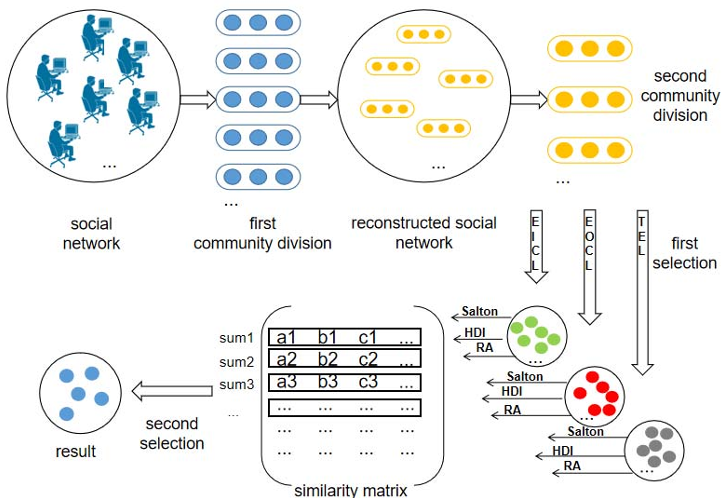 Fig 1: The IWS-CD-LP model workflow involving community identification and similarity-based filtering.
2. Link Prediction (LP) - Anticipating Collaborations
Even if two workers are currently in different communities, they might share many mutual friends, making a future connection likely. The framework uses the Resource Allocation (RA) index to calculate structural similarity. By selecting workers with the lowest RA scores, the model ensures long-term independence.
Experimental Results: Quantitative Independence
The authors validated their model using real-world data from four major worker forums. They used three key metrics: (expected crossover), (average community closure), and (differentiated closure).
- Baseline Comparison: Random selection results in worker sets where and are nearly equal to the population probability , indicating zero independence gain.
- The Big Win: The IWS-CD-LP model significantly pushed and below . Specifically, the combination of EOCL and RA index slashed homogeneity by over 50%.
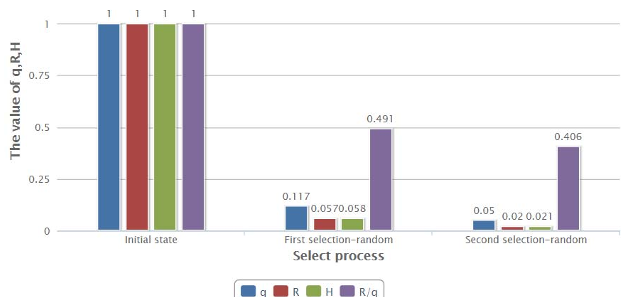 Fig 2: Comparison of homogeneity metrics (R, H, q) under the IWS-CD-LP model, showing a clear reduction in worker connections.
Critical Analysis & Conclusion
This paper shifts the focus of worker selection from "competence" to "topology." By treating independence as a structural property of a social graph, it provides a mathematical framework to combat plagiarism.
Limitations: The model relies on the availability of metadata (location, forum usage, etc.). In highly anonymous settings, building an accurate social graph might be challenging. Additionally, as attackers (plagiarizers) become more sophisticated, they might intentionally mask their social ties.
Future Outlook: We expect this "Social-Aware" selection logic to move into Generative AI evaluation, where researchers need diverse "Human-in-the-loop" feedback to avoid model collapse caused by repetitive training data.