
Quantity vs. Quality: Decoding Hidden Social Influence in Online Systems
Individual behavior and social influence in online social systems
This paper investigates the causality between individual behavior and social influence by analyzing the diffusion of the "geotagging" innovation on Flickr. Using a social graph of 525k nodes, the authors propose a shuffletest-based method to detect social influence and a "wisdom of the crowd" metric to quantify user credibility (quality of behavior).
TL;DR
By analyzing 13 million geotagged photos on Flickr, this study explores a fundamental question: What makes a person influential? While we intuitively expect both active and "credible" users to lead trends, the data reveals a startling gap: Activity/Quantity significantly drives influence, but Credibility/Quality is effectively invisible to the network, failing to aid the spread of innovations.
Context: The Macro-Micro Gap
In the study of online social systems, we are often good at observing what happens (macroscopic patterns) but poor at understanding how individual traits (microscopic behaviors) cause those patterns. This paper bridges that gap by studying the adoption of geotagging—the act of adding geographical metadata to photos—as a technological innovation spreading through the Flickr social graph.
1. Detecting Real Influence: The Shuffle Test
How do we know if a user adopted geotagging because of a friend, or simply by chance? The authors employ a Shuffle Test.
- The Logic: If timing is irrelevant, then shifting the order of activations (shuffling) shouldn't change the results.
- The Result: The "original" sequence of activations showed significantly more "influenced" nodes (those with active neighbors) than the "shuffled" sequence. This confirms that geotagging adoption on Flickr is a contagious cascading process, not a series of random events.
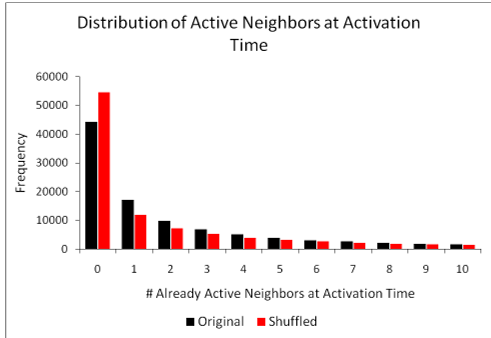 Figure 1: Comparison between original and shuffled activations shows that social influence is a dominant factor in innovation adoption.
2. Methodology: Measuring "Credibility"
A core contribution of this work is the quantification of User Credibility. The authors ask: "How accurately does a user place their photo on a map?"
Using the Wisdom of the Crowd principle, they didn't just compare a user's pin to a static coordinate. Instead:
- They mapped text tags to WOEIDs (Where On Earth IDs) using Yahoo! Placemaker.
- They calculated the Geodesic Distance (accounting for Earth's ellipsoid shape) between the user's pin and the "target" location.
- A user's action is a "Hit" only if they are more accurate than the average user for that specific location.
3. The Great Paradox: Activity vs. Credibility
The researchers categorized 25,000 users into groups based on their Activity (how much they geotag) and Credibility (how accurately they geotag).
The Active Influence
The data confirmed that the most active users are roughly 23% more influential than the least active. High visibility and frequency act as reinforcements, signaling the innovation to their social circle.
The Hidden Credibility
Surprisingly, Credibility had almost zero correlation with influence. A user could be the most accurate geotagger in the world, but their friends were no more likely to adopt the technology because of them.
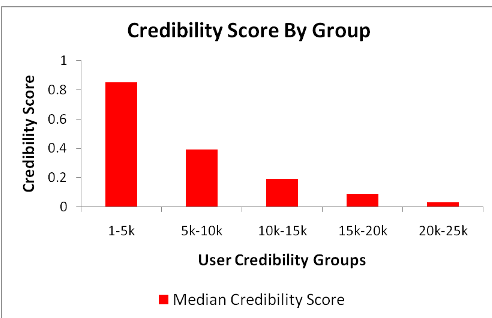 Figure 2: Social influence increases with user activity (left), but remains stagnant regardless of user credibility levels (right).
Deep Insight: The Value of Visibility
Why is quality ignored by the network? The authors argue it is a design failure.
In most social systems, we can easily see how many posts a friend has made (Quantity), but we have no quick metric for how accurate those posts are (Quality). Because credibility is "hidden" by the interface, it cannot exert social pressure or influence.
Conclusion & Future Outlook
This paper serves as a wake-up call for UX designers and social platform architects. If we want higher-quality information to spread (e.g., reducing misinformation or encouraging expert contributions), we must design mechanisms that reveal the quality of behavior to peers.
Current systems favor the "loud" (active) over the "right" (credible). Future social design should aim to balance this by surfacing individual expertise, allowing quality to finally become a driver of social contagion.