
Behavioral DNA: Decoding Individual Characteristics through LSTM and Social Networks
Individual Characteristics Analytical Models based on Deep Learning, Trajectory and Social Network Data
This paper introduces a hybrid individual characteristic analysis framework that combines Deep Learning (LSTM) and Social Network Analysis to classify individuals (e.g., criminal suspects). By processing multi-modal data—static features, spatiotemporal trajectories, and social link structures—the authors achieved a state-of-the-art accuracy improvement of 5% on average compared to baseline models.
Executive Summary
TL;DR: Researchers from Tongji University have pioneered a deep learning framework that transforms raw movement trajectories and social links into a "digital fingerprint" for individual classification. By leveraging LSTM (Long Short-Term Memory) networks for temporal feature extraction and an ensemble stacking architecture, they increased suspect identification accuracy by a substantial 5% margin over traditional baselines.
Positioning: This work bridges the gap between traditional urban surveillance and modern AI, moving from simple empirical "scoring" to latent behavioral modeling within the Public Safety domain.
1. The Core Challenge: Static Models in a Dynamic World
Most prior work in individual profiling relies on static data: age, occupation, or simple historical counts. However, true "characteristics" are hidden in dynamics:
- The Trajectory Problem: Human movement is sequential. Traditional models flatten these into averages, losing the "rhythm" of behavior (e.g., specific check-in times associated with suspicious activity).
- The Relation Problem: Social networks aren't just about who you know, but the nature of those connections and the attributes of the peers within that network.
The authors recognized that to categorize a person accurately, one must look at the Time-Space-Relation triad.
2. Methodology: From Raw Points to Latent Vectors
A. Trajectory Feature Extraction (The LSTM Path)
The authors moved beyond simple empirical formulas (like the exponential decay of time importance) and utilized an LSTM-based architecture.
- Normalization: Spatiotemporal data (Long/Lat, check-in/out times) are geocoded and normalized to a 0-1 range.
- Sequence Processing: For each individual, their activity sequence is fed into an LSTM.
- Feature Fusion: The final hidden state () from the LSTM, representing the compressed "logic" of the trajectory, is used as the high-level feature for classification.
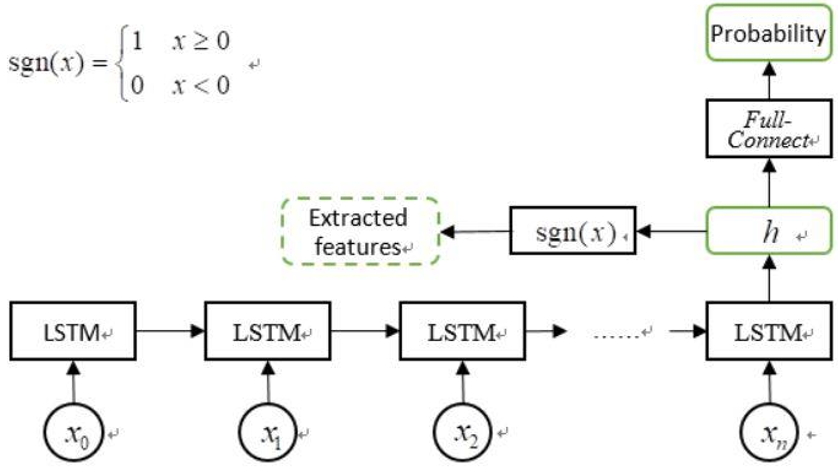 Figure 1: The architecture showing how raw trajectory vectors are transformed via LSTM layers and a Fully Connected layer into a classification probability.
B. Social Network Analysis
Instead of just counting "friends," the model analyzes:
- Node Degrees: Centrality of the individual.
- Peer Categories: The proportion of "suspicious" neighbors vs. "ordinary" neighbors.
- Relationship Types: Distinguishing between types of relations and categories of people to create a multi-dimensional social feature vector.
3. Experimental Breakthroughs: Does it Work?
The authors evaluated their model across four datasets (Basic, +Social, +Trajectory, +Full).
Key Performance Indicators:
- Accuracy Boost: The Stacking model achieved 87.44% accuracy on the full dataset (Data4), a marked improvement over the 82.37% achieved using static data alone (Data1).
- LSTM vs. Math Formulas: Feature extraction via LSTM significantly outperformed manual empirical formulas, proving that deep learning can "see" patterns in movement that humans cannot easily quantify.
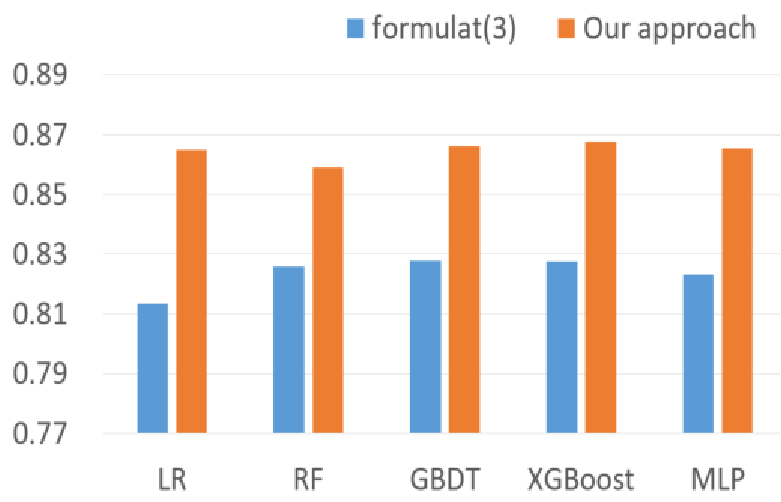 Figure 2: Performance comparison across different algorithms (LR, RF, GBDT, etc.). Note the consistent superiority of the Stacking approach.
The Stacking Advantage
The study utilized a two-tier Stacking framework:
- Tier 1: Trained diverse base learners (XGBoost, GBDT, MLP).
- Tier 2: A Meta-learner (Neural Network) that synthesizes the predictions from Tier 1 to produce the final result, effectively reducing individual model bias.
4. Critical Insight & Conclusion
Takeaway: The real value of this research lies in its methodological flexibility. By treating trajectories as time-series and social links as feature-rich attributes, the model creates a holistic view of the individual.
Limitations:
- The model relies on structured trajectory data (hotels/Internet cafes), which may be sparse for typical citizens.
- The current social network model is relatively static; future iterations could benefit from Temporal Graph Networks (TGNs) to see how social circles evolve over time.
Future Outlook: This framework is not limited to security. The same architecture could revolutionize personalized urban services or epidemiological tracking, proving that our trajectories are more than just points on a map—they are a story that AI is finally learning to read.