
SVM-with-kNN: Bridging the In Vitro to Clinical Gap in Personalized Oncology
2975_Individual Drug Treatment Prediction in Oncology Based on Machine Learning Using Cell Culture Gene Expression Data.
The paper introduces a hybrid machine learning framework, SVM-with-kNN, designed to predict individual drug treatment responses in oncology. By leveraging large-scale cell line gene expression data (CancerRxGene) as a training set and signaling pathway activation scores (PAS) as features, the method achieves SOTA-level predictive accuracy on small-scale clinical patient datasets.
TL;DR
Predicting how a specific patient will respond to a specific cancer drug is the "holy grail" of personalized medicine. However, clinical data is scarce. This paper proposes a clever hybrid approach: training models on thousands of laboratory cell lines but using a kNN-based "floating window" to ensure the model only learns from the cell lines most relevant to a specific patient. Combined with Pathway Activation Scores (PAS), this method achieves robust AUCs (>0.70) even with very small clinical cohorts.
Background: The Scarcity of Clinical Data
In the world of AI, data is king. But in oncology, clinical data—where we have a patient's full gene expression profile and their actual response to a drug—is rare. We often have data for only 20 or 30 patients. Conversely, we have data for thousands of cancer cell lines (in vitro cultures).
The problem? A lung cancer cell in a petri dish doesn't behave exactly like a lung cancer tumor in a human body. Traditional Machine Learning (ML) models trained on cell lines often fail when applied to humans because they try to "extrapolate" across a vast biological divide.
Methodology: Local Intelligence via SVM-with-kNN
The authors' core insight is that we shouldn't use all cell line data to predict a patient's outcome. Instead, we should find the "neighbors."
1. Feature Engineering: Beyond Individual Genes
Instead of looking at raw gene expression (which is noisy), they use the OncoFinder algorithm to calculate Pathway Activation Scores (PAS).
- Why? Signaling pathways are more stable markers of cancer progression than individual genes.
- Formula:

2. The Hybrid Architecture
The researchers combined k-Nearest Neighbors (kNN) and Support Vector Machines (SVM). For every single patient (Validation point):
- The algorithm identifies the K-nearest cell lines in the PAS feature space.
- An SVM model is trained only on these K neighbors.
- This local model then predicts the drug response for that specific patient.
This prevents distant, irrelevant cell line data from "obscuring" the pattern needed for a specific patient's profile.
(Note: The paper describes a flow where T-data (Cell lines) is filtered by proximity to V-data (Patients) before SVM application.)
Experimental Results: Proving the Concept
The authors tested their approach on three distinct datasets:
- Renal Cancer (Sorafenib): 28 patients, achieved AUC 0.81.
- Lung Cancer (Sorafenib): 37 patients, achieved AUC 0.72.
- CML (Imatinib): 28 patients, achieved AUC 0.78.
Robustness via Permutation
To ensure these weren't just "lucky guesses," they ran a permutation test, replacing real responder labels with random ones. The performance dropped significantly, proving that the model was genuinely capturing biological signals.
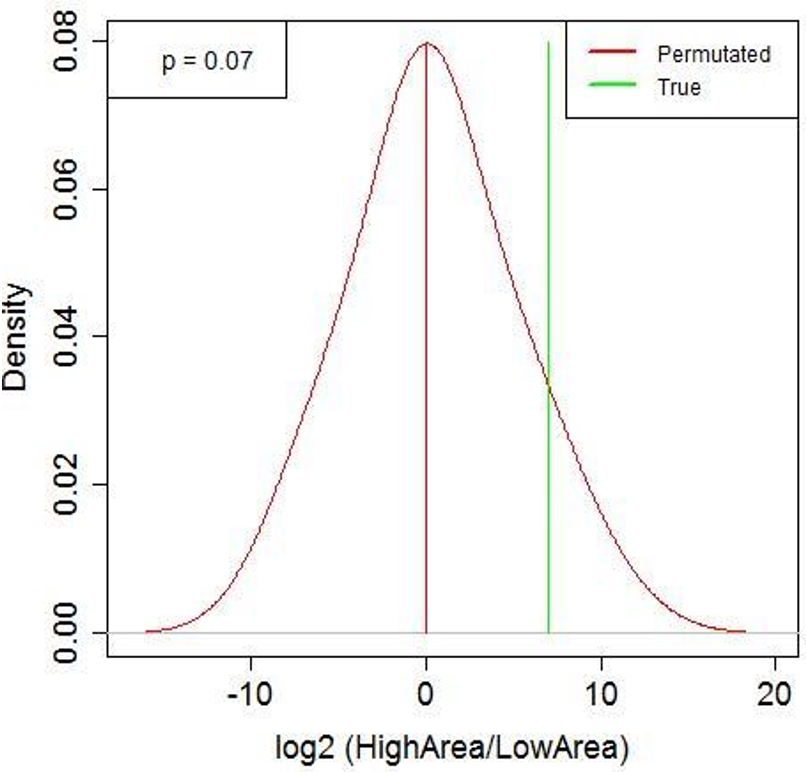 Figure 1: Permutation tests showing that the real data (green line) significantly outperforms random chance distributions (red peaks).
Critical Insight: The "Cosine" Predictor
The paper introduces a fascinating metric for future researchers: the Cosine Similarity between the normal vectors of the training (cell line) and validation (patient) hyperplanes. They found a strong correlation (0.49, p=0.004) between this angle and the model's success.
Takeaway: If the "separating boundary" of responders vs. non-responders in cell lines looks similar to the one in patients, the transfer learning will likely succeed.
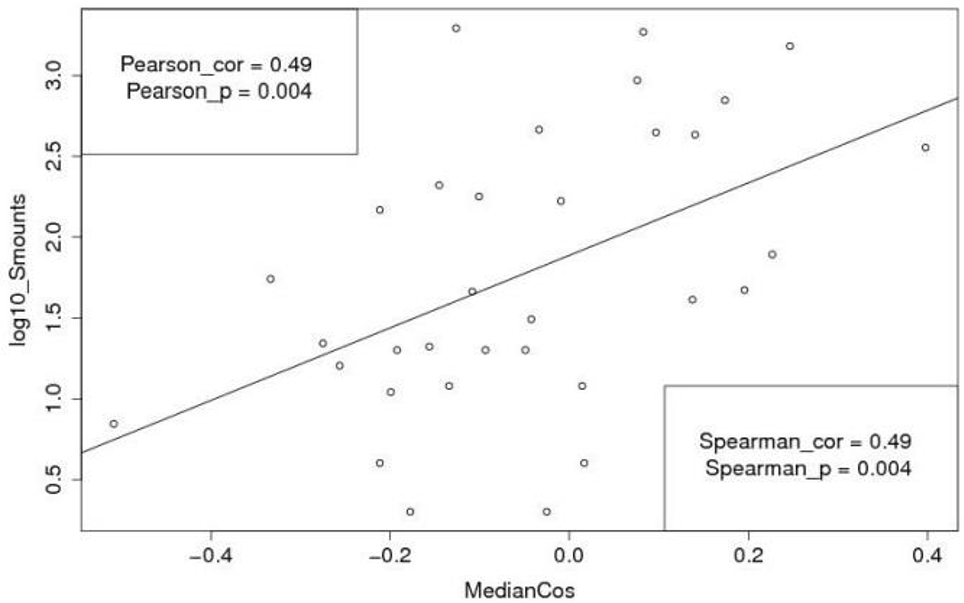 Figure 2: Correlation between hyperplane alignment (cosine) and prediction quality.
Conclusion and Future Outlook
The SVM-with-kNN approach effectively tackles the Achilles heel of SVMs: extrapolation. By turning a global classification problem into a series of local, personalized sub-problems, the authors have provided a roadmap for using "big-data" from labs to solve "small-data" problems in clinics.
While the p-values for individual cases were sometimes modest, the aggregate success across multiple cancers suggests that signaling pathway analysis combined with localized learning is a powerful tool for the future of precision oncology.