
Beyond Static Links: Leveraging Interaction Intimacy for Precision Friend Recommendations
Individual Friends Recommendation Based on Random Walk with Restart in Social Networks
The paper proposes an individual friend recommendation method based on a Random Walk with Restart (RWR) model tailored for social networks. It introduces "Intimacy Degree"—a metric derived from user interactions like likes, shares, and comments—to enhance social structure-based recommendations, achieving a higher Conversion Rate (CR) on real-world Sina Microblog data.
TL;DR
This research moves beyond simple "friend-of-friend" network topology by introducing Intimacy Degree—a quantitative measure of how users actually interact (likes, retweets, @mentions). By applying a Random Walk with Restart (RWR) algorithm on a bipartite graph weighted by these interactions, the authors achieved a significant boost in user conversion rates on the Sina Microblog platform compared to traditional profile-matching methods.
Background: The Limitations of "Follow" Graphs
In the era of massive social networks, being "connected" doesn't always mean being "close." Most recommendation engines treat a follow or a friend request as a binary state (0 or 1). However, your relationship with a celebrity you follow is fundamentally different from a colleague you interact with daily. Prior works often failed because they:
- Relied on incomplete user profiles (the "cold start" or missing data problem).
- Ignored the dynamic intensity of social behaviors.
- Lacked a united model that combines structural distance with behavioral frequency.
Methodology: Quantifying "Intimacy"
The core innovation of this paper is the Intimacy Degree (I). Instead of a simple adjacency matrix, the authors build a weighted bipartite graph where the edge weight is determined by:
- Reviewing and Forwarding
- Making Comments and "Likes"
- Direct Replies and @Relationships
By shifting the problem into a state-transition matrix, they utilize the Random Walk with Restart (RWR) model.
The RWR Logic:
Imagine a "walker" starting at the Target User. At each step, the walker moves to a neighboring node based on the transition probability (Intimacy Degree). Crucially, there is a probability c that the walker "restarts" and jumps back to the Target User. This ensures the recommendation stays personalized to the user's immediate social neighborhood rather than wandering off into the global network.
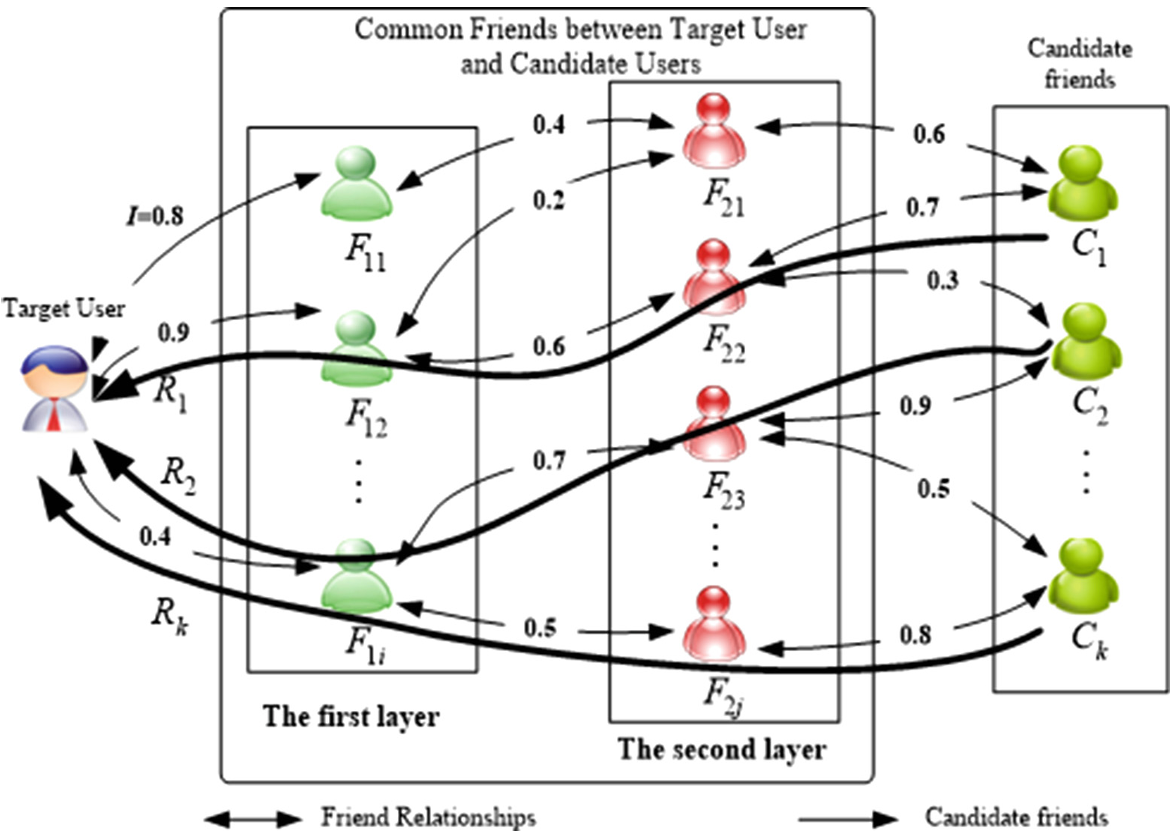 Figure 1: The structural layers of friend recommendation using intimacy values (I).
The final ranking value for a candidate friend is the stationary probability distribution of this random walk, represented by:
Experimental Proof: Real-World Impact
The researchers didn't just test this in a vacuum; they deployed it on the Sina Mobile Client Platform (SMCP) with 300,000 real users. They compared three groups:
- Group I: New Strategy (Intimacy-based) + New Algorithm (RWR).
- Group II: New Strategy + Old Algorithm.
- Group III: Old Strategy + Old Algorithm.
Key Metrics:
- PV (Page View): Exposure of the recommendation.
- UV (Unique Visitor): Number of unique users engaging.
- Conversion Rate (CR): The ultimate "truth" metric ().
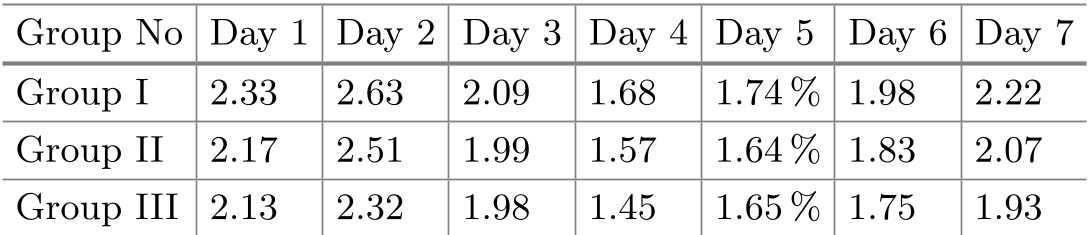
The results clearly show that Group I outperformed the others. Even when the algorithm was the same, simply having a better "strategy" (identifying candidates via interaction weights) improved performance, but the combination of the new strategy and the RWR algorithm provided the best results.
Determining the "Magic Number" (Top N)
A critical practical question for any recommender is: How many people should we suggest? By analyzing the distribution of "following" behaviors, the authors found that 86% of users followed fewer than 10 people, and 97% followed fewer than 30. Thus, they set N=30 as the optimal recommendation window for a 7-day period.
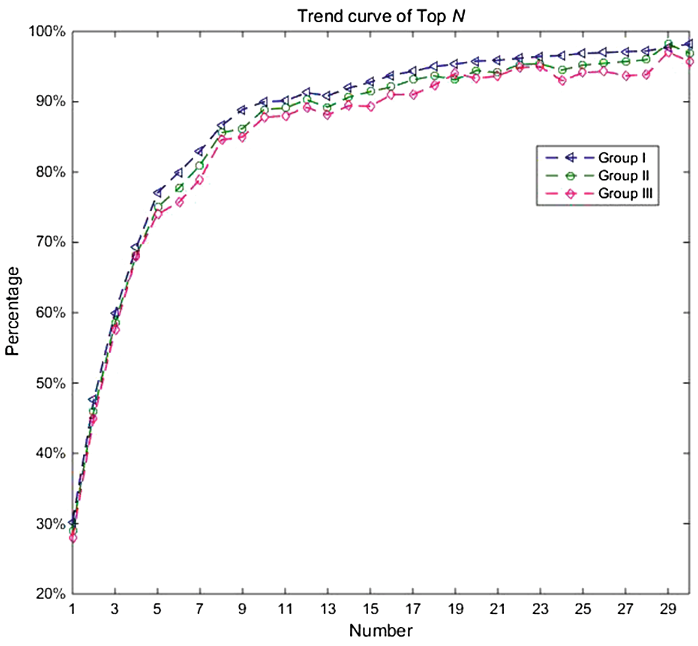 Figure 2: Analysis of user behavior to determine Top N value.
Critical Insight & Conclusion
This paper demonstrates that in social network analysis, behavioral data trumps structural data. While the "Random Walk" provides the engine, the "Intimacy Degree" provides the high-octane fuel.
Limitations: The study notes that the performance gain, while statistically significant, was somewhat diluted by the massive existing dataset of the Sina platform. Future work could benefit from applying this to heterogeneous information networks (HINs) where different types of nodes (e.g., topics, locations) are integrated alongside users.
Final Takeaway: If you want to predict who someone will befriend next, don't just look at who they know—look at who they talk to.