
Beyond "Who You Know": A Quantitative Framework for Individual Social Capital
Individual-Level Social Capital in Weighted and Attributed Social Networks
This paper introduces a formal quantitative framework for measuring individual-level social capital within weighted and attributed social networks. It proposes a family of measures covering four key dimensions—resource mobilisation, linking, bonding, and bridging—validated through a workplace social network use case.
TL;DR
The adage "it’s not what you know, but who you know" finally gets a formal mathematical treatment. This paper presents a robust model for calculating Individual-level Social Capital by treating social networks as weighted, attributed graphs. By measuring how individuals access resources, connect with superiors (linking), and balance similar (bonding) versus diverse (bridging) ties, the authors provide a toolkit for quantifying personal influence in professional environments.
Context & Motivation: The Resource-Based View
While social capital is a cornerstone of sociology, computer science has struggled to move beyond simple centrality measures (like PageRank) to represent the "value" of a person's network. The authors argue that an individual's capital isn't just about their position—it's about the mobilization of resources through that position.
The core insight is that a "tie" is not binary. To accurately model reality, one must consider:
- Tie Strength: Not all friends are equal.
- Resource Context: Does the contact actually have the Java expertise I need?
- Hierarchy: Is the contact a peer or a superior who can "link" me to power?
Methodology: The Four Dimensions of Capital
The authors construct a social network model where represents tie weights and represents node attributes. From this, they derive four computable measures:
1. Resource Mobilisation ()
It’s not just about who has the resource, but whether your relationship is strong enough to "mobilize" it. The measure sums the tie strengths to all reachable nodes that satisfy a specific logical resource requirement (e.g., "Expertise = Python").
2. Linking Capital ()
This measures access to "superiors" in a hierarchy. In a corporate setting, this quantifies your "reach" into management levels.
3. Bonding vs. Bridging ( and )
- Bonding (Homogeneity): Measures ties to people similar to yourself. High bonding capital often yields high trust and efficiency.
- Bridging (Heterogeneity): Measures ties to people different from yourself (e.g., different departments). High bridging capital is essential for innovation and avoiding echo chambers.
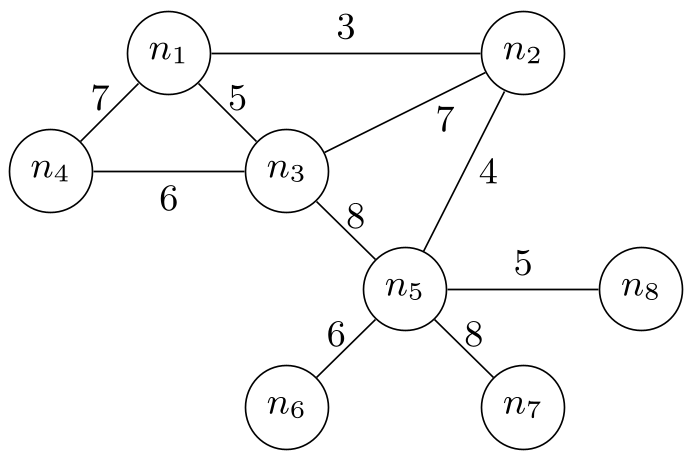 Figure 1: An illustrative workplace social network graph used to validate the measures.
Key Experimental Insights
By applying these formulas to a workplace case study (8 employees, various roles), the authors uncovered a vital truth: Personal talent Social Capital.
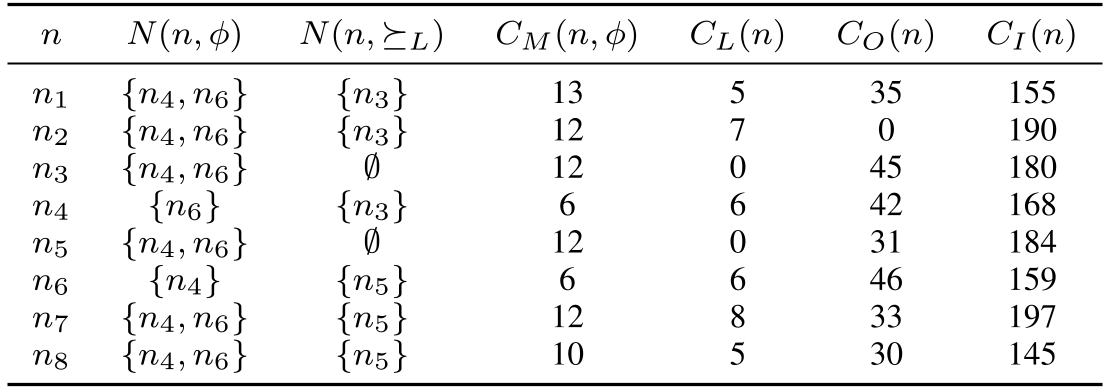 Table III: Comprehensive Social Capital values for the test nodes.
As seen in the results, individuals like n4 and n6—who were the only ones actually possessing Python expertise—had the lowest resource mobilisation scores. Why? Because while they were valuable to others, their own networks were poorly positioned to extract value from others. Conversely, n7 emerged as a powerful "structural hole" filler, boasting the highest bridging and linking capital.
Critical Analysis & Future Outlook
The beauty of this framework lies in its domain-independence. Whether it’s a GitHub contributor network or a corporate Slack workspace, the logic holds.
However, two challenges remain:
- Incommensurability: You cannot simply add "Bridging Capital" and "Linking Capital" together. They represent different "currencies."
- Dynamics: Social ties change. A future iteration using temporal graphs would be necessary to model how capital accumulates or decays over time.
Conclusion
This work moves social capital from a "gut feeling" to a "data point." For HR departments and organizational psychologists, these measures offer a way to identify hidden influencers and recommend networking actions that go beyond simple ice-breakers, targeting the specific structural weaknesses in an individual's professional reach.